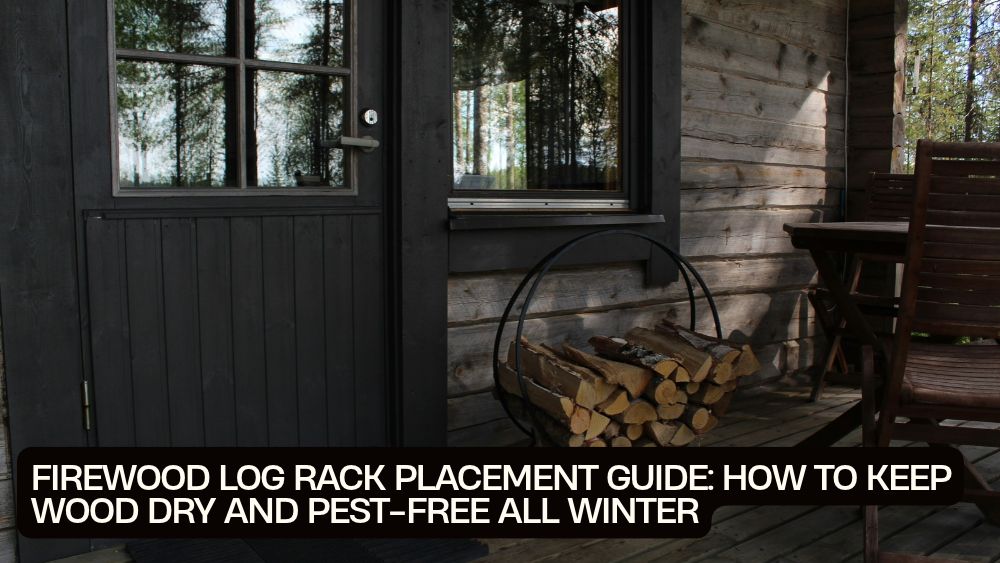
There is nothing quite like having a stack of dry firewood ready when the temperature drops. But winter-ready logs do not happen by accident. Leave them sitting on damp soil, pile them against a fence, or wrap them completely in plastic, and you may end up with mold, rot, insects, and wood that struggles to burn.
The secret is getting three things right: elevation, airflow, and location.
A well-positioned firewood rack keeps logs away from ground moisture, allows air to circulate, and makes it easier to protect your supply from rain and snow. It can also reduce the chances of inviting termites, carpenter ants, and other unwanted guests closer to your home.
If you are wondering how to store firewood off the ground to prevent termites and rot, this guide covers practical rack placement, ideal clearances, winter covering, pest prevention, and seasonal maintenance for homeowners in the US and Canada.
Why Firewood Should Never Sit Directly on the Ground
Firewood absorbs moisture from its surroundings. When logs sit directly on soil, they remain exposed to dampness, rain splash, and insects moving through the ground.
That creates several problems.
-
Rot: Persistent moisture encourages fungal decay, particularly in logs that remain damp for extended periods.
-
Termites: Ground contact can make firewood more accessible to subterranean termites.
-
Carpenter ants: Damp or decaying wood can attract insects that establish nests in unsuitable storage areas.
-
Mold: Poor airflow and trapped moisture encourage surface mold.
-
Slow seasoning: Wet wood takes longer to dry and may produce more smoke when burned.
The solution is simple: create a physical barrier between the logs and the ground.
A raised firewood rack, sturdy pallets, or treated support rails can provide that separation. A clearance of approximately 4–6 inches is a useful starting point for many outdoor stacks, provided the support remains stable and does not trap water.
The goal is not just to lift the logs. It is to let air move beneath the stack while keeping the bottom layer away from damp soil.
Where Should You Place a Firewood Rack?
The best location balances convenience with ventilation, drainage, sunlight, and pest prevention.
A rack should be easy to reach during winter without being positioned directly against your home or another wooden structure.
Choose a well-drained area
Start by looking at how water moves through your yard.
Avoid placing the rack in:
-
Low spots where rainwater collects
-
Areas beneath leaking gutters
-
Damp corners beside garden walls
-
Places where snow accumulates and melts slowly
-
Ground that remains muddy after rainfall
A slightly elevated, well-drained location is usually preferable.
If your yard slopes, position the rack on a stable, level base rather than allowing the structure to lean downhill.
Look for sunlight and natural airflow
Sunlight helps warm the wood, while moving air carries away moisture.
A location with some direct sunlight and good ventilation is often better than a shaded corner surrounded by fences and shrubs.
However, do not sacrifice safe clearance from buildings or heating equipment just to find a sunny spot.
Keep the rack away from your home
Firewood piles can provide shelter for termites, carpenter ants, rodents, and other insects.
Purdue Extension recommends keeping firewood at least 3 feet from buildings, while Cornell Cooperative Extension suggests approximately 30 feet as a practical placement target where space permits.
The right distance depends on your property, local pest conditions, and fire-safety requirements. In wildfire-prone areas, additional separation may be recommended.
A good approach is to store your main supply away from the house and bring in only a small amount when needed.
Placement tip: Do not stack firewood directly against siding, wooden fences, garages, sheds, or deck supports. A gap helps with airflow and makes inspections easier.
How to Store Firewood Off the Ground to Prevent Termites and Rot
Elevation is one of the simplest ways to improve firewood storage.
You have several options, depending on the size of your wood supply and your budget.
Option 1: Use a metal firewood rack
A purpose-built metal rack is a convenient choice for many homeowners.
It keeps logs raised, provides a defined stacking area, and often includes side supports to prevent the pile from spreading.
Look for:
-
A stable frame
-
Corrosion-resistant construction
-
Adequate ground clearance
-
Side supports that hold logs securely
-
Enough capacity for your seasonal supply
-
A design that allows air to circulate
A metal rack is especially useful when you want a neat, accessible stack without building a permanent storage structure.
Option 2: Use sturdy pallets
Pallets can provide an inexpensive raised base.
Place them on firm, level ground and inspect them for broken boards, protruding nails, or signs of rot before stacking wood.
Not every pallet is suitable for outdoor firewood storage. Avoid damaged or contaminated pallets, and make sure the support can handle the weight of the logs.
Option 3: Build a simple raised timber base
A basic platform can be made using sturdy support rails or appropriately rated lumber.
Keep the design simple and strong. The base should support the full weight of the stack without sagging or shifting.
Use materials suitable for outdoor exposure, and avoid creating enclosed spaces where water and debris can collect.
Which option is best?
| Storage option | Best for | Main advantage |
|---|---|---|
| Metal rack | Regular household firewood supply | Stable, organized storage |
| Pallets | Budget-friendly storage | Easy to source and raise |
| Timber base | Custom-sized wood stacks | Flexible dimensions |
| Covered woodshed | Larger seasonal supply | More complete weather protection |
Whatever you choose, inspect the support regularly. A raised rack that becomes unstable or rots underneath can create a bigger problem than the original ground contact.
Why Airflow Matters as Much as a Roof
Covering firewood is important, particularly in regions with heavy winter rain or snow.
But completely wrapping the stack can trap moisture.
Firewood needs airflow to dry properly. If you cover every side with a plastic tarp, moisture may become trapped around the logs, especially when the wood is freshly cut.
Cover the top, not the sides
A better approach is to protect the top of the stack while leaving the sides open.
Suitable options include:
-
A metal rack cover
-
A small sloping roof
-
A waterproof tarp covering only the top
-
A ventilated woodshed
-
A lean-to with open sides
Make sure the cover extends beyond the stack so rain and melting snow do not run directly onto the logs.
A sloped roof is particularly useful because it allows water to drain rather than collect.
Leave room between rows
Avoid packing logs so tightly that air cannot move through the stack.
A loosely arranged pile allows moisture to escape more easily. If you are storing a large quantity, separate rows can improve ventilation.
Cornell Cooperative Extension recommends stacking firewood no more than two layers deep for effective drying in its storage guidance.
The exact arrangement will depend on the rack and available space, but ventilation should always be part of the plan.
How to Stack Firewood for Better Winter Storage
A well-stacked pile is easier to inspect, more stable, and less likely to trap moisture.
Follow these steps:
Step 1: Split the wood before stacking
Splitting exposes more surface area and helps moisture escape. Large unsplit rounds generally take longer to season.
Step 2: Sort logs by size
Keep pieces of similar length together. This makes the pile easier to arrange and reduces awkward gaps.
Step 3: Place the largest logs at the bottom
Use heavier pieces as the foundation, ensuring they sit securely on the raised supports.
Step 4: Keep the stack stable
Arrange logs so they do not roll or shift. Avoid building an excessively tall pile unless the rack is specifically designed to support it.
Step 5: Leave ventilation space
Do not compress the wood into an airtight wall. Allow natural air movement around the stack.
Step 6: Keep the cover clear of the sides
Use a roof or tarp that sheds rain and snow while leaving the ends and sides exposed.
Step 7: Inspect the stack
Check for leaning, sagging supports, damp lower logs, and signs of insects.
A tidy stack is not just attractive. It is easier to maintain throughout winter.
How Far Should Firewood Be Stored From the House?
This is one of the most important parts of pest prevention.
Firewood can harbor insects that you do not want moving toward your home.
Termites, carpenter ants, and wood-boring insects may use a pile as a source of food or shelter. Keeping the main supply away from buildings helps reduce the opportunity for pests to move directly from stored logs into nearby structures.
A practical placement guide is:
| Location | General recommendation |
|---|---|
| House or garage | Keep at least 3 feet away as a basic minimum; more separation is preferable where practical |
| Wooden fence | Avoid stacking directly against it |
| Deck or porch | Keep the main supply away from structural wood |
| Garden trees | Avoid storing firewood directly against living trees |
| Outdoor heater | Keep firewood outside the heater's required clearance zone |
| Indoor fireplace area | Bring in only a small amount for immediate use |
These are general storage guidelines, not substitutes for local fire codes or pest-control advice.
In areas with significant wildfire risk, firewood placement requires additional attention. The National Plant Board's consumer guidance notes that storage may need to be at least 30 feet from structures or farther in wildfire-prone locations.
Check local fire department and wildfire-prevention recommendations before choosing a permanent storage location.
How to Prevent Termites and Other Pests in Firewood
Keeping wood elevated and away from buildings reduces pest risks, but it does not make the pile insect-proof.
Firewood can naturally contain insects, eggs, or larvae.
Use these habits to reduce problems:
Inspect wood before stacking
Look for:
-
Small holes in the bark or wood
-
Sawdust-like material
-
Unusual tunnels
-
Visible insects
-
Soft, decaying sections
-
Fungal growth
If you suspect a serious infestation, seek local extension or pest-control advice before moving the wood.
Store firewood away from living trees
A pile close to healthy trees may provide a route for certain pests or diseases to spread.
The National Plant Board recommends storing firewood away from living trees as part of responsible firewood management.
Rotate your supply
Use older, properly seasoned wood first and avoid leaving the same logs untouched for several seasons.
A simple first-in, first-out arrangement makes inventory easier and reduces the chance of neglected wood becoming damp or deteriorating.
Bring in only what you need
Do not keep a large firewood stack inside your home, garage, or basement.
Insects can become active when cold wood is brought into a warm environment. Bring in only enough for immediate use, inspect the logs, and keep the indoor supply limited.
Never spray firewood with insecticide
Do not treat logs intended for burning with household insecticides or pesticides.
Chemical residues can create dangerous fumes when burned. If wood is infested, follow local disposal guidance rather than attempting an improvised chemical treatment.
How Long Should Firewood Season Before Winter?
A dry-looking log is not necessarily ready to burn.
Freshly cut wood contains substantial moisture. It needs time to season before it becomes an efficient fuel.
The US Environmental Protection Agency recommends allowing approximately:
-
Softwood: At least 6 months
-
Hardwood: Around 12 months
Some dense hardwoods may take longer, particularly in damp or shaded conditions.
How can you tell if wood is dry?
Look for several indicators:
-
Cracks at the ends of the logs
-
Bark that loosens or falls away
-
A lighter feel compared with freshly cut wood
-
A sharper sound when two dry pieces are knocked together
These signs are useful, but they are not as reliable as measuring moisture.
A wood moisture meter can help. For a meaningful reading, split a log and test the freshly exposed interior surface according to the meter instructions.
For cleaner, more efficient burning, aim for a moisture content below 20%.
Winter Firewood Storage: Rain, Snow, and Freezing Temperatures
Winter introduces a new set of storage challenges.
Snow can accumulate on the cover, melting ice can run beneath the stack, and repeated freeze-thaw cycles can create damp conditions.
Before winter arrives:
-
Check the rack's stability.
-
Clear leaves and debris from beneath the base.
-
Repair damaged roof panels or covers.
-
Make sure water drains away from the storage area.
-
Remove any logs touching wet soil.
-
Check that the tarp is secure but does not block airflow.
After heavy snowfall, remove excessive snow from the cover where it is safe to do so.
Avoid sealing the stack inside a plastic enclosure. A dry, ventilated pile is generally better than a tightly wrapped one.
Position Your Firewood Storage Safely Around Outdoor Heating Areas
If you use your backyard during winter, you may also have a patio heater, fire pit, or other outdoor heating equipment.
Keep your firewood storage area separate from the heating zone.
Never place a stack of logs beside a propane patio heater, electric heater, or open-flame appliance simply because it makes refueling or access more convenient.
Follow the heater manufacturer's clearance instructions. Keep combustible materials, including firewood, away from hot surfaces and ignition sources.
For homeowners creating a comfortable outdoor seating area, the TotalFindz patio heater collection offers different outdoor heating options, including freestanding propane models, tabletop heaters, and electric patio heaters.
The collection is useful when planning a separate outdoor heating setup. Remember that most patio heaters are not designed to burn firewood. Choose the appropriate fuel type and follow the individual product's safety instructions.
A Simple Firewood Storage Maintenance Checklist
A few minutes of regular maintenance can help keep your supply in better condition.
Weekly during wet weather:
-
Check that the cover is shedding water.
-
Look for pooling beneath the rack.
-
Remove leaves and debris.
-
Check for obvious pest activity.
Monthly during winter:
-
Inspect rack legs and supports.
-
Check for leaning or unstable logs.
-
Look for mold or unusual dampness.
-
Rotate the supply where necessary.
-
Inspect nearby structures for signs of pest activity.
Before the next heating season:
-
Remove deteriorated wood.
-
Repair or replace damaged supports.
-
Clean the storage area.
-
Restack the supply with fresh wood.
-
Check that the location still provides adequate clearance.
Frequently Asked Questions
How do you store firewood off the ground to prevent termites?
Use a raised metal rack, sturdy pallets, or support rails to separate logs from soil. Keep the stack away from buildings, provide airflow, and inspect the wood regularly for signs of insects.
Should firewood be covered completely?
No. Covering the top helps protect logs from rain and snow, but leaving the sides open allows moisture to escape. Fully wrapping a damp stack can slow drying.
Is it okay to store firewood against a fence?
It is better to leave a gap. Stacking directly against a wooden fence can trap moisture, reduce airflow, and create a sheltered environment for insects.
Can firewood be stored in a garage?
A garage may be suitable for a small, temporary supply if it is dry and ventilated. However, avoid storing large quantities of firewood indoors for long periods because insects can emerge and the wood introduces moisture and combustible material into the space.
Does a metal firewood rack prevent termites?
A raised metal rack reduces direct contact between logs and soil, which can help discourage pests. It does not guarantee protection from termites or other insects. Location, ventilation, and regular inspection still matter.
How high should a firewood rack be off the ground?
Approximately 4–6 inches is a useful starting clearance for many outdoor racks. The important factors are preventing ground contact, allowing airflow underneath, and maintaining a stable support structure.
Dry Firewood Starts With the Right Storage Spot
Keeping firewood dry and pest-free through winter is less about complicated equipment and more about smart placement.
Raise the logs above the ground, choose a well-drained location, leave room for airflow, and cover the top without sealing the sides. Keep your main supply away from buildings and bring indoors only what you plan to burn soon.
A sturdy firewood rack makes these habits easier to maintain. With proper stacking, seasonal inspections, and enough time for seasoning, your logs will be in much better condition when cold weather arrives.
And if you are also preparing your backyard for winter gatherings, keep outdoor heating equipment in a separate, manufacturer-approved safety zone. A well-organized storage area and a properly positioned heater can make your outdoor space more comfortable without putting your firewood or property at unnecessary risk.