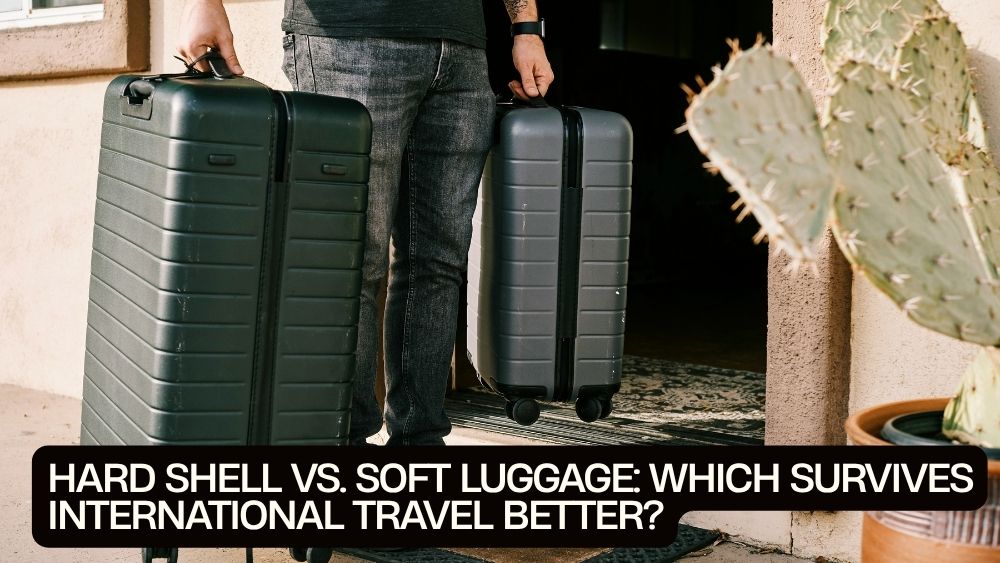
International travel has a way of turning a perfectly respectable suitcase into a battle-tested veteran.
It gets dragged across sidewalks, squeezed into overhead bins, stacked under other bags, tossed onto luggage carts, exposed to rain, and occasionally subjected to the mysterious airport conveyor-belt physics that seems designed to test every zipper and wheel.
That raises an important question when you're choosing your next suitcase:
Hard shell vs soft side luggage for international travel: which actually survives better?
The answer isn't as simple as "hard luggage is tougher."
Hard-shell luggage can provide a rigid exterior, good impact protection, and resistance to certain types of moisture. Soft luggage offers flexibility, exterior pockets, easier expansion, and often a little more forgiveness when you're trying to squeeze in that last jacket.
For international travel, the better choice depends on how you pack, where you're going, whether you'll check the bag, and which features matter most to you.
Let's put both styles through the airport obstacle course.
Hard Shell vs. Soft Luggage at a Glance
Before getting into the details, here's the quick comparison:
| Feature | Hard-Shell Luggage | Soft-Side Luggage |
|---|---|---|
| Exterior protection | Excellent | Good |
| Flexibility | Limited | Excellent |
| Exterior pockets | Usually limited | Usually excellent |
| Water resistance | Often better | Depends on fabric |
| Expansion | Limited or model-dependent | Often better |
| Packing flexibility | Structured | Forgiving |
| Weight | Varies | Often lightweight |
| Impact resistance | Good, but may crack | Can flex under impact |
| Compression | Low | High |
| Organization | Interior-focused | Interior + exterior |
| Best for | Protection-focused travelers | Flexible packers |
There are excellent and terrible examples of both styles.
Material quality, wheels, zippers, handles, stitching, and construction can matter just as much as the basic shell-versus-fabric decision.
What Happens to Luggage During International Travel?
Before choosing a suitcase, think about what your bag actually experiences.
International travel can involve:
- Airport conveyor belts
- Baggage carts
- Car trunks
- Hotel hallways
- Cobblestone streets
- Sidewalks
- Escalators
- Stairs
- Security inspections
- Rain
- Tight storage spaces
- Long walking distances
- Multiple transfers
Checked luggage faces the most abuse.
Carry-on luggage generally has a more civilized existence because you control it more of the time.
That's why the ideal suitcase for a checked international bag may not be identical to the ideal suitcase for a carry-on.
Why Choose Hard-Shell Luggage?
Hard-shell luggage has a rigid exterior made from materials such as polycarbonate, ABS, polypropylene, or blends.
The exact material matters.
A quality polycarbonate case, for example, can behave very differently from a cheaper rigid case.
1. Strong Exterior Protection
A hard shell creates a physical barrier between your belongings and the outside world.
That can be particularly useful when you're carrying:
- Electronics
- Cameras
- Bottles
- Souvenirs
- Structured clothing
- Fragile items
The shell doesn't make the contents indestructible, but it provides a level of rigid protection that fabric luggage doesn't.
2. Better Resistance to Rain and Splashes
A hard exterior can be advantageous when you're moving between an airport, taxi, hotel, and train station during bad weather.
However, don't assume every hard-shell suitcase is waterproof.
Zippers, seams, locks, and openings can still allow water through.
Think water-resistant, not submarine.
3. Easier to Wipe Clean
International travel can introduce luggage to questionable floors, dusty sidewalks, airport baggage belts, and the occasional mystery smudge.
Hard shells are generally easy to wipe down.
That's a surprisingly useful advantage after a long trip.
The Weaknesses of Hard Shell Luggage
Hard luggage isn't invincible.
Cracking
A rigid shell can crack under certain impacts, especially depending on material, temperature, construction, and impact force.
Scratches and scuffs are also common.
A suitcase covered in scratches isn't necessarily structurally damaged. In many cases, it's simply carrying souvenirs from the journey.
Limited Exterior Storage
This is one of the biggest complaints from soft-luggage fans.
A traditional hard shell may give you little or no easy-access exterior storage.
Want your passport, charger, headphones, or travel documents?
You may need to open the entire suitcase.
Less Forgiving Packing
Hard-shell cases don't compress much.
If the suitcase is full, it's full.
That can be wonderful for organization and frustrating when you're trying to fit one more sweater inside.
Why Choose Soft-Side Luggage?
Soft luggage typically uses woven fabric such as polyester or nylon.
Instead of resisting movement, it flexes.
That flexibility can be a major advantage during international travel.
1. More Flexible Packing
Soft luggage can often accommodate awkwardly shaped items more easily.
The fabric can give slightly when the bag is packed close to capacity.
That's particularly helpful for travelers who return home with souvenirs.
2. Exterior Pockets
This is where soft luggage often wins decisively.
Exterior pockets are convenient for:
- Passports
- Boarding documents
- Chargers
- Headphones
- Travel adapters
- Water bottles
- Snacks
- Jackets
Instead of opening your entire suitcase, you can access a small pocket.
That can make airport transitions much faster.
3. Easy Access
Soft luggage often provides a practical combination of main-compartment access and exterior storage.
For frequent travelers, that convenience can outweigh the rigid protection of a hard case.
The Weaknesses of Soft Luggage
Fabric luggage has its own vulnerabilities.
Less Rigid Protection
A soft suitcase doesn't create the same hard barrier around your belongings.
It can still provide plenty of protection, especially with good internal structure and padding, but fragile items require more thoughtful packing.
More Vulnerable to Stains
Fabric can absorb dirt and stains more easily than a smooth hard shell.
A rainy sidewalk or dusty airport floor may leave evidence.
Fabric Can Wear
Zippers, stitching, corners, handles, and wheels can wear over time.
This doesn't mean soft luggage is fragile. Quality fabric luggage can last for years.
But construction quality matters.
Hard Shell vs Soft Side Luggage for International Travel: Which Is More Durable?
This is the question everyone wants answered.
Unfortunately, there isn't a universal winner.
A well-made soft suitcase can outlast a poorly made hard suitcase.
A high-quality hard shell can survive years of travel that would destroy a cheap fabric case.
Durability depends on the entire construction.
Look at:
- Shell or fabric quality
- Corner construction
- Wheel attachment
- Handle mechanism
- Zipper quality
- Stitching
- Reinforcement
- Frame design
- Warranty
- Replacement-part availability
Don't judge durability based solely on how thick the shell looks or how heavy the fabric feels.
Wheels May Matter More Than the Shell
Here's a travel truth that doesn't get enough attention:
Your suitcase's wheels are often more important than its shell.
A perfect suitcase with terrible wheels becomes an exercise in frustration.
Look for:
- Smooth-rolling wheels
- Secure wheel housings
- Stable directional control
- Wheels appropriate for the terrain you'll encounter
- Strong attachment points
Four-wheel spinner luggage is particularly convenient on smooth airport floors.
But sidewalks, cobblestones, gravel, and uneven pavement can be a different story.
Large wheels and robust construction can be more useful when your journey includes significant outdoor walking.
Two Wheels vs. Four Wheels
Soft luggage often appears in two-wheel configurations, while hard-shell cases frequently use four-wheel spinner designs, although both styles exist in both formats.
Two-Wheel Luggage
Advantages:
- Can be easier to pull over uneven surfaces
- Wheels are often partially recessed
- Smaller wheel footprint can protect them
- Familiar rolling style
Drawback:
- Requires tilting the suitcase
Four-Wheel Spinner
Advantages:
- Can roll beside you
- Excellent maneuverability
- Convenient in airports
- Easy directional changes
Drawbacks:
- Wheels may protrude
- Wheel assemblies can be exposed to impacts
- Uneven surfaces can be harder
If your international itinerary is mostly airports, hotels, and smooth train stations, spinner wheels can be excellent.
If you're navigating old streets and uneven sidewalks, wheel design deserves serious attention.
Which Is Better for Checked Luggage?
Checked luggage experiences more uncontrolled handling.
That makes exterior protection particularly important.
Hard-shell luggage can be appealing for travelers carrying fragile or structured items.
However, a quality soft suitcase can also perform well when packed correctly.
If you choose soft luggage for checked travel:
- Wrap fragile items in clothing.
- Avoid overloading.
- Protect sharp objects.
- Use internal compartments.
- Keep liquids sealed.
- Don't depend entirely on the outer fabric for protection.
If you choose hard shell:
- Don't overstuff the case.
- Protect fragile items internally.
- Avoid assuming the shell makes glassware safe.
- Check the shell material and construction.
Your packing technique still matters.
Which Is Better for Carry-On International Travel?
For carry-on travel, soft luggage has a strong advantage for many travelers because of its flexibility and exterior pockets.
You can quickly access:
- Passport
- Laptop
- Charger
- Headphones
- Documents
- Snacks
Hard-shell carry-ons can be excellent too, particularly if you want a structured interior and stronger protection for electronics.
The key issue is airline size limits.
Never assume a suitcase is acceptable as a carry-on simply because its product label says "carry-on."
Airlines can have different dimensional and weight restrictions.
Measure the actual suitcase, including wheels and handles, and check your airline's current requirements before flying.
What About Luggage Weight?
This category is more complicated than it looks.
A heavy suitcase eats into your baggage allowance before you've packed anything.
But the lightest suitcase isn't automatically the best.
You want a balance between:
Empty weight + durability + usable capacity + features.
A very lightweight case with weak wheels isn't necessarily a bargain.
A slightly heavier suitcase with better construction may provide better long-term value.
For international travel, compare the empty weight of several models in the same size category.
Then consider how much weight you normally pack.
Which Is Better for Overpacking?
Soft luggage wins this round.
Its flexible exterior and expansion features can give you a little more forgiveness.
That's useful on the return journey when your suitcase somehow contains:
- Souvenirs
- Clothes
- Gifts
- Snacks
- Three things you absolutely didn't plan to buy
Hard luggage generally has stricter physical boundaries.
That's excellent for disciplined packing.
Less excellent when you're trying to close the case after a two-week trip.
Which Is Better for Organization?
This depends on your organizational style.
Hard-shell luggage often provides a structured interior, sometimes with split compartments, compression panels, or dividers.
Soft luggage often combines interior organization with external pockets.
If you like everything zipped into its own compartment, either can work.
If you frequently need access while traveling, soft luggage may have the edge.
Which Handles Bad Weather Better?
Hard shells generally have an advantage against light rain and surface moisture.
But no suitcase should be assumed waterproof unless the manufacturer specifically states it.
For either type:
- Keep electronics in protective sleeves.
- Seal liquids properly.
- Use internal waterproof bags for important items.
- Don't leave luggage exposed to rain unnecessarily.
A waterproof pouch inside the suitcase can be more useful than simply hoping the outer shell handles everything.
How to Choose the Right Luggage for Your Trip
Instead of asking "Which type is better?" ask these questions:
Are You Checking the Bag?
If yes, prioritize durability, wheel quality, and impact protection.
Are You Carrying Electronics?
Consider a structured case and protective packing.
Do You Need Quick Access?
Soft luggage with exterior pockets can be excellent.
Are You Traveling Through Wet Weather?
A hard shell may provide additional protection, but check zipper and seam construction.
Will You Walk on Uneven Streets?
Prioritize wheel size and wheel durability.
Do You Usually Overpack?
Soft luggage may provide more flexibility.
Do You Pack Carefully?
Hard shell can reward organized packing with its structured interior.
Hard Shell vs. Soft Luggage: A Practical Decision
Here's a simple decision framework.
Choose hard shell if you prioritize:
- Rigid protection
- Structured packing
- Easy exterior cleaning
- Protection against everyday bumps
- A sleek, structured design
- Reduced exterior access
Choose soft luggage if you prioritize:
- Exterior pockets
- Flexible packing
- Easy access
- Expandability
- Slightly more forgiving capacity
- Practical organization
And if you're still undecided, don't assume you need one style for every trip.
Many frequent travelers use a hard-shell checked suitcase and a soft carry-on, or the reverse.
Your luggage doesn't need to belong to one philosophical camp.
A Practical International Travel Luggage Checklist
Before buying a suitcase, check:
-
Actual dimensions
-
Empty weight
-
Wheel construction
-
Handle stability
-
Zipper quality
-
Shell or fabric material
-
Internal compartments
-
Exterior pockets
-
Expansion capability
-
Locking system
-
Water resistance
-
Warranty
-
Replacement-wheel availability
-
Airline size restrictions
-
Your typical packing weight
For shoppers comparing different travel options, the TotalFindz luggage collection is a useful place to explore different luggage styles and configurations.
Final Verdict
So, hard shell vs soft side luggage for international travel: which survives better?
There isn't one universal champion.
Hard-shell luggage is a strong choice when rigid protection, structured packing, and easy exterior cleaning are priorities.
Soft-side luggage shines when flexibility, exterior pockets, easy access, and expandable storage matter more.
For checked international travel, focus heavily on construction quality, wheels, handles, and impact resistance.
For carry-on travel, consider accessibility, weight, organization, and airline size limits.
And remember the suitcase rule that quietly beats almost every other rule:
The best luggage is the one that matches the journey you're actually taking.
A hard-shell suitcase may be perfect for protecting fragile gear on a multi-city trip. A soft-sided case may be better for someone who spends half the journey reaching into exterior pockets for passports and chargers.
If you're preparing for your next international adventure, browse the TotalFindz luggage collection and compare the features that matter most to your travel style.
Because the goal isn't simply to own luggage that survives the airport.
It's to arrive with your belongings intact, your wheels still rolling, and your suitcase looking like it has at least one more trip left in it.