A commercial slushie machine should turn a properly prepared drink into a smooth, scoopable slush. When the mixture freezes into a solid block, the stirring auger slows down, or the motor starts making grinding noises, something is wrong.
The culprit might not be a broken motor. An incorrect sugar ratio, too much alcohol, an overly aggressive consistency setting, or poor ventilation can all interfere with normal operation. Keep running the machine with a frozen auger, however, and you risk turning a simple mix problem into an expensive repair.
This guide explains how to troubleshoot a commercial slushy machine freezing up with stir motor noise, correct mix ratios, recognize motor warning signs, and maintain reliable performance in a café, restaurant, bar, or convenience store.
Why Does a Commercial Slushie Machine Freeze Up?
Commercial slushie machines cool a liquid mixture while an internal auger or stirring mechanism keeps the forming ice crystals moving. This produces the familiar semi-frozen texture rather than a solid block of ice.
When the mixture becomes too hard, the auger may struggle to rotate. The motor can slow down, make unusual noises, or activate its overload protection. Some machines automatically stop refrigeration or pause operation to protect the components.
Several issues can trigger this problem:
-
Insufficient sugar in the drink mixture.
-
Incorrect alcohol concentration.
-
A consistency setting that is too aggressive.
-
A tank filled below the minimum level.
-
An auger that is incorrectly installed or obstructed.
-
Poor ventilation or excessive ambient heat.
-
A faulty sensor, control board, or motor.
VEVOR's guidance for its 12L × 3 commercial slushie machine identifies sugar concentration, temperature settings, and drink preparation as important operating factors. The manufacturer's listing also recommends keeping alcohol content below 13% for the specified drink applications. See the VEVOR triple-tank slushie machine specifications.
Step 1: Check the Sugar Ratio Before Blaming the Motor
One of the first things to investigate is the drink recipe.
Sugar affects the freezing behavior of a beverage. If the mixture contains too little sugar, it can freeze harder than expected, placing extra resistance on the auger and its drive motor.
Some VEVOR commercial slushie machine manuals specify a sugar concentration in the range of approximately 13% to 18%, while other models or drink formulations may have different requirements. Follow the manual for your exact machine and the concentrate manufacturer's mixing directions.
How to prepare the mix correctly
1. Read the concentrate instructions. Check the required dilution ratio and whether the product is intended for commercial slush machines.
2. Measure ingredients accurately. Use a consistent recipe rather than estimating the amount of concentrate, sugar, or water by eye.
3. Mix thoroughly before filling the tank. Concentrated syrup should be diluted and stirred in a separate container according to the manufacturer's instructions.
4. Verify the prepared mixture. If the machine or concentrate manufacturer specifies a sugar-content range, use an appropriate measurement method and follow its instructions for interpreting the result.
5. Avoid plain water. Water alone does not provide the sugar content needed for many commercial slush formulations. It may freeze too hard and stress the stirring mechanism.
Do not assume that adding more sugar is always the answer. Excessively concentrated mixtures can also behave differently, and certain machines specify an acceptable range rather than a minimum alone.
For model-specific guidance, consult the VEVOR commercial slush machine instruction manual.
Step 2: Check Alcohol Content in Frozen Cocktails
Alcohol changes the freezing behavior of a beverage. A cocktail mixture with too much alcohol may remain too soft to form a proper slush, while an unsuitable recipe can make the machine work harder to achieve the desired consistency.
For the linked VEVOR triple-tank machine, the product information recommends alcohol content below 13%. Treat this as a model-specific operating guideline, not a universal formula for every frozen cocktail machine.
If the margarita or frozen cocktail will not set correctly:
-
Verify the base mix's dilution instructions.
-
Measure the alcohol rather than pouring freely.
-
Check whether the recipe is designed for a commercial slush machine.
-
Avoid compensating for a high-alcohol mixture by continuously lowering the temperature.
-
Confirm that the chosen consistency setting is suitable for the drink.
If the machine has already frozen the mixture too hard and the auger is struggling, stop the freezing cycle according to the manufacturer's instructions and allow the product to soften before restarting.
Step 3: Adjust the Consistency Setting
Many commercial machines let operators adjust slush hardness or consistency. These controls change how the machine manages freezing, but their operation varies by model.
A setting that is too aggressive can make the mixture excessively hard. As the auger struggles to move the product, the motor may slow down or trigger a protective shutdown.
A safer adjustment process
-
Stop the affected tank's freezing operation according to the manual.
-
Allow the mixture to soften if the auger is blocked by ice.
-
Check the recipe and fill level before changing settings.
-
Select a less aggressive consistency setting or a warmer target, as directed by the manufacturer.
-
Restart the machine and monitor the auger's movement and the texture of the drink.
Avoid changing hidden service parameters or factory settings to solve a routine freezing issue. Incorrect settings may interfere with temperature control or protective functions.
Also remember that a softer setting cannot correct a bad recipe. If the sugar concentration is outside the approved range, fix the mixture first.
Step 4: Diagnose Stir Motor Noise
Unusual stirring noise is an important warning sign. A properly operating machine will make some sound from its compressor, fans, and stirring mechanism, but sudden grinding, squealing, repeated clicking, or heavy rattling deserves attention.
Use the sound as a clue, not as a definitive diagnosis.
| Symptom | Possible cause | Safe first step |
|---|---|---|
| Auger slows or stops as the mix hardens | Mixture too hard, low sugar, or excessive consistency setting | Stop freezing and allow the mixture to soften |
| Squealing or squeaking | Dry or incorrectly fitted components, depending on model | Switch off and inspect removable parts as instructed |
| Grinding or heavy rattling | Obstruction, damaged component, or incorrect assembly | Stop the machine and inspect only after safe shutdown |
| Motor starts, then stops | Overload protection, excessive resistance, or motor fault | Allow the prescribed cooling period and check the cause |
| Noise continues with a softened mixture | Mechanical or electrical fault | Keep the machine out of service and contact a technician |
Inspect the auger and tank assembly
Before inspecting removable components, switch off and unplug the machine. Follow the manual's instructions for removing the tank and auger. Never reach into a tank while the machine is connected to power.
Check for:
-
An auger that has not seated correctly.
-
Visible damage to the stirring assembly.
-
Foreign objects or hardened residue.
-
Worn or displaced seals.
-
Components that are difficult to turn or fit together.
Clean and reassemble parts according to the manufacturer's instructions. Use only the specified food-safe lubricant on components that require lubrication. Do not apply ordinary grease to food-contact parts.
If the auger remains jammed, do not force it by hand or restart the motor repeatedly.
Step 5: Check the Tank Fill Level and Ventilation
Two simple setup problems can create symptoms that resemble a mechanical failure.
Is the tank too empty?
If the mixture drops below the machine's minimum fill mark, cooling and stirring may not work as intended. Add properly prepared mix according to the operating instructions, while staying below the maximum fill line.
Avoid filling the tank with hot liquid. Let prepared beverages cool to the temperature permitted by the manufacturer before adding them.
Is the machine overheating?
Commercial slushie machines need space around their ventilation openings to remove heat. If the condenser cannot dissipate heat properly, freezing performance can suffer and components may run under greater stress.
Check that:
-
The machine sits on a stable, level surface.
-
Ventilation openings are not blocked.
-
The unit is away from direct sunlight and strong heat sources.
-
The surrounding temperature falls within the permitted operating range.
-
Dust and debris are removed from accessible ventilation areas according to the manual.
Do not push the machine tightly against a wall if the manufacturer requires clearance. Do not spray water directly into the machine or its electrical components.
Step 6: What to Do When the Motor Stops Working
If the stirring motor stops after the mixture becomes excessively hard, the machine may have activated an overload or protective shutdown. Some models require a cooling period before restarting.
Follow the exact recovery procedure for your model. If the manual permits it, switch off the affected function, allow the mixture to soften, and wait for the specified cooling period before testing again.
Do not repeatedly reset the machine while the auger remains frozen or blocked. Doing so can place further stress on the motor and drive components.
If the motor still will not run after the mix softens and the assembly is correctly installed, possible causes include:
-
A failed motor or gear motor.
-
A faulty control board or switch.
-
A damaged electrical connection.
-
A defective temperature sensor.
-
A mechanical obstruction within the drive assembly.
Electrical diagnosis and component replacement should be handled by a qualified technician. Never bypass a safety switch or overload protector to force the machine to run.
If the compressor operates but the drink does not freeze, the problem may instead involve the refrigeration system, condenser airflow, temperature control, or refrigerant circuit. Refrigerant leaks and sealed-system repairs require qualified service.
Step 7: Keep a Commercial Slushie Machine Running Reliably
Preventive maintenance is cheaper than losing a full tank of product during a busy service.
Clean the tanks daily. Follow the manufacturer's cleaning and sanitizing instructions, including the recommended procedure for dispensing valves, seals, and removable components.
Inspect seals and gaskets. Misaligned or worn seals can cause leaks and allow components to sit incorrectly.
Check the auger during cleaning. Look for visible damage, unusual wear, or parts that do not fit correctly.
Use consistent recipes. Record the concentrate, dilution, and alcohol content for each drink. Consistency makes it easier to identify mix-related freezing problems.
Keep ventilation clear. Clean accessible air passages and filters at the intervals recommended by the manufacturer.
Train staff to recognize warning signs. Grinding noises, a stopped auger, or repeated overload shutdowns should trigger a safe stop, not repeated restart attempts.
Follow the maintenance schedule. Electrical, motor, and refrigeration inspections should be performed according to the machine's manual and by qualified personnel where necessary.
For food safety, use appropriate cleaning and sanitizing procedures and follow local health requirements in the US or Canada. A machine that appears clean is not necessarily sanitized.
Is the VEVOR 12L × 3 Commercial Slushie Machine Right for Your Business?
If you're evaluating equipment for a café, restaurant, bar, concession stand, or convenience store, the VEVOR 12L × 3 commercial slushie machine is worth considering for operations that need several drink options.

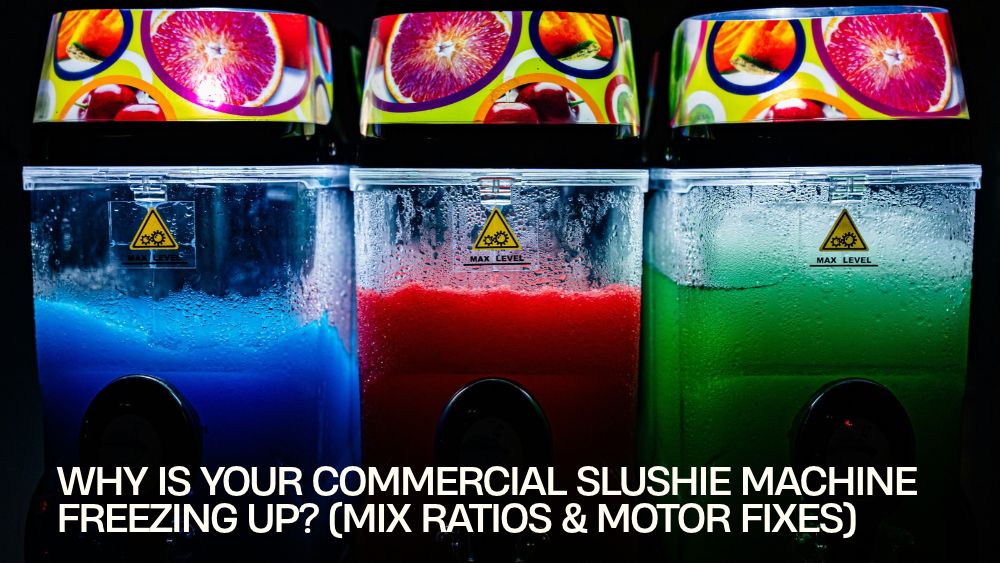
The triple-tank configuration gives you three separate 12-liter bowls, allowing different beverages to be prepared at the same time. The manufacturer's listing describes independent tank settings and adjustable consistency for different drink styles.
Before purchasing, confirm the current product specifications, electrical requirements, operating temperature range, cleaning procedure, and mix recommendations for the exact version being sold.
Think about your daily service volume, counter space, ventilation, staff cleaning routine, and the drinks you plan to serve. A multi-tank machine is useful when you need several flavors available together, but each bowl still needs the correct recipe and regular maintenance.
Frequently Asked Questions
Why does my commercial slushie machine freeze into a solid block?
Common causes include insufficient sugar, an overly aggressive consistency setting, or a mixture that is unsuitable for the machine. Stop the freezing cycle as instructed and allow the product to soften before inspecting the auger.
What sugar percentage should a commercial slushie machine use?
The correct percentage depends on the machine and concentrate. Some VEVOR models specify approximately 13% to 18%, while other models have different requirements. Follow the manual for your exact model and the concentrate manufacturer's directions.
Why is my slush machine making a grinding noise?
Possible causes include a frozen or obstructed auger, incorrect assembly, damaged stirring components, or a motor or gear-motor fault. Switch off and unplug the machine before inspecting removable parts. If the noise persists after safe cleaning and reassembly, arrange professional service.
Can I keep running the machine if the auger stops?
No. Stop the affected function and follow the manufacturer's recovery procedure. Continuing to run a blocked auger may damage the drive system.
Why does my slushie machine cool but fail to make slush?
Check the recipe, sugar concentration, selected operating mode, fill level, and consistency setting. If these are correct and the machine still cannot freeze the mixture, a ventilation, sensor, compressor, or refrigeration-system problem may need professional diagnosis.
Final Thoughts
When a commercial slushie machine freezes too hard or makes unusual stirring noises, start with the mix ratio and consistency setting before assuming the motor has failed.
Prepare the drink according to the correct sugar and alcohol guidelines, maintain the required tank level, and keep ventilation clear. If the auger stalls, stop the machine and allow the mixture to soften before inspecting the assembly.
Persistent grinding, repeated overload shutdowns, or poor cooling after the basic checks point to a problem that needs qualified service. A careful diagnosis protects the motor, reduces downtime, and helps keep your frozen drinks consistent during the busiest part of the day.