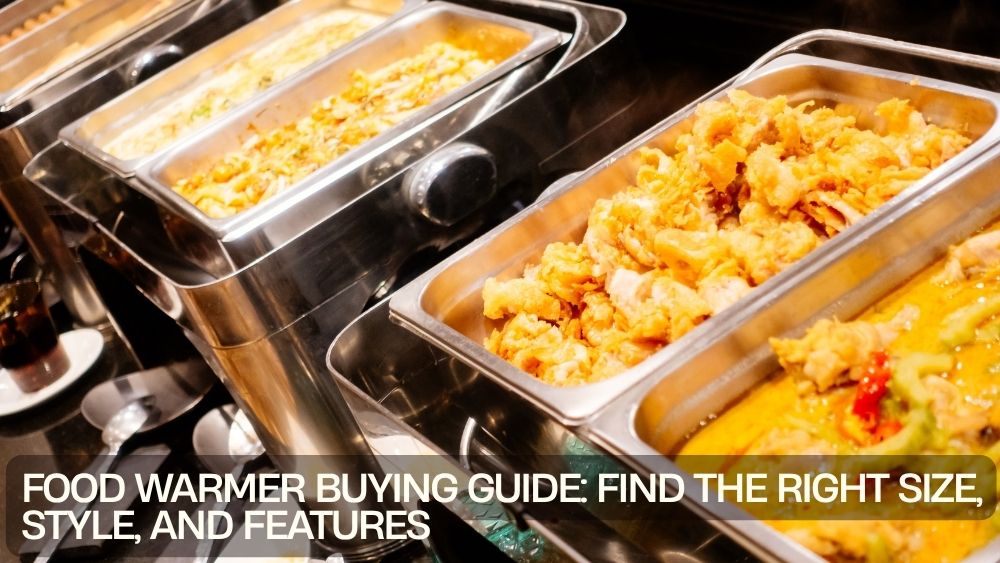
Serving food to a crowd sounds simple until the first dish starts cooling before everyone has made it to the table.
Whether you are hosting a family gathering, running a restaurant, preparing a buffet, or catering a large event, keeping prepared food ready to serve requires more than good timing. The right food warmer can help maintain serving temperatures while making meal service smoother and more organized.
But food warmers come in different sizes, styles, capacities, and heating methods. A compact countertop unit may be perfect for a home kitchen, while a commercial operation may need a much larger warming cabinet.
So how do you choose the right food warmer?
Start with the food you serve, the number of people you serve, the available space, and how you plan to use the equipment. From there, features such as temperature control, construction, capacity, portability, and cleaning become much easier to evaluate.
This complete food warmer selection guide breaks down the key factors to consider before buying.
Start With Your Serving Needs
The best food warmer is not necessarily the biggest or most powerful model.
It is the one that matches your serving routine.
A household preparing dinner for a few people may only need a compact food warming tray. A family hosting a holiday gathering could benefit from a buffet-style warmer that keeps several dishes ready at once.
Restaurants and catering businesses have different requirements. They may need commercial food warmers with larger capacities, adjustable shelves, durable construction, and enough space to handle continuous meal service.
Before shopping, ask yourself three questions:
How much food do I need to keep warm?
How often will I use the warmer?
Where will I use it?
Those answers will quickly narrow down the options in the TotalFindz Food Warmers Collection.
Choose the Right Capacity
Size is one of the most important factors in a food warmer buying guide.
A warmer that is too small may force you to work in batches. One that is unnecessarily large can consume valuable counter or storage space.
For smaller meals and casual entertaining, countertop food warmers can provide a convenient solution without dominating the kitchen.
For large gatherings, catering events, or commercial kitchens, capacity becomes much more important.
A larger warming cabinet can hold multiple trays or containers, allowing different dishes to remain ready for service at the same time.
Think about your busiest serving occasion rather than your average meal.
If you regularly host large gatherings, choosing a little extra capacity can make the equipment more useful in the long run.
Countertop Food Warmers for Home Kitchens
Home cooks often need convenience above all else.
A countertop food warmer should fit comfortably into your kitchen while providing enough capacity for the meals you regularly prepare.
These units are particularly useful for family gatherings, buffet-style meals, parties, and occasions when everyone eats at different times.
A smaller warmer can also help when you are preparing several dishes simultaneously. Instead of trying to coordinate every item to finish at precisely the same moment, you can keep prepared food warm while completing the rest of the meal.
That can turn hosting from a frantic countdown into a much calmer operation.
Electric Food Warmers for Convenient Service
Electric food warmers are popular because they provide a straightforward way to maintain heat without relying on constant stovetop monitoring.
Look for models with practical temperature controls so you can adjust the heat according to your serving needs.
Adjustable temperature food warmers are particularly useful when working with different types of dishes. Sauces, prepared meals, and other foods may have different warming requirements.
For smaller applications where sauces and toppings are part of the menu, an Electric Cheese Dispenser With Heated Pump can provide a specialized warming solution.

Its adjustable temperature range and heated dispensing design make this type of equipment especially relevant for cheese, sauces, and similar serving applications.
Commercial Food Warmers for High-Volume Service
Restaurants, catering operations, cafeterias, and event venues need equipment built for heavier workloads.
Commercial food warmers should provide enough capacity for the volume of food being served while fitting into the kitchen's workflow.
For large-scale operations, a warming cabinet can be more practical than several small countertop units.
The 16-Tier Commercial Food Warming Cabinet offers a much larger storage solution, with multiple tiers, adjustable shelving, a glass door, and a water tray.

This type of configuration can be useful when a catering team or commercial kitchen needs to manage multiple trays and dishes simultaneously.
Instead of scattering several warmers around the workspace, one larger unit can create a dedicated hot-holding area.
Consider Stainless Steel Construction
When food warming equipment is used frequently, durability matters.
Stainless steel is a popular choice in commercial kitchens because it offers a professional appearance and is generally practical for demanding environments.
A stainless steel food warmer can also fit naturally into kitchens where other equipment uses the same material.
When evaluating construction, look beyond the outer finish. Consider the doors, handles, shelves, controls, trays, and overall build.
Equipment that is used every day needs to withstand repeated loading, unloading, cleaning, and temperature changes.
For occasional home use, construction may be less demanding. For commercial kitchens, however, durability should be high on the buying checklist.
Think About Temperature Control
Not every dish needs the same warming approach.
That makes temperature control one of the most useful features to consider.
Adjustable controls give you greater flexibility than equipment operating at a single fixed setting.
When comparing food warmers, consider how easy the controls are to access and adjust. Clear controls can make a difference when staff need to change settings quickly during service.
Temperature flexibility is particularly useful for commercial kitchens and catering operations where multiple types of food may be served throughout the day.
Steam Food Warmers and Moisture
Some food warming systems use water or steam to help maintain a suitable warming environment.
Steam food warmers can be useful when you want to reduce the risk of food drying out during holding.
A water tray is another feature worth noticing when comparing commercial models. It can form part of the warming system and support a more humid environment inside the cabinet.
However, the ideal configuration depends on the foods you serve. Crispy foods may have different requirements from sauces, prepared meals, or other moist dishes.
Choose the warming method around your menu rather than simply selecting the most feature-packed machine.
Look for Easy Cleaning
Food equipment has one unavoidable reality: eventually, something will spill.
That makes easy cleaning an important consideration.
Look for removable trays, accessible surfaces, smooth interiors, and components that can be cleaned without dismantling the entire unit.
For commercial operations, cleaning efficiency becomes even more important because equipment may need attention multiple times during a busy service schedule.
A food warmer that is easy to clean can save time long after the excitement of the purchase has disappeared.
Match the Warmer to Your Space
Capacity is important, but physical dimensions matter too.
Measure the counter, kitchen area, serving station, or storage location before buying.
For home kitchens, a large commercial cabinet may provide impressive capacity but create a completely different problem by consuming too much usable space.
For catering businesses, the opposite may be true. A compact warmer could become frustrating if the operation regularly serves large groups.
Think vertically when possible. Multi-tier warming cabinets can provide substantial capacity without requiring an equally large floor footprint.
Food Warmers for Parties and Family Gatherings
Buffet food warmers are especially useful for entertaining.
Instead of asking guests to wait while every dish finishes cooking, you can prepare food ahead of time and keep it ready for serving.
This works well for birthdays, holiday meals, family reunions, celebrations, and casual weekend gatherings.
Food warming trays can also help create a more organized buffet layout. Dishes stay in designated areas, guests can serve themselves, and the host spends less time running between the kitchen and dining table.
For occasional entertaining, prioritize convenience, storage, and ease of setup.
Food Warmers for Catering Events
Catering introduces another challenge: transportation and volume.
Food needs to remain organized from preparation through service, and equipment may need to handle significantly larger quantities than a typical household setup.
This is where commercial warming cabinets and larger hot-holding equipment can become valuable.
When choosing food warmers for catering events, consider capacity, access, durability, controls, and how the equipment fits into your transportation and serving process.
The right unit should support the workflow rather than create another obstacle.
Portable Food Warming Solutions
Not every event happens in a traditional kitchen.
Parties may take place outdoors. Catering may happen at different venues. Family gatherings can move between homes, patios, halls, and other spaces.
Portable food warming solutions are therefore worth considering when your serving location changes regularly.
Think about how the warmer will be transported, where it will receive power, and how much food it needs to accommodate.
Portability should be considered alongside capacity. The largest unit is not always the easiest unit to move.
Choose Features That You Will Actually Use
Modern food warmers can offer plenty of features, but more features do not automatically mean a better purchase.
Focus on functions that solve real problems.
Useful considerations include:
- Adjustable temperature control
- Suitable capacity
- Multiple shelves or compartments
- Durable construction
- Easy-clean surfaces
- Glass doors for visibility
- Water trays where appropriate
- Convenient controls
- Suitable power requirements
- Easy access to food
For home users, simplicity may be the priority.
For commercial kitchens, capacity and workflow may matter more.
The best equipment is the equipment that earns its counter space.
Consider Your Menu
Different foods behave differently when held warm.
Sauces and cheese require a different setup from baked dishes. Large trays of prepared food have different space requirements from individual servings.
That means your menu should influence your purchase.
If sauces are a major part of your service, a heated dispenser may make more sense than a large warming cabinet.
If you regularly serve multiple trays at once, a multi-tier cabinet may be the better choice.
Think menu first, machine second.
Plan for Your Busiest Days
A food warmer should make your busiest service easier.
Consider the largest event you regularly host and work backward.
How many dishes need to remain warm? How many trays are required? How much counter or floor space is available? How quickly does food need to move from kitchen to serving area?
Answering these questions gives you a realistic picture of the capacity you need.
It also prevents a common mistake: buying equipment based only on today's needs and discovering six months later that it cannot keep up.
Build a Practical Food-Warming Setup
You do not necessarily need one giant piece of equipment.
A practical setup might combine a larger warming cabinet for prepared dishes with a specialized dispenser for sauces or toppings.
This allows each piece of equipment to do a specific job.
For home cooks, a smaller warmer may be enough for family meals and occasional gatherings.
For commercial kitchens, multiple warming solutions can create separate zones for different types of food.
The goal is a smooth serving workflow.
Final Thoughts
Choosing the right food warmer comes down to matching the equipment with your food, space, serving volume, and frequency of use.
For smaller kitchens and family gatherings, countertop food warmers can offer convenience without taking over the workspace. For sauces and cheese, specialized heated dispensers can provide targeted warming. For restaurants and catering operations, larger commercial warming cabinets can deliver the capacity needed for high-volume service.
Pay attention to size, temperature control, construction, cleaning, heating method, portability, and the types of food you regularly serve.
The perfect food warmer is not necessarily the biggest one or the one with the longest feature list. It is the one that quietly does its job while you focus on what matters most: getting good food onto the table, buffet, or serving line at the right moment.