Want to carry groceries, camping gear, or everyday cargo by bicycle without loading down your rear rack? A bike cargo trailer can turn an ordinary bicycle into a surprisingly capable hauling setup.
But before choosing one, there is an important decision to make: should you buy a single-wheel or two-wheel bicycle cargo trailer?
Both designs have advantages. A single-wheel trailer tracks closely behind your bicycle and handles narrow paths well. A two-wheel trailer offers a wider, more stable platform that makes loading groceries and bulky items easier.
The right choice depends on what you carry, where you ride, how much weight you need to tow, and how much space you have for storage.
This guide breaks down the differences, explains load-capacity considerations, and looks at the VEVOR 70 lb bike cargo trailer as an option for everyday transportation.
Single-Wheel vs. Two-Wheel Bike Cargo Trailers: What's the Difference?
The biggest difference is how the trailer interacts with your bicycle when you turn.
A single-wheel trailer generally leans with the bicycle. Its narrow profile allows it to follow the bike through turns and along tighter paths.
A two-wheel trailer normally remains upright while the bicycle leans independently. Its wider footprint creates a stable cargo platform, especially when the bike is stationary.
Neither design wins every situation.
Single-wheel cargo trailers

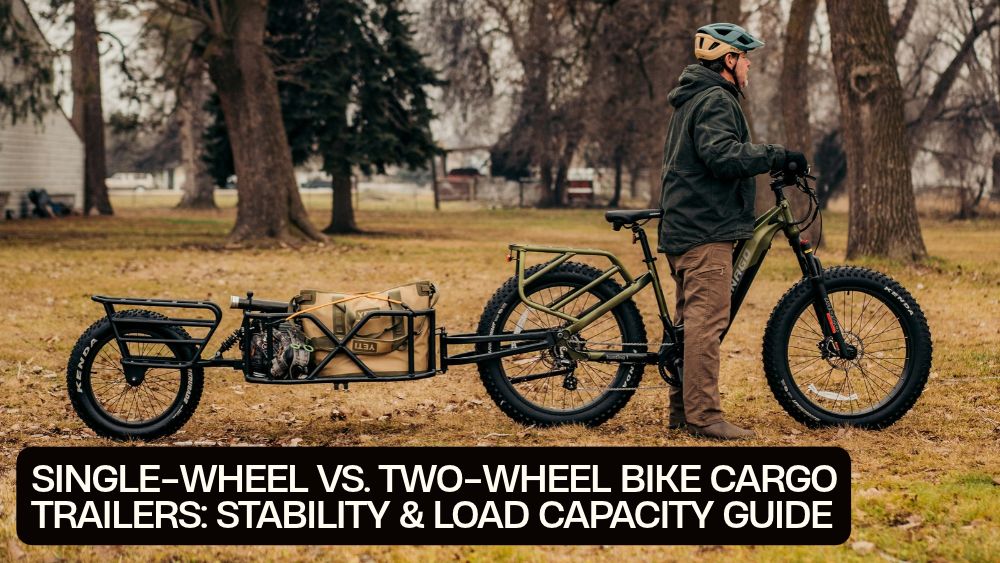
A single-wheel trailer usually has one wheel positioned behind the bicycle, with a hitch that allows it to follow the bike's movement.
Its main advantages include:
-
Narrower overall profile
-
Better maneuverability on tight trails
-
Easier tracking through turns
-
Less width to navigate around bollards and narrow paths
-
A natural fit for some touring and bikepacking setups
The main trade-off is load balance. Because the trailer leans with the bicycle, the cargo and trailer can influence how the bike feels when turning.
Packing also matters more. An uneven or shifting load can affect handling, particularly at higher speeds.
Two-wheel cargo trailers
 A two-wheel trailer has a wheel on each side of its cargo platform.
This arrangement gives it several practical advantages:
-
More stable loading and unloading
-
A platform that stays upright when detached, depending on the design
-
Convenient transport of boxes and grocery bags
-
Less influence from side-to-side cargo movement on the bicycle
-
A wider base for everyday utility use
The main disadvantage is width.
A two-wheel trailer needs more room around corners, gates, bike racks, and narrow cycle paths. You also need to account for its wider turning path when passing obstacles.
Which Bike Cargo Trailer Is More Stable?
For ordinary grocery trips and stationary loading, a two-wheel trailer generally offers the more stable platform.
Its two wheels support the cargo independently, so the trailer does not need to lean with the bicycle.
That makes it easier to load shopping bags, transport boxes, and keep bulky items organized.
However, stability is not simply a matter of wheel count.
The trailer's center of gravity, wheel track, hitch design, frame stiffness, tire pressure, load distribution, and riding speed all matter.
Stability while riding
A single-wheel trailer follows the bicycle closely and can be easier to maneuver through narrow spaces. It is particularly useful on routes where width matters.
A two-wheel trailer remains upright, but its wider stance introduces different handling considerations. If one wheel hits a curb, pothole, or uneven surface while cornering, the trailer can experience a strong sideways force.
Do not assume a two-wheel trailer cannot tip. Sharp turns, excessive speed, uneven loading, and sudden obstacles can destabilize either design.
Stability while stopped
This is where two-wheel trailers usually have the advantage.
A single-wheel trailer may need support from the bicycle or a dedicated stand while loading.
A two-wheel trailer can often stand upright on its own, making it more convenient for grocery shopping and unloading.
Check whether the particular model includes a kickstand or stable parking arrangement. Two wheels alone do not guarantee that a loaded trailer will remain upright on every surface.
Which Design Has the Higher Load Capacity?
Two-wheel trailers often offer higher load capacities because their wider platforms and independent wheel support make them practical for heavier utility loads.
However, this is a general design tendency, not a universal rule. Some single-wheel touring trailers carry substantial loads, while some compact two-wheel models have relatively modest ratings.
Always compare the manufacturer's stated maximum capacity.
Typical uses by trailer type
| Use case | Single-wheel trailer | Two-wheel trailer |
|---|---|---|
| Lightweight bikepacking | Excellent fit for narrow routes | Can work, but may be wider |
| Grocery shopping | Suitable for smaller, balanced loads | Often more convenient |
| Bulky boxes | Depends on cargo design | Generally easier |
| Narrow trails | Usually better | Width can be restrictive |
| Stationary loading | May need support | Often more stable |
| Heavy utility loads | Model-dependent | Often a practical choice |
| Tight urban spaces | Narrower profile | Requires more clearance |
Never confuse trailer capacity with total towing capacity
A trailer's advertised maximum load is only one part of the equation.
You must also consider:
-
Bicycle manufacturer's trailer-towing restrictions
-
Hitch and axle compatibility
-
Wheel and tire ratings
-
Frame and fastener strength
-
Braking performance
-
Road surface and gradient
-
The rider's ability to control the combined setup
A trailer rated for 70 lb does not mean every bicycle can safely tow 70 lb.
The bicycle, hitch, trailer, and riding conditions must all be suitable for the intended load.
Single-Wheel vs. Two-Wheel Trailers for Touring
Bike touring puts different demands on a cargo trailer than a quick trip to the supermarket.
You may ride for hours, travel over changing surfaces, climb hills, and pass through narrow gates or trail sections.
A single-wheel trailer can be attractive for touring because it tracks closely behind the bicycle and has a narrow profile.
That makes it useful when the route includes:
-
Narrow gravel paths
-
Tight trail sections
-
Technical terrain
-
Restricted-width gates
-
Routes where maneuverability matters
The trade-off is that the trailer leans with the bicycle. Its load can influence handling, so careful packing becomes particularly important.
A two-wheel trailer may be more suitable for touring on wider roads and established paths when you want a stable cargo platform.
It can also make loading bulky camping equipment easier.
However, the added width can become inconvenient on narrow trails and crowded cycle routes.
Touring tip: Choose based on the narrowest and most difficult part of your planned route, not just the smoothest section.
Which Bike Cargo Trailer Is Better for Groceries?
For most grocery trips, a two-wheel cargo trailer is the more practical option.
Shopping bags, food boxes, drinks, and household supplies are easier to arrange on a wider platform.
You can also distribute weight between the two sides rather than trying to balance everything along a single narrow cargo line.
How to pack groceries safely
-
Place heavier items low and close to the trailer axle.
-
Distribute weight evenly across the platform.
-
Keep fragile items away from hard edges.
-
Secure bags and boxes so they cannot slide.
-
Keep the load below the trailer's rated capacity.
-
Avoid stacking cargo so high that it becomes unstable.
-
Keep the hitch area clear of loose straps and packaging.
A high center of gravity can make a trailer less stable, particularly during turns.
Also consider how you will handle the trailer after reaching the store. A detachable trailer with a practical parking arrangement can make shopping considerably easier.
What Load Capacity Should You Choose?
The right capacity depends on your typical cargo rather than the biggest load you might carry once a year.
Here is a simple planning guide:
| Intended use | What to prioritize |
|---|---|
| Small errands | Compact size and easy attachment |
| Weekly groceries | Stable platform and practical cargo volume |
| Camping trips | Capacity, storage dimensions, and secure tie-downs |
| Touring equipment | Route compatibility and balanced loading |
| Tools and equipment | Frame strength, secure mounting, and load rating |
Do not buy a trailer simply because it advertises a high maximum load.
A trailer that weighs more may be harder to pull when empty. A large cargo box can also tempt you to carry more than your bicycle and braking system can comfortably manage.
Think about the complete setup, including the trailer's own weight.
Product Spotlight: VEVOR 70 lb Bike Cargo Trailer
If you want a two-wheel-style utility trailer for everyday hauling, the VEVOR Bike Cargo Trailer with 70 lb Load Capacity is worth comparing.
According to the TotalFindz listing, this model is designed for groceries, tools, camping equipment, and general cargo transportation.
Listed specifications
| Feature | Product details |
|---|---|
| Model | CT906 |
| Maximum load capacity | 70 lb (32 kg) |
| Frame material | Carbon steel |
| Wheel size | 20 inches |
| Tire width | 4 inches |
| Expanded dimensions | 78.74 × 18.70 × 27.36 inches |
| Cargo box dimensions | 27.2 × 16.9 × 11 inches |
| Product weight | 37.48 lb (17 kg) |
| Hitch position | Rear axle |
| Attachment | Universal hitch, listed for most bicycles |
| Convenience features | Quick-release structure and compact storage |
Why consider this trailer?
A practical cargo box: The listed 27.2 × 16.9 × 11-inch cargo area provides space for everyday supplies, shopping bags, and smaller equipment.
Wide tires: The product uses 20-inch air-filled wheels with 4-inch-wide tires. Tire width and pressure can influence how a trailer rolls over different surfaces, although they do not guarantee suitability for every terrain type.
Carbon steel construction: The frame is listed as carbon steel, providing a rigid structure for the trailer's intended cargo use.
Quick-release design: The quick-release structure is intended to make setup, removal, and storage more convenient.
Universal hitch: The listing describes a rear-axle hitch designed to fit most bicycles. You should still verify your bike's axle and drivetrain configuration before ordering.
Is 70 lb enough for groceries?
For many ordinary shopping trips, 70 lb can provide useful capacity.
For example, you might carry a combination of:
-
Fresh produce
-
Packaged groceries
-
Household supplies
-
Bottled drinks
-
Small bags of pet food
But remember that 70 lb is the manufacturer's stated maximum cargo capacity, not a recommended everyday target for every bicycle.
The trailer itself weighs approximately 37.48 lb. That weight is additional to the cargo and must be considered when assessing how much your bicycle will be towing.
What should you check before buying?
The listing does not establish compatibility with every bicycle axle or every e-bike configuration.
Before purchasing, confirm:
-
Whether your rear axle accepts the supplied hitch.
-
Whether your bike requires a special thru-axle adapter.
-
Whether the rear derailleur, disc brake, or hub motor creates clearance issues.
-
Whether your bicycle manufacturer permits trailer towing.
-
Whether the assembled trailer fits your storage space.
You can review the VEVOR 70 lb bike cargo trailer on TotalFindz for the full product details.
How to Choose the Right Trailer Hitch
The hitch is one of the most important parts of your trailer setup.
It connects the trailer to the bicycle and transfers forces during acceleration, braking, and turning.
A trailer may have an impressive frame and cargo capacity, but an incompatible hitch can make the entire setup unsafe.
Check your rear axle type
Bicycles commonly use:
-
Quick-release axles
-
Solid nutted axles
-
Thru-axles
-
Specialized hub and motor arrangements
A universal hitch does not necessarily fit every axle without an adapter.
If your bicycle has a thru-axle, internal gearing, or a rear hub motor, check compatibility with the trailer manufacturer before ordering.
Never force a hitch onto an axle or modify a safety-critical attachment without manufacturer approval.
Inspect the connection before every ride
Check that:
-
The hitch is fully seated.
-
All supplied locking pins are installed.
-
Bolts and fasteners are secure.
-
Any secondary safety strap is attached as instructed.
-
The drawbar has the correct clearance.
-
The trailer can articulate without binding.
Follow the trailer's installation instructions rather than improvising a mounting arrangement.
Safe Riding Tips for Bike Cargo Trailers
Towing a trailer changes how your bicycle accelerates, turns, and stops.
Even an experienced cyclist should practice with an empty trailer before carrying a heavy load.
Start in a quiet, open area and gradually become familiar with the added length and weight.
Follow these practical precautions
Practice wider turns. Two-wheel trailers need more clearance than the bicycle alone. Avoid cutting corners.
Brake earlier. Additional mass increases the effort required to slow down. Leave more stopping distance, especially on descents.
Keep the load low. Heavy items should generally sit near the trailer floor and close to the axle.
Secure everything. Loose cargo can shift suddenly and affect handling.
Avoid excessive speed. Slow down before corners, rough surfaces, and uneven crossings.
Check tire pressure. Follow the tire and trailer manufacturer's recommendations.
Inspect the hitch regularly. A loose connection can become a serious hazard.
Be visible. Use required lights and reflectors, especially when riding in low-light conditions. Check local bicycle equipment requirements in your area.
Never carry passengers in a cargo trailer unless it is specifically designed, rated, and approved for that purpose.
Final Buying Checklist
Before choosing between a single-wheel and two-wheel bike cargo trailer, ask yourself:
-
Will I mainly carry groceries, camping gear, or touring equipment?
-
Do my routes include narrow trails or tight urban spaces?
-
Do I need the trailer to stand independently while loading?
-
What is the realistic weight of my typical cargo?
-
Does the trailer have enough usable cargo space?
-
Is the hitch compatible with my bicycle?
-
Can my bicycle manufacturer approve the intended towing load?
-
Can I store the trailer when it is detached?
-
Are the tires, frame, and hitch suitable for my riding conditions?
-
Have I checked local lighting and road-use requirements?
Single Wheel for Narrow Routes, Two Wheels for Everyday Hauling
A single-wheel cargo trailer is a smart choice when maneuverability, narrow trails, and close tracking behind the bicycle matter most.
A two-wheel trailer is generally more convenient for groceries, bulky equipment, and everyday utility trips because it offers a wider cargo platform and easier stationary loading.
For riders who want to carry ordinary shopping or equipment, the VEVOR 70 lb bike cargo trailer offers a carbon steel frame, 20-inch wheels, a compact cargo box, and a quick-release structure. Its listed capacity may suit moderate hauling, provided the bicycle and hitch are compatible with the complete towing setup.
Ultimately, choose the trailer around your actual routes and cargo. Check the load rating, hitch, bicycle restrictions, and storage dimensions before ordering.
A good cargo trailer should make cycling more useful, not turn every corner into a balancing exercise.