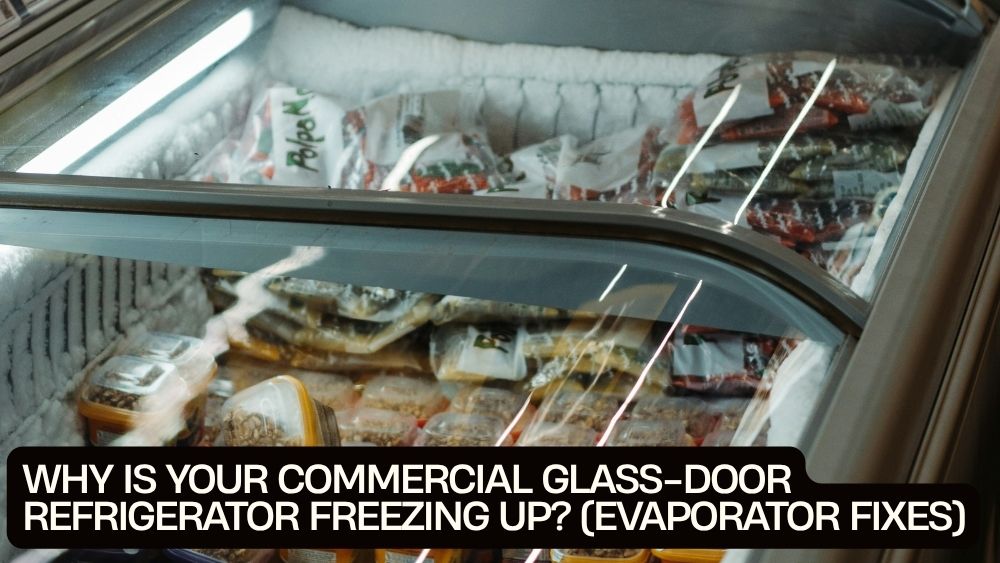
A commercial refrigerator should keep ingredients cold, not turn its evaporator into an ice sculpture. Yet if you run a restaurant, café, food truck, or convenience store, you may eventually notice frost spreading across the evaporator, weak airflow, or a compressor that seems to run all day without reaching the right temperature.
The problem can be especially frustrating when the refrigerator looks cold inside but your ingredients are warming up. Ice buildup can restrict airflow, interfere with heat transfer, and prevent the refrigeration system from maintaining consistent temperatures.
If your commercial reach-in refrigerator is running constantly and ice is forming on the evaporator, the cause could be something relatively simple, such as a door gasket that leaks warm air, or a mechanical fault involving the defrost system, evaporator fan, or refrigerant circuit.
This guide explains the most common causes, the checks you can perform safely, and when it is time to call a qualified refrigeration technician.
1. Why Is Your Commercial Refrigerator Freezing Up?
A small amount of frost may occur during normal refrigeration operation, depending on the equipment design and operating conditions. Persistent, heavy ice buildup is different. It usually indicates that moisture is entering the cabinet faster than the system can remove it, airflow is restricted, or the defrost process is not working correctly.
The evaporator absorbs heat from the refrigerator's interior. Moisture in the air can condense on its cold surfaces and freeze. As ice accumulates, it can block the spaces between evaporator fins and reduce the amount of air passing across the coil.
The refrigeration system then struggles to remove heat effectively. The compressor may run longer, temperatures may become inconsistent, and energy consumption can increase.
The most common causes include:
-
A damaged or poorly sealing door gasket.
-
Frequent door opening or prolonged open-door periods.
-
Blocked evaporator airflow.
-
A malfunctioning defrost heater, timer, sensor, or control.
-
An evaporator fan that has stopped working.
-
A blocked condensate drain.
-
A temperature control or sensor problem.
-
A refrigerant-circuit fault requiring professional diagnosis.
The key is to identify the underlying cause rather than repeatedly removing the ice and hoping it stays away.
2. Check the Door Gasket and Warm-Air Leaks First
One of the easiest places to start is the door seal.
Every time a refrigerator door opens, warm, humid air enters the cabinet. When that moisture reaches a sufficiently cold surface, it can condense and freeze. A damaged gasket makes the problem worse because warm air continues entering even when the door is closed.
Look for:
-
Torn, cracked, or hardened gasket material.
-
Sections that have pulled away from the door.
-
Food containers preventing the door from closing completely.
-
A door that appears misaligned.
-
Moisture or frost concentrated around the door opening.
Clean the gasket and its contact surface using a suitable food-equipment cleaning method. Check whether the door closes evenly and whether anything obstructs the seal.
If the gasket is damaged, replace it with the correct part for the specific model. Do not use makeshift repairs that prevent the door from sealing properly.
Why glass-door refrigerators need special attention
Glass-door display refrigerators often experience frequent customer access, and their doors may remain open longer during stocking or service. This can increase moisture entering the cabinet.
Check that staff close the doors promptly and avoid leaving them open while restocking. If the refrigerator has heated glass or other special door features, follow its manufacturer instructions when inspecting or replacing components.
A gasket problem is worth investigating early because it is relatively easy to identify. However, if heavy ice returns after the seal is repaired, another fault may be involved.
3. Inspect Airflow Around the Evaporator
Restricted airflow is another common reason for a refrigerator that runs constantly while cooling poorly.
The evaporator fan moves air across the coil and circulates cooled air through the cabinet. When the fan cannot move enough air, some areas may become excessively cold while other areas warm up. Existing ice can then make the airflow problem progressively worse.
Start with the checks that do not require opening electrical or refrigeration compartments.
Check for blocked vents
Avoid stacking food containers against interior air outlets or returns. Overloading the refrigerator can interfere with circulation, especially when large containers sit directly in front of vents.
Keep products arranged according to the equipment's loading instructions. Do not pack the cabinet so tightly that air cannot move around stored ingredients.
Listen for unusual fan behavior
If airflow seems weak, listen for a fan that is unusually noisy, repeatedly stopping, or not operating when expected.
Some refrigeration systems cycle fans or stop them during particular operating conditions, so a fan that is temporarily silent does not automatically indicate failure.
Do not reach into a fan compartment or remove protective covers while the equipment is powered. If ice appears to be trapping the fan, switch off the equipment as directed by the manufacturer and arrange a safe inspection.
A failed evaporator fan, damaged blade, or faulty motor may require replacement by a qualified technician.
4. Investigate a Failed Defrost System
If ice repeatedly covers the evaporator, the defrost system deserves close attention.
Many commercial refrigerators use automatic defrost controls to remove frost from the evaporator at scheduled intervals. Depending on the model, the system may use a defrost heater, timer, temperature sensor, electronic controller, or a combination of these components.
During defrost, the equipment temporarily changes its normal cooling operation so accumulated frost can melt and drain away.
If the defrost cycle does not occur, ends too early, or fails to melt the ice, frost can build up until the evaporator becomes heavily blocked.
Commercial refrigerated prep-table manuals also describe scheduled defrost cycles and the melting of accumulated frost as part of normal operation. The precise controls and procedures vary by model.
Signs of a defrost problem
Watch for these symptoms:
-
Thick ice repeatedly returning on the evaporator.
-
Cooling performance gradually deteriorating over several days.
-
Airflow becoming weaker as frost accumulates.
-
A refrigerator that cools normally after defrosting but struggles again later.
-
An error code or alarm related to temperature or defrost, if your model provides one.
What can you safely do?
Check the user manual for the approved defrost procedure. If the manufacturer provides a user-accessible defrost control, follow its instructions.
Do not chip ice off the evaporator with a screwdriver, knife, or other sharp tool. The coil and refrigerant tubing can be damaged, potentially creating an expensive and hazardous failure.
Never use an open flame or an uncontrolled heat source to melt ice.
If the evaporator repeatedly freezes over, a technician should inspect the defrost heater, timer, sensors, wiring, and controller as applicable. Replacing parts without identifying the failed component can waste money and leave the original fault unresolved.
5. Check the Condensate Drain
When frost melts during defrost, the resulting water needs a clear route out of the evaporator area.
If the drain is blocked by food debris, residue, ice, or other material, water may collect in the cabinet or evaporator compartment. That water can freeze again, create additional ice, and contribute to recurring drainage problems.
Look for signs such as:
-
Water pooling inside the refrigerator.
-
Ice forming near the drain opening.
-
Water leaking onto the floor.
-
A recurring puddle after a defrost cycle.
If the drain is accessible to the operator, clean it only as directed in the manufacturer's instructions. Use approved cleaning tools and methods, and avoid pushing sharp objects into drain tubing.
Do not pour boiling water into an unknown drain or electrical compartment. If the drain is frozen, inaccessible, or repeatedly blocked, arrange a professional inspection.
A blocked drain may not be the original reason the evaporator iced over, but correcting drainage is important to prevent the melted frost from becoming another problem.
6. Is the Temperature Control Set Too Low?
A temperature setting that is too low can contribute to freezing products or create complaints about excessive cold. However, it does not automatically explain a thick layer of ice covering the evaporator.
First, compare the actual cabinet temperature with the manufacturer's recommended operating range. Use a reliable thermometer rather than relying solely on the display.
Check whether the control setting has been changed accidentally, whether a sensor is positioned correctly, and whether the temperature reading agrees with an independent measurement.
A faulty sensor or controller can misread the cabinet temperature and cause the refrigeration system to operate incorrectly.
Why food may freeze while other areas stay warm
Cold-air distribution is not always uniform. Products positioned directly in the path of cold air may freeze even while other parts of the cabinet remain too warm.
If food is freezing in one location but warming in another, consider airflow restrictions, fan operation, sensor accuracy, and product placement rather than immediately changing the temperature setting.
Do not lower the setpoint to compensate for a refrigerator that cannot maintain temperature. That can make the problem worse without correcting the underlying fault.
7. Could Low Refrigerant or a Compressor Problem Be Responsible?
Yes, refrigeration-circuit faults can cause abnormal evaporator temperatures, poor cooling, or extended compressor operation. But ice on the evaporator does not, by itself, prove that the system is low on refrigerant.
A refrigerant leak, metering-device restriction, compressor problem, or another sealed-system fault can produce symptoms that overlap with airflow and defrost problems.
These faults require proper diagnostic equipment and refrigeration expertise.
Signs that warrant professional service
Contact a qualified refrigeration technician if:
-
The compressor runs almost continuously and cabinet temperatures remain too warm.
-
The evaporator repeatedly ices over despite proper loading and clear airflow.
-
The system makes unusual mechanical noises.
-
Cooling performance changes significantly without an obvious reason.
-
There are signs of refrigerant leakage or damage to refrigeration tubing.
-
Electrical components show signs of overheating or damage.
Do not open the sealed refrigeration system, release refrigerant, or attempt to recharge it based on frost patterns alone. Refrigerant handling and repairs must comply with applicable US or Canadian requirements.
A technician can check operating pressures, temperatures, electrical components, refrigerant charge, and other system conditions to determine the actual cause.
8. What to Do When Your Refrigerator Runs Constantly
A commercial refrigerator that runs almost continuously deserves attention, particularly when ice is building up and the cabinet is not reaching its target temperature.
Use this practical troubleshooting sequence.
Step 1: Check the temperature. Measure the actual cabinet temperature and record whether it is stable, rising, or falling.
Step 2: Check the door seal. Make sure doors close fully and gaskets are clean and undamaged.
Step 3: Review the loading. Remove obstructions from vents and avoid overpacking the cabinet.
Step 4: Inspect visible frost and water. Note where ice appears and whether water is pooling near the drain. Do not remove protective covers to reach inaccessible components.
Step 5: Check the manual. Look for the approved defrost procedure, temperature settings, cleaning instructions, and any error-code guidance.
Step 6: Arrange service if the problem persists. Repeated evaporator icing, weak airflow, abnormal compressor operation, or poor temperature control may indicate a mechanical or electrical fault.
Avoid repeatedly switching the unit off and on as a substitute for diagnosis. Follow the manufacturer's instructions, especially if the refrigerator is loaded with perishable ingredients.
9. Protect Food Safety While Troubleshooting
In a commercial kitchen, refrigerator trouble is not just an equipment issue. It can become a food-safety issue quickly.
The FDA Food Code is a model used by state and local authorities in the United States, and local requirements may differ. For many time/temperature control for safety foods, the Food Code uses a cold-holding limit of 41°F (5°C) or below. Verify the rules applicable to your location and food operation.
If the refrigerator cannot maintain the required temperature:
-
Check food temperatures with a suitable thermometer.
-
Move vulnerable ingredients to functioning refrigeration if necessary.
-
Record temperatures and follow your food-safety procedures.
-
Follow local health requirements for food that has been held outside safe temperature limits.
-
Do not assume food is safe based on smell or appearance alone.
If a refrigerator is malfunctioning, keeping the door closed as much as practical can help limit additional warm-air entry while you arrange appropriate storage.
10. Choosing Commercial Refrigeration for Food Prep
If you are replacing an unreliable unit or equipping a restaurant, sandwich shop, or food truck, consider how the refrigerator will be used throughout the day.
A traditional glass-door reach-in is designed for refrigerated storage and product visibility. A refrigerated prep table serves a different purpose: it combines chilled storage with a work surface and ingredient-pan access for preparing sandwiches, salads, and similar foods.
The right equipment depends on your workflow, available space, ingredient volume, and required temperature performance.
One option to evaluate is the VEVOR 72-inch commercial refrigerated prep table.

The listed model offers 18.7 cubic feet of capacity, a 72-inch work surface, and 30 ingredient pans. Its layout is designed for food-preparation environments that need ingredients accessible during service.
Before choosing a prep table, consider:
-
Storage capacity: Make sure the refrigerated space suits your typical ingredient volume.
-
Ingredient access: Check whether the pan arrangement fits your menu and preparation workflow.
-
Air circulation: Follow the loading and clearance instructions so products do not obstruct cooling airflow.
-
Cleaning access: Review the recommended cleaning procedure for the cabinet, pans, condenser area, and other operator-serviceable components.
-
Temperature requirements: Confirm that the model can meet the requirements of your operation under the conditions in which you plan to use it.
-
Service and maintenance: Review the warranty, available replacement parts, and instructions for routine care.
A prep table is not a direct replacement for every glass-door display refrigerator. Choose the equipment based on its intended use, and review the model-specific manual before operating or servicing it.
Frequently Asked Questions
Why does my commercial refrigerator have ice on the evaporator?
Common causes include warm, humid air entering through a leaking door gasket, restricted airflow, a failed defrost system, a blocked drain, or a refrigeration-system fault. The location and pattern of the ice can help a technician narrow down the cause.
Why is my commercial refrigerator running constantly but not getting cold?
Possible causes include blocked evaporator airflow, a dirty condenser, a malfunctioning fan, a defrost problem, a door-seal leak, or a fault in the refrigeration circuit. Check the user-accessible items first, then arrange service if the temperature remains too high.
Can I remove evaporator ice with a heat gun?
Do not use an uncontrolled heat gun or open flame. Excessive heat can damage plastic parts, wiring, sensors, and refrigeration components. Use only the defrost procedure approved by the manufacturer.
Does low refrigerant always cause evaporator icing?
No. Frost patterns alone cannot confirm a low refrigerant charge. Airflow, defrost, control, and sealed-system problems can produce overlapping symptoms. A qualified technician should diagnose the fault before any refrigerant work is performed.
How often should I clean a commercial refrigerator's condenser?
Follow the cleaning schedule in your equipment manual and adjust maintenance frequency to the environment. Kitchens with significant grease, dust, or airborne debris may need more frequent attention. Disconnect power as instructed before cleaning operator-serviceable areas, and never open electrical compartments unless qualified to do so.
Final Thoughts
When a commercial glass-door refrigerator freezes up, the ice is a symptom, not necessarily the root cause. Start by checking door seals, airflow, visible drainage issues, and temperature settings. If the evaporator repeatedly becomes covered in ice or the compressor runs constantly while the cabinet stays warm, investigate the defrost system and arrange professional diagnosis of any electrical or refrigeration-circuit faults.
For food-preparation operations, the right equipment and consistent maintenance can help reduce interruptions during busy service. If you need chilled ingredient storage alongside a dedicated prep surface, review the VEVOR commercial refrigerated prep table and confirm that its specifications fit your workflow.
Fix the cause, not just the ice, and your refrigeration system will have a much better chance of keeping ingredients cold and service running smoothly.