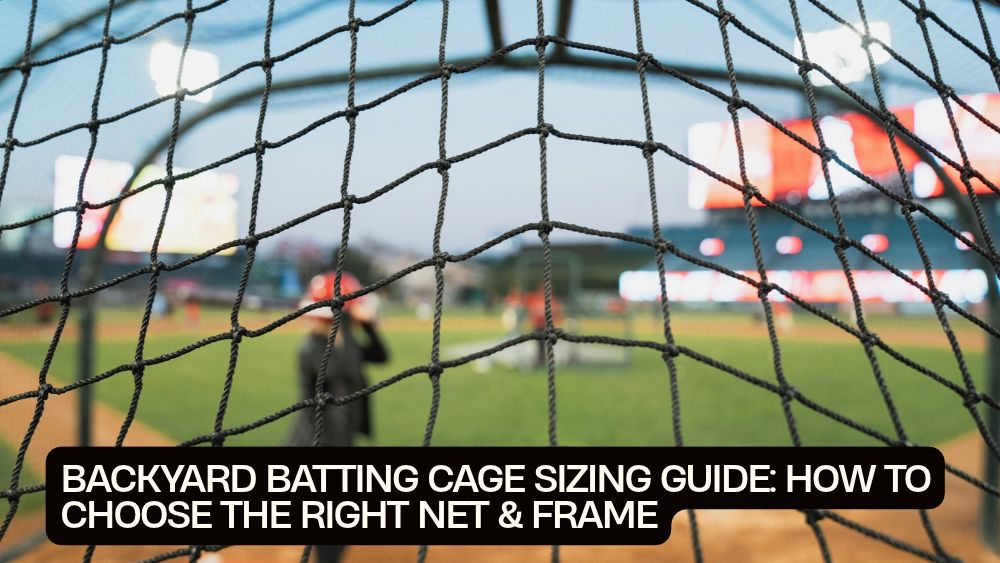
A backyard batting cage can turn a patch of open grass into a serious practice space. It gives players room to work on timing, make repeatable swings, and hit without chasing baseballs across the neighborhood.
But buying the first net that looks big enough is an easy way to waste money.
A cage that is too short limits pitching distance. One that is too narrow can interfere with a full swing. A frame that does not match the net dimensions may leave awkward gaps, poor tension, or an unstable setup.
So, what size baseball batting cage net do you need for a backyard? The answer depends on the player's age, the type of practice, and the space available.
This guide breaks down the measurements, compares common cage sizes, explains net and frame choices, and helps you plan a setup that fits your yard.
Start With the Three Essential Batting Cage Measurements
Batting cage dimensions are normally written as:
Length × Width × Height
For example, a 55 × 14 × 12 ft cage is 55 feet long, 14 feet wide, and 12 feet high.
Each measurement affects how the cage performs.
Length: How much pitching distance do you need?
Length is usually the most important measurement.
A longer cage gives the pitcher or pitching machine more room and allows the hitter to see the ball over a more realistic distance.
A short cage can still be excellent for tee work, soft toss, and controlled front toss. However, it will not provide the same practice conditions as a full-length tunnel.
Width: Can the hitter swing freely?
Width determines how much room the batter has for the swing and follow-through.
A narrow cage can work for younger players, but older players often benefit from additional width. You also need to consider whether an L-screen, pitching machine, or other training equipment will sit inside the tunnel.
Height: Will the net contain high balls?
Height helps keep line drives, pop-ups, and high swings inside the cage.
A 12-foot net is a common backyard choice. Lower nets can work for tee practice, but they offer less overhead protection for players who hit the ball high.
What Size Baseball Batting Cage Net Do You Need for a Backyard?
Most backyard buyers can begin with three common net lengths: 35 ft, 55 ft, and 70 ft.
The right option depends on how the cage will be used.
| Net size (L × W × H) | Best suited to | Typical practice |
|---|---|---|
| 35 × 12 × 12 ft | Younger players and smaller yards | Tee work, soft toss, short front toss |
| 55 × 14 × 12 ft | Youth and many family setups | Tee work, soft toss, machine practice at adjusted distances |
| 70 × 14 × 12 ft | Older players and larger yards | Longer pitching-machine sessions and more realistic pitching distances |
These are practical planning examples, not universal manufacturer specifications. Always compare the dimensions of the exact net and frame you intend to buy.
Choose 35 feet for compact practice areas
A 35-foot cage is a practical starting point when backyard space is limited.
It can support:
-
Batting tee drills.
-
Soft toss.
-
Short front toss.
-
Swing mechanics.
-
Contact practice for younger players.
It is not a full-length cage for regulation-distance pitching. Think of it as a focused hitting tunnel rather than a complete substitute for a larger training facility.
Choose 55 feet for a versatile family setup
A 55-foot cage offers more room for youth practice and can accommodate a wider range of drills.
It may suit families whose players are developing their hitting skills and use a pitching machine at a shortened distance.
It can also work for softball practice, depending on the player's level and the actual distance required.
For many homes, this is a useful balance between training space and backyard footprint.
Choose 70 feet for longer-distance practice
A 70-foot cage is worth considering when older teenagers or adults will use it regularly.
High school baseball uses a 60 ft 6 in pitching distance. A 70-foot tunnel provides more room for the hitter's area and pitching equipment than a cage that barely matches the pitching distance.
It also gives a family more flexibility as younger players grow.
The trade-off is obvious: you need a much longer, clear section of land.
Match Cage Length to the Player's Level
Age alone should not determine cage size. The player's competition level and training method matter too.
Use the following table as a planning guide.
| Player or training level | Relevant pitching distance | Practical cage direction |
|---|---|---|
| Tee work and soft toss | No pitching distance | 20–35 ft |
| Little League baseball | 46 ft for Majors | Around 55 ft |
| Little League Intermediate (50/70) | 50 ft | 55 ft minimum; more room is useful |
| High school and adult baseball | 60 ft 6 in | Around 70 ft |
| High school and college fastpitch softball | 43 ft | Around 55 ft |
League rules and age divisions can vary, so verify the actual distance used by the player's organization.
A pitching machine can often be positioned closer than regulation distance and adjusted according to its instructions. That makes shorter cages useful for machine work, but the ball speed and reaction time will differ from a full-distance setup.
Buying tip: If the oldest player in the household will use the cage, size around that player's training needs rather than choosing only for the youngest hitter.
How Wide and Tall Should a Backyard Batting Cage Be?
Length gets most of the attention, but width and height can make or break the setup.
Width: 12 ft or 14 ft?
A 12-foot width can work for younger players and tighter yards.
A 14-foot width gives older players more room for a full swing and follow-through. It can also make it easier to position an L-screen or other training equipment without crowding the hitter.
Consider the player's bat length, stance, swing path, and whether the cage will be shared by right- and left-handed hitters.
Do not assume that a wider net automatically fits a wider frame. The frame's outside dimensions may be larger than the net's listed width.
Height: Is 10 ft enough?
A lower cage may be suitable for controlled tee drills, but it leaves less room for high contact.
For general backyard use, 12 feet is a useful target when the site and frame allow it.
Before installing an outdoor cage, check for:
-
Tree branches.
-
Overhead utility lines.
-
Roof edges and nearby structures.
-
Uneven ground.
-
Other obstacles that could interfere with the frame or net.
Never install a cage where a bat, pole, cable, or raised net could contact overhead electrical wires.
Measure Your Backyard Before Ordering
The net dimensions are not the same as the total space needed for installation.
A frame may extend beyond the net, and a freestanding system may need room for anchors, guy lines, support poles, and access around the cage.
Follow this simple measuring process.
Step 1: Find the longest clear run
Use a tape measure to identify the longest uninterrupted area available.
Measure between the actual obstacles, not between approximate points on a property map.
Check for fences, trees, sheds, garden beds, driveways, and neighboring structures.
Step 2: Measure the available width
Measure across the proposed cage location.
Remember that a 14-foot net may require a wider frame footprint. Check the manufacturer's frame drawings or installation guide before deciding that the cage will fit.
Step 3: Check overhead clearance
Look above the entire installation area.
Tree limbs, roof overhangs, power lines, and other obstacles can make an otherwise suitable location unsafe.
Step 4: Account for access and anchoring
Leave room to walk around the setup, collect balls, inspect the net, and maintain the frame.
Freestanding frames may also require additional space for ground stakes or guy wires. Follow the supplied instructions rather than estimating anchor positions.
Step 5: Mark the footprint
Use stakes, string, or temporary markers to outline the proposed frame.
Walk the area and check whether the batter, pitching machine, and anyone helping with practice will have enough room.
A little planning on the lawn is much cheaper than discovering a fit problem after delivery.
Choose the Right Batting Cage Net Material
A cage net needs to contain repeated ball impacts while standing up to its environment.
The most useful specifications to compare are material, twine size, mesh construction, UV resistance, and intended use.
Polyethylene (PE)
PE netting is commonly used for outdoor sports applications.
It can be a practical option for backyard setups, but product quality depends on construction, twine thickness, mesh, and exposure conditions.
Nylon
Nylon netting is another common option. Its performance depends on the specific yarn, knotting, coating, and construction.
Do not assume that one material is automatically better for every backyard. Compare the manufacturer's stated specifications and care instructions.
What does net twine size mean?
Net listings may describe twine using numbered sizes such as #21, #36, or #42.
These numbers are product specifications, not a universal guarantee of impact strength. Compare the actual manufacturer's material and performance information rather than selecting a net from the number alone.
For frequent use, inspect the net regularly for broken strands, loose knots, abrasion, and UV-related deterioration.
Select a Frame That Matches the Net
The frame is the structure that keeps the cage in shape. It needs to support the net without creating sharp contact points or unstable sections.
Common backyard frame approaches include:
Freestanding frame
A freestanding frame can be useful when you want a defined cage structure without attaching the net to a building.
Check the frame's footprint, anchoring method, materials, and wind guidance.
Permanent post-and-cable system
A permanent system can suit a dedicated training area.
It requires careful planning for post placement, cable tension, ground conditions, and anchoring. For concrete footings or structural work, follow the frame manufacturer's engineering requirements and local building rules.
Portable frame
Portable systems are useful when the cage needs to be moved or stored between sessions.
Check how the frame is stabilized and whether the net is designed for that exact structure.
Important: A net-only product does not include a complete frame unless the listing specifically says so. Confirm the contents before ordering.
Match the Net to the Frame, Not Just the Yard
This is where many buyers make an expensive mistake.
A net can have the right length but still be incompatible with the frame.
Before buying, compare:
-
Net length, width, and height.
-
Frame inside and outside dimensions.
-
Attachment points and hanging method.
-
Cable or support requirements.
-
Door or entry opening position.
-
Ground clearance and bottom coverage.
-
Any extra netting required for the manufacturer's installation method.
The net should hang as intended by its manufacturer. Do not stretch it tightly across a frame if the instructions call for slack, and do not leave large openings where balls can escape.
Avoid allowing netting to rub continuously against rough metal edges, bolts, or other abrasive surfaces.
Explore Batting Cage Net Options at TotalFindz
If you are comparing backyard cage lengths, the TotalFindz Batting Cages & Frames collection includes several baseball and softball training products.
The collection lists VEVOR enclosed PE batting netting in three net-only lengths:
-
35 ft net: A compact option for tee work, soft toss, and shorter practice setups.
-
55 ft net: A longer option for youth training and more flexible machine practice.
-
70 ft net: A longer tunnel option for buyers planning a larger training area.
The listed batting net products include a door and carry bag. Because these are identified as net-only products, check the frame requirements and included accessories before purchasing.
The collection also includes portable baseball practice nets, backstop netting, and an L-screen. These can help build a more complete training area, depending on the player's drills and setup.
Compare the available options in the batting cage net and frame collection and match the dimensions to your measured space before choosing.
Plan for Weather, Ground Conditions, and Maintenance
An outdoor batting cage has to deal with more than baseballs.
Wind, rain, sunlight, and changing ground conditions all affect the setup.
Wind and anchoring
A large net catches wind. The frame and anchoring system must be suitable for the expected exposure.
Use the supplied anchors and follow the manufacturer's instructions. Do not assume that a few ordinary garden stakes will safely secure a large cage.
Take down or secure the equipment as directed when severe weather is expected.
Rain and drainage
Choose a location where water does not collect around the support poles.
Standing water can damage the ground, affect anchors, and make the hitting area slippery.
Sun exposure
UV exposure can gradually weaken some net materials.
Check whether the product listing specifies UV resistance and follow its care recommendations.
Routine inspection
Before practice, look for:
-
Torn or frayed netting.
-
Loose knots and attachment points.
-
Bent or damaged frame sections.
-
Loose anchors.
-
Sagging areas.
-
Openings near the ground.
-
Objects caught in the net.
Repair or replace damaged components before the next session.
Common Batting Cage Sizing Mistakes
Avoid these frequent planning errors:
-
Choosing length without considering pitching distance. A short cage is not a full-distance training tunnel.
-
Ignoring width. A cramped cage can interfere with a player's swing and follow-through.
-
Forgetting frame dimensions. The frame may need more space than the net itself.
-
Buying a net without checking the frame. Net and frame dimensions must match.
-
Ignoring overhead obstacles. Trees, roofs, and electrical lines can create serious hazards.
-
Assuming every net is weatherproof. Check the material and UV information.
-
Skipping anchoring. Wind can put significant force on a large net and frame.
-
Buying only for the current player. Consider who else will use the cage and how training needs may change.
Backyard Batting Cage Buying Checklist
Before placing an order, run through this list:
-
Measured the longest clear area.
-
Measured available width.
-
Checked overhead clearance.
-
Identified the oldest or most advanced player who will use the cage.
-
Decided between tee work, soft toss, machine practice, and live pitching.
-
Selected an appropriate net length.
-
Checked net width and height.
-
Confirmed the frame's outside footprint.
-
Verified net-to-frame compatibility.
-
Checked material, twine, and UV specifications.
-
Confirmed what is included in the package.
-
Planned anchoring and access around the cage.
-
Reviewed the installation and weather instructions.
Frequently Asked Questions
What size batting cage is best for a backyard?
A 55-foot cage is a versatile option for many youth and family setups. A 35-foot cage is useful for tee work and short toss, while a 70-foot cage is better suited to longer-distance practice for older players.
Is a 35-foot batting cage long enough?
It can be very useful for tee work, soft toss, and short front toss. It is not long enough to reproduce standard Little League or high school pitching distances.
Is a 55-foot batting cage big enough for high school baseball?
It can support tee drills and pitching-machine practice at an adjusted distance, but it is shorter than the 60 ft 6 in high school pitching distance. A 70-foot cage is generally a more suitable choice for longer-distance practice.
How much room do I need around a batting cage?
You need more room than the net dimensions suggest. Account for the frame footprint, anchors or guy lines, access, and the space needed for the batter and pitching equipment. Follow the exact frame manufacturer's site requirements.
Should I buy a net and frame together?
A matched kit can simplify compatibility, but a net-only purchase can work if you already have a suitable frame. Confirm the dimensions, attachment method, and frame requirements before ordering.
Can I leave a backyard batting cage outside all year?
That depends on the net material, frame, anchoring, local weather, and manufacturer instructions. Wind, snow, ice, and UV exposure can damage equipment. Follow the manufacturer's guidance for seasonal use and severe weather.
Build a Cage That Fits Your Practice
The right backyard batting cage is not necessarily the biggest one available. It is the one that gives the player enough room to train while fitting safely into the available space.
Start with the longest clear run in your yard. Match cage length to the player's training level, choose enough width for a comfortable swing, and allow sufficient height for the balls being hit. Then confirm that the net and frame are designed to work together.
For compact practice, 35 feet can be useful. For a flexible youth setup, 55 feet offers more room. For older players who need longer pitching-distance work, 70 feet is the stronger starting point.
Measure first, compare specifications, and plan the frame and anchoring before ordering. With the right setup, your backyard can become a dependable place to build better contact, sharper timing, and more confident swings.