A warehouse supervisor calls the loading dock. Nothing. A picker tries again from the far end of an aisle. Still nothing. Meanwhile, an event coordinator needs to reach the security team, but the radio only produces static.
When communication breaks down, small delays can quickly become operational headaches.
Choosing the right two-way radios is about more than comparing advertised mileage or buying the model with the highest power rating. You need equipment that works across your actual site, handles the environment, and gives every team member a reliable way to communicate.
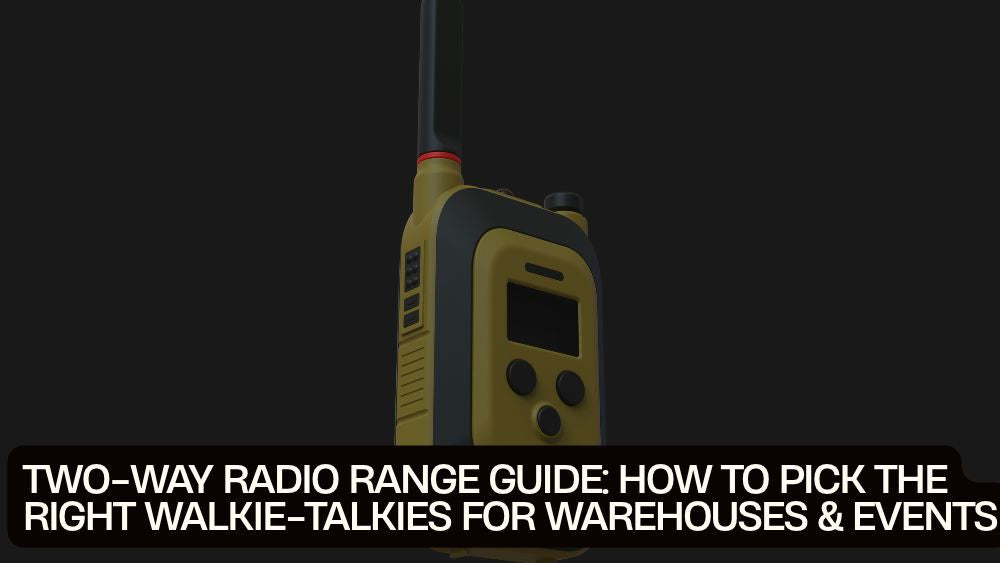
This guide explains how to choose walkie-talkies for warehouses and events, what affects real-world radio range, and how to set up a two way radio range extender for warehouse use when ordinary handheld coverage isn't enough.
How Far Can Two-Way Radios Really Reach?
Two-way radio range varies dramatically depending on the surroundings.
A pair of handheld radios may communicate over several miles in favorable open conditions but struggle to connect across a warehouse with concrete walls, steel shelving, and stacked inventory.
That's because radio range depends on several factors:
-
Transmit power and receiver sensitivity.
-
Frequency band.
-
Antenna design and placement.
-
Building materials and structural layout.
-
Terrain and surrounding obstacles.
-
Interference from other radio systems.
-
Whether communication is direct or uses a repeater.
A manufacturer's advertised range is usually based on favorable conditions. It should not be treated as a guarantee of coverage inside a busy building.
The better question is not how many miles a radio claims to cover. It's whether every person can communicate clearly from the locations where they actually work.
What Affects Walkie-Talkie Range in a Warehouse?
Warehouses are challenging radio environments. Their large open floor plans can look ideal for wireless communication, but the details tell a different story.
1. Metal shelving and loaded racks
Steel storage racks, machinery, and metal containers can obstruct or reflect radio signals.
The problem may become worse as inventory levels change. A warehouse that performs well when empty may develop dead zones once pallets, products, and equipment fill the aisles.
2. Concrete walls and multiple floors
Reinforced concrete can weaken signals significantly. Stairwells, elevators, utility rooms, and enclosed offices can create additional coverage problems.
A handheld radio that works perfectly near the main entrance may struggle in a basement or upper-level storage area.
3. Cold rooms and loading docks
Freezers, insulated panels, dock doors, and parked trailers can create difficult signal paths.
Test these locations separately instead of assuming that coverage across the main warehouse floor means the entire property is covered.
4. Radio position and antenna design
The way a person carries a radio can affect performance.
A handheld buried inside a bag, placed beneath heavy clothing, or used inside a metal forklift cabin may have a weaker connection than one held in a clear position.
For vehicle operators, a properly installed mobile radio with a suitable external antenna may be a better solution than relying on a handheld inside a metal enclosure.
UHF vs. VHF: Which Frequency Is Better?
Two-way radios commonly use UHF and VHF frequency bands. Both can work well, but the operating environment should guide your choice.
| Feature | UHF radios | VHF radios |
|---|---|---|
| Frequency range | Commonly around 400–512 MHz | Commonly around 136–174 MHz |
| Typical applications | Warehouses, buildings, hotels, retail facilities | Open outdoor areas, farms, large properties |
| Indoor use | Often a practical starting point | Can work, depending on building construction |
| Obstacles | Often preferred in dense built environments | Often useful across open areas |
| Best selection method | Test inside the actual building | Test across the actual outdoor coverage area |
For a warehouse filled with racks, equipment, and concrete partitions, UHF is often the first band worth evaluating.
For an outdoor festival, agricultural property, or open event site, VHF may be suitable depending on the terrain, equipment authorization, and available frequencies.
Neither band guarantees better range in every situation. The correct choice depends on the building, frequency authorization, antenna system, and radio configuration.
How to Choose Walkie-Talkies for Warehouse Operations
Before buying a fleet of radios, identify who needs to communicate and where they work.
A warehouse may have several teams operating simultaneously:
-
Receiving and inventory.
-
Picking and packing.
-
Shipping and dispatch.
-
Forklift operators.
-
Maintenance.
-
Security.
-
Supervisors and management.
Each role may need different radio features.
1. Choose the right radio type
For smaller facilities, conventional handheld radios may provide enough coverage.
For larger operations, consider professional business radios that support the required channels, accessories, and system infrastructure.
Digital Mobile Radio (DMR) equipment may offer features such as talkgroups, improved channel organization, and digital audio. The exact capabilities depend on the model and system configuration.
2. Check battery life
A radio that dies halfway through a shift is not a reliable communication tool.
Look for battery performance that matches your longest working period. Consider spare batteries, charging docks, and a clear charging routine for shift changes.
Check advertised battery life under realistic operating conditions, since heavy transmitting, scanning, and accessories can affect runtime.
3. Consider durability
Warehouse radios may encounter dust, bumps, moisture, and frequent handling.
Check the product's IP rating, impact-resistance claims, operating temperature range, and warranty.
For cold-storage operations, verify that both the radio and battery are suitable for the expected temperature.
4. Choose useful audio accessories
Accessories can make radios easier to use without changing the underlying coverage area.
Useful options include:
-
Remote speaker microphones.
-
Earpieces.
-
Headsets with boom microphones.
-
Belt clips.
-
Spare batteries.
-
Multi-unit charging stations.
Forklift operators and other workers who need to keep their hands available should use an approved communication setup that does not interfere with vehicle controls or safety equipment.
5. Plan channels and talkgroups
One shared channel may be enough for a small team. Larger operations often benefit from separating routine communication by department.
For example:
| Channel or talkgroup | Intended users |
|---|---|
| Channel 1 | Supervisors |
| Channel 2 | Receiving and inventory |
| Channel 3 | Picking and packing |
| Channel 4 | Shipping and dispatch |
| Channel 5 | Maintenance |
| Channel 6 | Security and emergency coordination |
This is an organizational example, not a frequency assignment. The actual channel plan must use authorized frequencies and compatible equipment.
How to Set Up a Two-Way Radio Range Extender for Warehouse Use
If handheld radios repeatedly fail in important locations, a range extender may help. However, the phrase can describe different technologies.
For professional radio systems, the most common solution is a repeater. It receives a transmission from one radio and retransmits it from a better-positioned antenna, helping extend coverage.
A repeater is not simply a universal amplifier that can be attached to any walkie-talkie. It must be compatible with the radio system, frequency plan, and applicable regulations.
Here is a practical planning process.
Step 1: Map the warehouse coverage area
Start with a floor plan.
Mark locations where employees need dependable communication:
-
Receiving bays.
-
Loading docks.
-
Storage aisles.
-
Upper-level racks.
-
Cold rooms.
-
Maintenance areas.
-
Offices.
-
Security stations.
-
Outdoor yards.
Pay particular attention to locations where communication is safety-critical.
Step 2: Test your existing radios
Before purchasing a repeater, test the current equipment throughout the facility.
Have two people perform calls from opposite ends of the warehouse. Test both directions because one radio hearing the other does not prove that the return signal works.
Record each location as:
-
Clear: Both users communicate comfortably.
-
Marginal: Communication works inconsistently.
-
Failed: One or both users cannot understand the other.
Repeat the test with racks fully loaded and normal warehouse activity underway.
Step 3: Determine whether a repeater is necessary
A repeater may be appropriate when:
-
Direct radio-to-radio communication repeatedly fails in important areas.
-
The facility has multiple floors or separated work zones.
-
A better antenna location can improve the signal path.
-
The radio system supports repeater operation.
-
The required frequencies and equipment can be legally authorized.
Sometimes a different antenna arrangement, better radio positioning, or a vehicle-mounted radio solves the problem without a full repeater installation.
Step 4: Choose a suitable repeater location
A repeater's antenna location can make a major difference.
A professional installer may evaluate:
-
Roof or elevated mounting locations.
-
Central positions within the coverage area.
-
Antenna height and orientation.
-
Cable routing and antenna-system losses.
-
Nearby sources of radio interference.
-
Building structure and potential obstructions.
Higher placement can improve coverage, but the highest possible point is not automatically the best location for every warehouse. The objective is dependable coverage across the areas that matter.
Step 5: Confirm frequency and equipment compatibility
Before installation, confirm that the handheld radios, repeater, duplexer, antenna, and programming are designed to work together.
A repeater system generally requires a suitable transmit and receive frequency arrangement, correct programming, and appropriate antenna equipment.
Do not randomly change frequencies, connect an unapproved amplifier, or transmit on an arbitrary channel to improve range.
Step 6: Arrange professional installation and compliance
A commercial repeater system may require frequency coordination, licensing, equipment authorization, and professional installation.
In the United States, many industrial and business radio systems operate under FCC Part 90 rules. The appropriate authorization depends on the service, frequency, equipment, and operation.
In Canada, radio licensing and equipment requirements are administered by Innovation, Science and Economic Development Canada (ISED). Check the applicable authorization and technical requirements before operating a repeater.
A radio dealer or qualified system integrator can help with frequency planning, programming, antenna installation, and coverage testing.
Step 7: Test the complete system
Once installed, repeat the original coverage survey.
Test calls:
-
Between the loading dock and receiving area.
-
From the far end of each major aisle.
-
Inside enclosed rooms.
-
Between floors.
-
From the warehouse to the yard.
-
From the yard back into the building.
Test with normal inventory levels and operating conditions. Document weak areas and adjust the system through the qualified installer.
A successful installation is one that passes the coverage test, not simply one that powers on.
Walkie-Talkies for Events: What Should You Look For?
Warehouses aren't the only places where reliable radio communication matters.
Festivals, conferences, sporting events, concerts, and outdoor markets often have staff spread across large areas.
Event teams may include:
-
Security personnel.
-
Stage managers.
-
Technical crews.
-
Parking attendants.
-
Guest-services staff.
-
Operations supervisors.
-
Medical and safety teams.
For event use, prioritize radios that are comfortable to carry, easy to operate, and capable of handling a full shift.
Consider the event layout
A compact indoor conference may work with conventional handheld radios. A large outdoor festival with multiple stages, parking zones, and temporary structures may require a more carefully designed coverage system.
Test communication around stages, backstage areas, ticket gates, temporary buildings, and crowded sections.
Keep communication organized
Assign channels or talkgroups to specific teams.
Give each radio a clear label or number, and provide staff with a short channel guide before the event begins.
A simple communication protocol also helps. For example, users can identify the intended team or person before delivering a message.
Plan for temporary staff
Events often involve volunteers and temporary workers who may have little radio experience.
Provide a short briefing covering:
-
How to turn the radio on and adjust volume.
-
Which channel to use.
-
How to press and release the push-to-talk button.
-
How to keep messages brief.
-
What to do if communication fails.
-
How to report an urgent situation.
Common Mistakes That Reduce Radio Range
Even a good radio system can perform poorly when users or managers overlook basic details.
Avoid these mistakes:
Buying based only on advertised miles. Open-field range claims do not predict indoor performance.
Ignoring loaded warehouse conditions. Racks and inventory can change signal paths.
Assuming more power fixes every dead zone. Antenna placement, building construction, and system design matter too.
Using incompatible repeaters. A repeater must match the radio system and authorized frequency plan.
Testing only one direction. Both users must be able to hear and understand each other.
Ignoring batteries and accessories. Poor batteries, damaged antennas, and unsuitable headsets can undermine daily operation.
Using unauthorized frequencies or boosters. Equipment and transmission must comply with the applicable US or Canadian radio rules.
Explore Two-Way Radios at TotalFindz
The right radio setup depends on your team size, coverage area, working environment, and communication requirements.
If you're comparing options for warehouse operations, events, security teams, or general business use, browse the TotalFindz two-way radio collection.
Before choosing a model, compare its frequency band, supported channels, battery capacity, audio accessories, durability rating, and compatibility with any repeater system you plan to use.
For a professional warehouse installation, confirm the equipment's regulatory authorization and whether it supports the required licensed business-radio frequencies. Don't assume that every consumer walkie-talkie can be integrated into a commercial repeater network.
Frequently Asked Questions
How far do two-way radios work inside a warehouse?
There is no universal distance. Concrete walls, steel racks, inventory, machinery, and antenna placement can reduce usable range significantly. Test the radios in the actual facility before buying a large fleet.
What is the best frequency for warehouse walkie-talkies?
UHF is often a practical starting point for warehouses because it is commonly used in built environments. However, the correct frequency must be selected according to local regulations, equipment authorization, and a site-specific coverage assessment.
Can I use a range extender with any walkie-talkie?
No. Repeaters and other range-extending equipment must be compatible with the radio service, frequency arrangement, and equipment. Some consumer radio services have restrictions that prevent the use of ordinary repeaters.
Does a repeater improve indoor radio coverage?
It can. A properly designed repeater system can improve coverage by receiving transmissions at a better antenna location and retransmitting them. However, the result depends on antenna placement, building materials, system design, and the return signal from handheld radios.
Are digital radios better than analog radios?
Digital radios can offer useful features such as talkgroups, clearer audio under certain conditions, and improved channel organization. However, digital technology does not automatically overcome concrete walls, steel racks, or poor antenna placement. Compare complete system performance rather than choosing based on digital or analog labels alone.
Do businesses need a license for two-way radios?
It depends on the radio service and country. In the United States, many professional industrial/business radio systems require FCC authorization. In Canada, ISED administers radio licensing and equipment requirements. Check the rules for the exact equipment and frequencies before transmitting.
Final Thoughts: Choose Coverage Before You Choose the Radio
The best walkie-talkie system is the one that keeps your team connected where the work actually happens.
For warehouses, start with a coverage map and test handheld radios around loaded racks, loading docks, offices, cold rooms, and outdoor yards. UHF professional radios may be a sensible starting point for dense indoor environments, while larger facilities may need a properly engineered repeater system.
For events, focus on staff distribution, clear channel assignments, battery life, audio accessories, and coverage across every operational zone.
If you need a range extender, don't buy an unverified signal booster and expect it to work with every radio. Identify the system, confirm legal frequency use, and work with a qualified installer to design and test the solution.
Explore the TotalFindz two-way radio collection to compare available options and start building a communication setup that fits your operation.