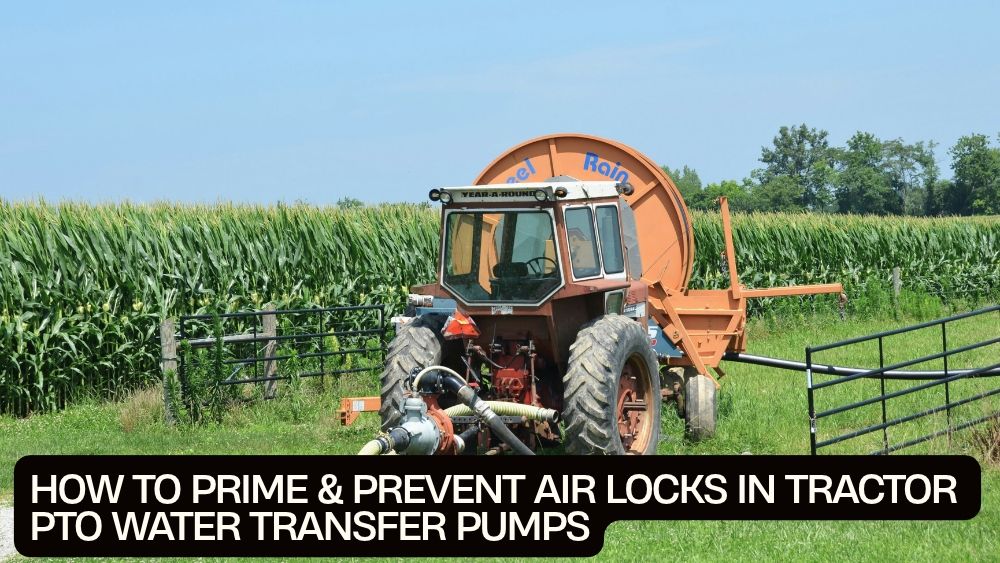
A tractor PTO water transfer pump can move a serious amount of water when everything is working properly. But when the pump loses prime, the flow can suddenly drop to a trickle or disappear altogether. The tractor may still be running, the PTO shaft may still be turning, and the pump may sound busy, yet no water reaches the discharge hose.
The culprit is often air trapped in the pump or suction line. A suction leak, a faulty foot valve, an intake hose that rises and dips, or a pump casing that was never completely filled can all interrupt water transfer.
The good news? Many priming problems can be prevented with a reliable setup and startup routine.
This guide explains how to prime a tractor PTO water transfer pump, diagnose common air-lock symptoms, and keep the suction side of the system working properly. It also covers important safety steps for PTO-driven equipment used on farms, ranches, and irrigation sites across the US and Canada.
What Causes an Air Lock in a PTO Water Transfer Pump?
An air lock occurs when trapped air prevents water from moving through the pump as intended. The exact cause depends on the pump design.
Many agricultural water transfer pumps use centrifugal pump principles. These pumps rely on a rotating impeller to create a pressure difference that moves water. If too much air remains in the pump casing or suction line, the impeller may not establish the conditions needed to draw water from the source.
A conventional centrifugal pump must be filled with water before startup. Some self-priming centrifugal pumps can evacuate air from the suction line after their priming chamber has been filled, but they still require the correct initial priming procedure. KSB explains the distinction between priming and self-priming pump designs.
Common causes of lost prime include:
-
An empty or partially filled pump casing
-
A suction hose connection that leaks air
-
A damaged or dirty foot valve
-
A suction hose that is too long or undersized
-
A blocked intake strainer
-
A suction line with high points where air becomes trapped
-
A water source that drops below the intake
-
A pump operating beyond its intended suction lift
Agricultural pump troubleshooting guidance identifies suction leaks, clogged suction pipes, excessive suction lift, and air pockets as common reasons for no water or reduced flow.
1. Understand Your Pump Before Priming
Before reaching for a bucket of water, identify the pump type.
Conventional centrifugal PTO pump
A conventional centrifugal pump generally requires the pump casing and suction line to be filled with water before it starts. If the pump sits above the water source, it may also need a foot valve or another suitable arrangement to keep the suction line full between operating cycles.
If the pump loses prime, the casing and suction line must be refilled and air removed before normal operation resumes.
Self-priming PTO pump
A self-priming pump is designed to remove air from its suction line during a priming cycle. However, it typically retains a quantity of water in a priming chamber or casing to help establish suction.
Self-priming does not mean dry-running is safe. The pump’s seal and internal components may depend on water for cooling or lubrication. The BCS water transfer pump manual, for example, instructs operators to fill the priming chamber and warns against running the pump dry.
Always check the manual for your exact pump model. Do not assume that a priming method used on one PTO pump applies to another.
2. Prepare the Tractor and Pump Safely
PTO-driven equipment can cause severe injury if the shaft or rotating components are exposed. Make safety checks part of the priming routine, not an afterthought.
Before working around the pump:
-
Park the tractor on firm, level ground.
-
Set the parking brake and place the transmission in the manufacturer-recommended position.
-
Disengage the PTO.
-
Shut off the engine and remove the key.
-
Wait for all rotating parts to stop.
-
Confirm that PTO and pump guards are installed and in good condition.
-
Secure the pump and hoses so they cannot shift or pull against the connections.
Never attempt to tighten a fitting, clear a blockage, or reach near a rotating PTO shaft while the tractor is running. Keep clothing, gloves, hair, and loose objects away from rotating machinery.
When the pump is ready to operate, follow the tractor and pump manuals for PTO engagement, operating speed, and shutdown. Do not assume that the tractor’s maximum PTO speed is appropriate for every pump.
3. How to Prime a Tractor PTO Water Transfer Pump
The exact procedure depends on whether your pump is conventional or self-priming. For a conventional centrifugal pump, the following is a general approach. Use it only when it matches the manufacturer’s instructions.
Step 1: Inspect the suction hose
Check the entire suction line from the water source to the pump inlet.
Look for:
-
Loose clamps or threaded fittings
-
Cracked hose sections
-
Damaged gaskets or O-rings
-
Kinks or flattened areas
-
A hose that is collapsing under suction
-
A blocked or dirty intake strainer
The suction line must be airtight. A fitting can draw air into the pump even if it does not visibly leak water while the system is stopped. Agricultural pump guidance recommends checking suction-side fittings, seals, strainers, and hose condition when a pump will not prime.
Step 2: Position the intake correctly
Place the suction hose inlet below the water surface, with enough submergence to reduce the chance of drawing air through a surface vortex.
Keep the strainer clear of mud, weeds, leaves, and other debris. Avoid placing it directly on the bottom, where sediment can be pulled into the pump.
Position the pump as close to the water source as practical. Shorter suction lines and lower suction lift generally make priming easier.
Step 3: Fill the pump casing
Locate the pump’s priming plug, fill port, or priming chamber.
With the PTO disengaged and the tractor shut down:
-
Open the designated priming port.
-
Fill the casing with clean water as directed by the manual.
-
Allow trapped air to escape through the designated vent, if provided.
-
Continue filling until the casing is full.
-
Reinstall the plug or close the vent securely.
Some pump designs require filling the suction line as well as the casing. Others use a foot valve to retain water in the line. Follow the manufacturer’s instructions for your setup.
Do not start the pump until the required priming procedure is complete. Conventional centrifugal pumps need water in the casing to operate properly.
Step 4: Check the discharge arrangement
Confirm that the discharge hose is connected securely and is not kinked or blocked.
Some pump manuals recommend starting with a discharge valve closed or partially restricted, while others specify a different configuration. This is pump-specific, so follow the operating instructions rather than applying one valve position universally.
A blocked discharge can also create dangerous pressure conditions. Never operate a pump against a closed valve unless the manufacturer explicitly permits that operating condition.
Step 5: Engage the PTO according to the manual
Once the pump is primed, the suction line is ready, and guards are in place:
-
Start the tractor.
-
Engage the PTO using the tractor manufacturer’s procedure.
-
Bring the pump to its specified operating speed.
-
Observe the discharge and any available pressure or flow indicators.
If the pump does not begin delivering water within the manufacturer’s expected priming period, disengage the PTO and stop the tractor. Do not keep running the pump in the hope that it will eventually catch prime.
A pump that fails to establish flow may have an air leak, a faulty foot valve, a blocked intake, excessive suction lift, or another issue requiring correction.
4. Prevent Air Locks With Better Suction-Line Design
A pump may prime successfully one day and lose prime the next if the suction plumbing allows air to enter or become trapped.
A few setup improvements can make a significant difference.
Keep the suction line short and direct
Use the shortest practical suction hose. Avoid unnecessary elbows, sharp bends, and fittings close to the pump inlet.
Long or restrictive suction lines can increase resistance and make it harder for the pump to draw water. Cornell’s agricultural pump troubleshooting guide recommends reducing suction-line length and restrictions when diagnosing poor suction performance.
Avoid high points and hose humps
A suction hose that rises and then drops can trap air at its highest point. This can make priming difficult or interrupt water flow.
Where practical, arrange the suction line so it rises steadily toward the pump without unnecessary high points. The US Forest Service’s water-handling guidance identifies humps in suction plumbing as a problem for reliable priming and recommends eliminating them where possible.
Use the correct suction hose
A suction hose must be designed to withstand the vacuum created by the pump. A standard lightweight hose may flatten or collapse, restricting water flow.
Match the hose diameter to the pump inlet and the manufacturer’s recommendations. The BCS water transfer pump manual, for example, identifies undersized or collapsed suction hose as a cause of low discharge and poor priming.
Install a suitable foot valve or check valve
A foot valve is commonly installed at the bottom of a suction line to help retain water when the pump stops. This can reduce the need to refill the suction line at every startup.
But the valve must seal properly. Dirt, sand, worn seals, or a damaged valve face can allow water to drain away and air to enter.
Use a valve that is appropriate for the pump, water conditions, and installation. A foot valve is not a universal fix for a poorly designed suction line.
5. Troubleshoot a PTO Pump That Has Lost Prime
If the pump is turning but no water is coming out, stop the equipment safely and work through the likely causes.
| Symptom | Possible cause | What to check |
|---|---|---|
| Pump runs but delivers no water | Pump casing or suction line contains air | Re-prime according to the manual |
| Pump primes, then loses prime | Suction leak or faulty foot valve | Inspect fittings, gaskets, hose, and valve |
| Water flow is weak | Blocked strainer or excessive suction lift | Clean the strainer and check pump placement |
| Flow starts and stops | Air entering the suction line or water level fluctuating | Check submergence and suction connections |
| Hose collapses | Hose is not rated for suction service | Replace with suitable reinforced suction hose |
| Pump is noisy or vibrates excessively | Air entrainment, blockage, or mechanical issue | Stop operation and inspect the system |
These symptoms can overlap. A weak flow, for example, may result from air entering the system, a blocked suction line, excessive lift, or a mechanical problem.
Do not open the pump casing or dismantle the PTO drive while the equipment is operating. If the pump continues to lose prime after the suction line and foot valve have been checked, consult the manufacturer or a qualified service technician.
6. Keep the Pump Ready Between Jobs
Preventive maintenance is often easier than repeatedly restoring prime.
After each use
-
Disengage the PTO and shut down the tractor.
-
Allow all rotating components to stop.
-
Inspect the suction strainer and remove debris.
-
Check hose connections for damage or looseness.
-
Follow the manufacturer’s instructions for draining or retaining water in the pump.
-
Store hoses without sharp bends or crushing loads.
Before seasonal use
Inspect the pump for dried or damaged gaskets, worn seals, cracked hoses, and corrosion. Reconnect any piping removed during storage using the correct seals and fittings.
Agricultural pump maintenance guidance recommends checking connections and gaskets after seasonal shutdown because dried seals can contribute to leaks when the system is returned to service.
If freezing temperatures are expected, follow the pump’s winterization instructions. Water left in the casing or plumbing may freeze and damage components.
7. Choosing a Water Transfer Pump for Your Farm
Pump selection depends on the water source, required flow, total lift, discharge distance, and available power.
A tractor PTO pump is useful when a tractor is the available power source and the pump is designed for the tractor’s PTO configuration and operating speed. An electric pump may be more suitable for a stationary irrigation, garden, or water-transfer setup with an appropriate electrical supply.
The VEVOR 1 HP shallow-well pump with automatic controller is an electric pump, listed for 115V operation, with a stainless-steel construction and automatic controller. It is not a tractor PTO-driven pump.
It may be worth considering for compatible stationary or electric water-transfer applications, but confirm its suction-lift limits, flow at the required pressure, electrical requirements, and installation instructions before purchasing. Do not treat its advertised maximum head or flow as a guaranteed operating rate for every installation.
For a PTO-driven application, select a pump specifically designed for PTO operation and verify the required shaft speed, mounting arrangement, flow, pressure, and suction conditions.
Frequently Asked Questions
Why does my tractor PTO water pump keep losing prime?
Common causes include a suction-side air leak, a foot valve that does not seal, a clogged intake, excessive suction lift, or a hose arrangement that traps air. Inspect the suction system and re-prime according to the pump manual.
Can I run a PTO water pump dry to clear an air lock?
No. Do not run the pump dry unless the manufacturer explicitly states that the specific model is designed for that condition. Many pumps rely on water for seal cooling or lubrication, and dry operation can cause damage.
Does a foot valve prevent every air-lock problem?
No. A foot valve can help retain water in the suction line, but it cannot correct every leak, blockage, excessive lift, or poor hose layout. A damaged or contaminated valve may also fail to hold prime.
Why does the pump work for a few minutes and then stop delivering water?
Possible causes include a falling water level, air entering the suction line, a suction hose restriction, or an air pocket. Stop the pump safely and check the intake, suction connections, and hose arrangement.
How can I make priming easier next time?
Keep the suction line short and airtight, use a suitable suction hose, keep the strainer clean, eliminate unnecessary high points, and use a correctly installed foot valve when appropriate. Complete the manufacturer’s priming procedure before startup.
Conclusion
A tractor PTO water transfer pump needs a reliable supply of water at its inlet to deliver consistent flow. When air gets into the casing or suction line, the pump may lose prime, struggle to draw water, or stop delivering altogether.
The most effective approach is a consistent routine: inspect the suction hose, position the intake correctly, fill the pump as specified, and engage the PTO only after priming is complete. To prevent repeat problems, keep suction connections airtight, avoid trapped-air pockets, use the correct hose, and maintain the foot valve and strainer.
If a pump repeatedly loses prime, treat it as a sign of a problem to diagnose, not a reason to keep running it. A few careful checks can protect the pump, reduce downtime, and make water transfer more dependable throughout the season.