Living in a small apartment often means every square foot has to earn its keep.
Your dining table might double as a workspace. The kitchen counter may become a temporary office. A spare corner beside the sofa can suddenly become your entire work-from-home setup.
That's where the right desk can make a noticeable difference.
A C-shaped rolling standing desk for small spaces offers something a traditional fixed desk cannot: mobility. Instead of permanently occupying one section of the room, a rolling desk can be moved when you need it and tucked away when you don't.
But does that make a mobile standing desk better than a fixed desk?
Not necessarily.
Both have advantages, and the right choice depends on your apartment layout, working habits, available storage, and how often you need to move your workspace.
In this guide, we'll compare mobile rolling standing desks vs. fixed desks, explore the benefits and limitations of each, and explain how to choose a desk that works in a compact home.
Why Desk Choice Matters in a Small Apartment
A large home office gives you plenty of freedom.
A small apartment does not.
In a compact space, furniture has to work harder. A desk that takes up several feet of floor space can make a room feel crowded, particularly when paired with an office chair and other furniture.
That's why small-space desk designs often focus on:
- Compact footprints
- Adjustable heights
- Easy movement
- Flexible placement
- Multi-purpose functionality
- Simple storage
- Vertical space efficiency
A rolling standing desk can address several of these needs at once.
Instead of treating your desk as a permanent piece of furniture, you can treat it as a movable workstation.
That distinction can be surprisingly useful.
What Is a Mobile Rolling Standing Desk?
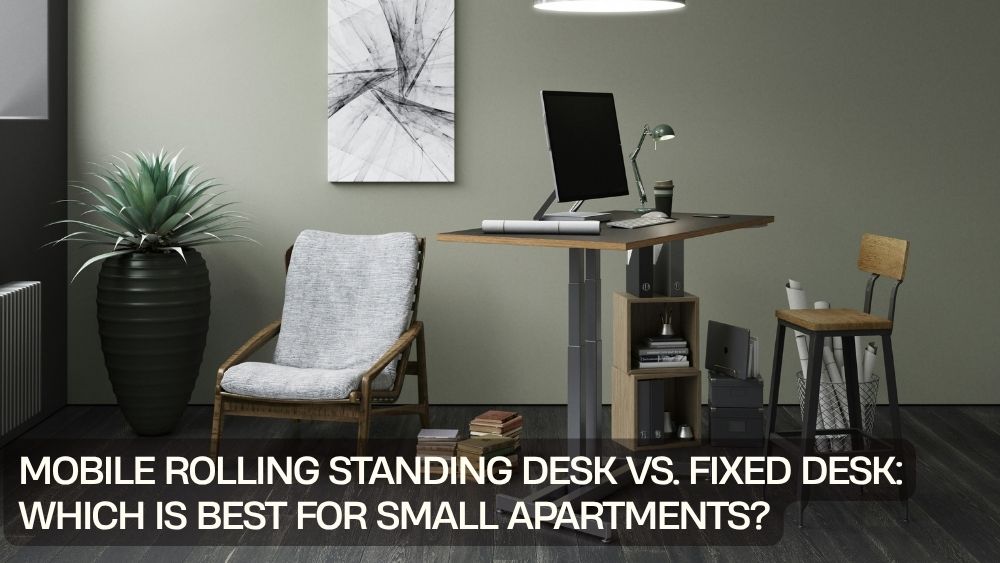
A mobile rolling standing desk is a desk mounted on wheels or casters, allowing you to move the workstation around your home.
Depending on the design, you may be able to adjust the desktop height for sitting or standing use.
A rolling desk can work beside a sofa, near a bed, against a wall, or in another suitable location.
When your workday ends, you can potentially move it out of the main living area.
This flexibility makes mobile desks particularly interesting for:
- Studio apartments
- Small bedrooms
- Home offices
- Dorm-style spaces
- Shared living spaces
- Multi-purpose rooms
- Compact work areas
Instead of dedicating an entire room to work, you can create a workstation that adapts to the room.
What Is a Fixed Desk?
A fixed desk is designed to remain in one location.
It may be a traditional writing desk, computer desk, office desk, or another stationary design.
Fixed desks can provide a stable and familiar workspace. They may also offer more surface area or integrated storage than some compact rolling models.
If you have a dedicated home office or enough floor space, a fixed desk can be a straightforward choice.
The challenge comes when your desk needs to share space with everything else.
In a small apartment, that permanent footprint can become important.
Mobile Rolling Desk vs. Fixed Desk: Quick Comparison
| Feature | Mobile Rolling Standing Desk | Fixed Desk |
|---|---|---|
| Mobility | Easy to reposition | Usually stays in one location |
| Space flexibility | High | Lower |
| Height adjustment | Often available | Depends on model |
| Small apartment use | Well suited to flexible layouts | Better when space is dedicated |
| Storage | Varies by design | Often offers more options |
| Workspace stability | Depends on wheels and construction | Typically very stable |
| Multi-purpose use | Strong | Depends on design |
| Easy relocation | Yes | Usually requires lifting |
| Best for | Flexible, compact workspaces | Permanent work areas |
The table provides a starting point, but your room layout should ultimately determine which style makes sense.
Why Choose a Rolling Standing Desk for a Small Apartment?
The biggest advantage is flexibility.
Imagine working in your living room during the morning.
At lunchtime, you want the area clear.
Instead of leaving a desk permanently beside the sofa, you can move a rolling workstation to another suitable location.
That ability to change the layout can be especially useful when a single room has several jobs.
1. Move Your Workspace When Needed
A rolling desk can travel with your routine.
You can position it near a window for natural light, move it closer to a power outlet, or shift it away when you need more open floor space.
The exact practicality depends on the desk's wheel design and your flooring.
2. Save Floor Space
A compact rolling desk can have a smaller footprint than a large traditional workstation.
This can make it easier to create a functional work area without turning the entire room into an office.
3. Create a Flexible Work-From-Home Setup
If you don't have a dedicated office, mobility can be valuable.
Your workstation can exist where you need it rather than forcing your apartment's layout to revolve around a desk.
4. Adjust Between Sitting and Standing
An adjustable-height model can offer another layer of flexibility.
You can raise or lower the desktop according to your preferred working position.
That can be useful if you alternate between sitting and standing throughout the day.
A Mobile Standing Desk Designed for Flexibility
TotalFindz offers a mobile standing desk with adjustable height, wheels, and a natural wood finish.
Mobile Adjustable-Height Standing Desk With Wheels

The combination of mobility and height adjustment makes this style worth considering for compact homes where a permanent workstation may not be practical.
You can also explore the broader writing and standing desk collection for additional desk options.
Writing & Standing Desks Collection
Before purchasing, check the product dimensions against your intended workspace, including the clearance required for the wheels and any chair or surrounding furniture.
When Does a Fixed Desk Make More Sense?
A rolling desk isn't automatically the right answer for every small apartment.
A fixed desk may be more appropriate if you have a dedicated workspace and rarely need to change the room layout.
For example, a small bedroom corner may have enough room for a compact stationary desk.
Once installed, everything stays in place.
Your monitor, keyboard, notebooks, lamp, and accessories can remain organized exactly where you left them.
That consistency can be valuable if you work at the desk every day.
Fixed Desks Can Offer More Stability
A stationary desk doesn't have wheels underneath it.
That can provide a solid, familiar working surface, particularly when typing, writing, drawing, or using equipment that benefits from minimal movement.
Fixed Desks May Provide More Storage
Many traditional desks include:
- Drawers
- Cabinets
- Shelves
- Larger desktops
- Dedicated cable-management areas
If you have a lot of office equipment, a fixed desk may provide more practical storage.
Fixed Desks Can Create a Dedicated Work Zone
There's something useful about having a clear boundary between your workspace and the rest of your home.
A permanent desk can establish that boundary.
You sit down.
You work.
You leave.
For people who have enough space, that simplicity can be appealing.
C-Shaped Rolling Standing Desk for Small Spaces
C-shaped desk designs are particularly useful when you're trying to work around existing furniture.
The shape can allow part of the base to slide closer to a sofa, chair, or bed, depending on the specific desk design.
That can make the workstation feel more integrated with your existing furniture rather than requiring a large empty rectangle of floor space.
A compact C-shaped or similarly mobile workstation can be useful for:
- Laptop work
- Reading
- Writing
- Browsing
- Studying
- Light office tasks
- Temporary workstations
Always check the exact dimensions and clearance of the product you're considering.
The word “compact” means different things in different apartments.
A desk that fits beautifully in a 600-square-foot studio may still be too large for a narrow bedroom corner.
How to Measure Your Apartment Before Buying a Desk
Before ordering any desk, grab a tape measure.
Measure the available floor area.
Then measure:
Width: How much wall or floor space can the desk occupy?
Depth: How far can the desk extend into the room?
Height: Will shelves, windows, or cabinets interfere?
Clearance: Can you comfortably move around it?
Chair space: If you plan to sit, is there enough room to pull a chair in?
Wheel clearance: If it's a rolling desk, can the casters move freely?
Don't forget doors and drawers.
A desk might technically fit in a corner but become frustrating if opening a nearby cabinet requires a geometry degree.
Think About Your Daily Routine
The best desk is often the one that fits your habits.
Ask yourself a few questions.
Do I work from home every day?
If yes, a dedicated fixed workstation may be useful.
Do I work in different rooms?
If yes, mobility becomes more valuable.
Do I need to clear the room regularly?
A rolling desk may make that easier.
Do I use multiple monitors or large equipment?
A larger fixed desk may provide more appropriate workspace.
Do I mostly use a laptop?
A compact mobile desk may provide enough surface area.
Do I alternate between sitting and standing?
An adjustable-height desk may offer greater flexibility.
Your answers can quickly narrow down the options.
How Adjustable Height Adds Flexibility
Height adjustment is another useful feature in a compact workstation.
Instead of having one fixed working height, you can position the desktop according to your preferred posture and task.
For example, you may use a lower position while seated and raise the desk when standing.
The correct height depends on your body dimensions and working setup.
Your elbows should generally be positioned comfortably when using a keyboard, while your screen should be placed so you aren't constantly bending your neck downward.
A height-adjustable desk doesn't automatically create an ergonomic setup. Monitor height, keyboard position, chair support, and working habits all matter.
How to Keep a Small Desk Organized
A compact desk can become cluttered surprisingly quickly.
A laptop.
Phone.
Charging cable.
Notebook.
Water bottle.
Coffee.
Somehow, three pens.
Suddenly you've lost the entire desktop.
Use a few simple strategies.
Keep Frequently Used Items Nearby
Only keep daily essentials on the desktop.
Use Vertical Storage
Wall shelves, pegboards, or nearby bookcases can move storage upward rather than outward.
Manage Cables
Keep charging cables organized so they don't become a tangled nest beneath the desk.
Create a Reset Routine
At the end of the workday, return the desk to a clean baseline.
This is especially useful when your workstation shares space with your living area.
Rolling Desk Safety and Stability
Mobility is useful, but it introduces an additional consideration: stability.
Before using a rolling desk, check the manufacturer's instructions for wheel locks and weight limits.
If the desk has locking casters, engage them when you want the workstation to remain stationary.
Don't overload the desktop beyond its rated capacity.
Place heavier equipment appropriately and avoid using furniture in ways it wasn't designed for.
If you're working on uneven flooring, check whether the desk remains stable in your intended location.
Common Mistakes When Choosing a Small-Space Desk
Buying Based Only on Appearance
A desk can look perfect online and still be too large for your apartment.
Measure first.
Ignoring the Depth
Width gets most of the attention, but depth can determine how much of your room the desk actually consumes.
Forgetting Storage
If you need drawers or shelves, make sure the desk provides them or plan another storage solution.
Choosing a Desk That's Too Small
Compact doesn't mean microscopic.
Make sure your laptop, monitor, keyboard, and other essentials actually fit.
Ignoring the Wheels
A rolling desk needs enough clear floor space to move.
Check the casters and intended flooring before buying.
Overloading the Desktop
Stay within the manufacturer's weight recommendations.
Which Desk Should You Choose?
The answer depends on what you value most.
A mobile rolling standing desk can be useful when flexibility, mobility, and efficient space usage are priorities.
A fixed desk can make more sense when you have a dedicated workspace and want maximum stability, storage, or a permanent setup.
For a small apartment where the living space needs to serve several purposes, mobility can be particularly valuable.
Instead of giving your desk permanent territory, you can make the workspace adapt to your day.
Frequently Asked Questions
Is a rolling desk good for a small apartment?
It can be. A rolling desk can be moved when you need additional floor space, making it useful in rooms that serve multiple purposes.
Are standing desks good for small spaces?
Compact standing desks can work well in small spaces, particularly when they have adjustable heights or a mobile design.
What is a C-shaped rolling standing desk?
A C-shaped rolling standing desk generally uses a curved or offset base designed to allow the desktop to move closer to furniture such as a sofa or chair, depending on the specific model.
Is a fixed desk more stable than a rolling desk?
A fixed desk generally provides a more stationary working surface because it does not rely on casters. A rolling desk can also be stable when properly designed, positioned, and locked according to the manufacturer's instructions.
Can a rolling desk replace a regular desk?
For laptop work, writing, studying, and other lighter tasks, a mobile desk can potentially serve as a primary workstation. People with larger equipment or extensive storage needs may prefer a traditional desk.
How do I choose a desk for a studio apartment?
Measure your available space, consider your daily work habits, determine whether you need mobility or storage, and check the desk's dimensions, height range, weight capacity, and clearance requirements.
Final Thoughts
Small apartments require smart furniture choices.
A desk doesn't have to dominate the room simply because you need somewhere to work.
A C-shaped rolling standing desk for small spaces can give you a flexible workstation that moves with your routine. You can work near the sofa, shift the desk toward another part of the room, or clear the area when your workday ends.
A fixed desk offers a different set of advantages. It can provide a stable, dedicated workspace with more storage and a consistent setup.
Neither design is universally right.
The better question is: How do you want your workspace to behave?
If you want your desk to stay put and create a permanent work zone, a fixed desk may fit naturally into your apartment.
If you want your workspace to move, adapt, and disappear from the spotlight when you're done working, a mobile rolling desk can be a practical solution.
Measure your space, consider your routine, check the specifications, and choose the design that works with your apartment rather than fighting against it.