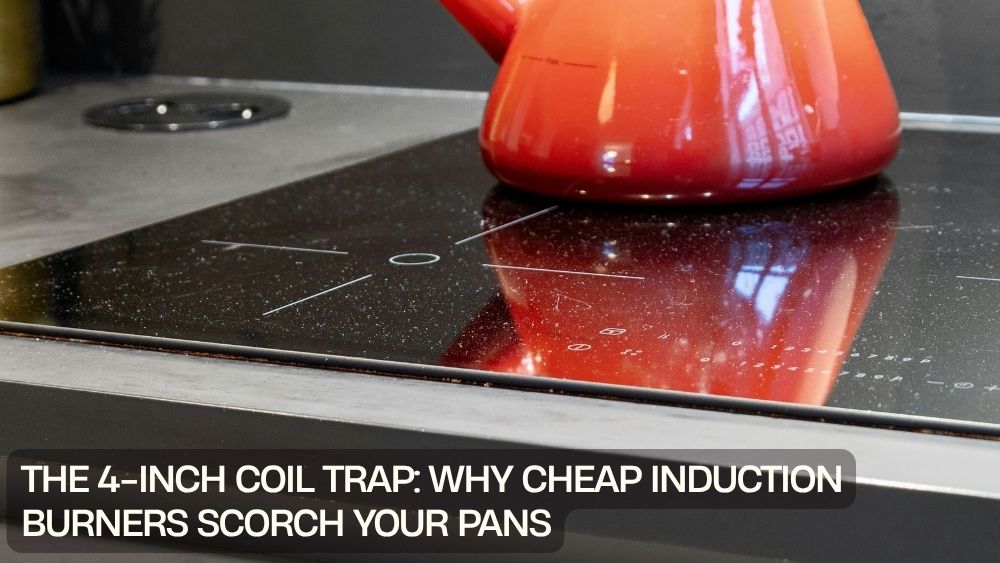
Induction cooking has a reputation for being fast, precise and wonderfully responsive.
Turn up the heat, and the pan heats quickly. Turn it down, and the cooking temperature responds without the lingering glow of a traditional electric heating element.
So why do some inexpensive induction burners still leave you with a scorching-hot spot in the center of the pan while the edges barely seem warm?
The answer may have less to do with the headline wattage and more to do with something hiding underneath the glass surface:
The induction coil.
A burner can advertise impressive power while using a relatively small heating zone. If that electromagnetic field doesn't cover enough of your pan's base, the center can receive substantially more energy than the outer sections.
The result can be uneven cooking, localized scorching and a frustrating collection of burnt centers and undercooked edges.
For anyone shopping for a Full-Surface 1800W Portable Induction Cooktop, understanding coil size and induction heating zones can help you separate useful specifications from flashy numbers.
How Does an Induction Cooktop Actually Heat a Pan?
Unlike a conventional electric burner, an induction cooktop doesn't primarily heat the cookware by making a heating element glow red-hot.
Instead, an induction system uses an electromagnetic field.
Under the glass cooking surface is a coil of conductive wire. When alternating electrical current passes through that coil, it produces a changing magnetic field.
When compatible magnetic cookware is placed above the coil, that changing magnetic field induces electrical currents within the cookware.
Those currents encounter resistance in the metal, generating heat directly in the cookware.
That's the fundamental idea behind induction cooking.
The cooktop surface itself can still become hot because heat transfers back from the pan, but the primary heating process occurs within the compatible cookware.
What's the “4-Inch Coil Trap”?
The phrase describes a common practical problem:
A cooking zone can be much smaller than the pan sitting on top of it.
Imagine placing a 10-inch frying pan over a small induction coil.
The electromagnetic field is concentrated primarily beneath the coil.
The center of the pan receives intense heating.
The outer sections extend beyond the main heating zone.
That doesn't necessarily mean the edges receive zero heat. Heat can spread through the cookware itself.
But if the pan doesn't distribute heat particularly well, the temperature difference can become significant.
That's when you get the dreaded result:
Burnt food in the middle. Pale food around the edges.
The problem isn't necessarily that induction cooking is uneven.
It can be a mismatch between coil size, cookware size and pan material.
Why Coil Size Matters More Than You Think
When shopping for a portable induction cooktop, many people immediately look at wattage.
1,800W sounds powerful.
2,000W sounds even better.
But wattage doesn't tell you how that energy is distributed across the cooking surface.
A smaller coil can concentrate a large amount of energy into a smaller area.
A larger heating zone can potentially distribute energy over a broader section of compatible cookware.
That's why two induction burners with similar wattage can behave differently with the same pan.
The heating system matters.
Can a Small Induction Coil Really Scorch a Pan?
Yes, but the outcome depends on several factors.
A concentrated heating zone can create a hot spot in the portion of the cookware directly above the coil.
The effect can become more noticeable when:
- The pan has poor thermal conductivity
- The cookware is thin
- The pan is significantly larger than the induction zone
- The heat setting is high
- The food requires frequent stirring
- The pan contains little liquid or oil
- Cooking continues for a long period
A high heat setting can make the difference especially obvious.
If the center of the pan becomes extremely hot before the rest of the cooking surface catches up, delicate foods can burn quickly.
Why Pan Material Matters
Not every pan behaves the same way on induction.
Induction cookware needs a magnetic material in the appropriate part of its construction.
Common induction-compatible cookware includes many cast iron and magnetic stainless-steel pans.
But compatibility is only the beginning.
Different materials distribute heat differently.
For example, cast iron can retain substantial heat and distribute it across the pan over time, while some thinner cookware may respond much more quickly and develop pronounced hot spots.
A good induction cooktop paired with poorly matched cookware can still produce disappointing results.
The Importance of a Flat Pan
The bottom of the pan matters too.
Induction heating works best when the cookware sits properly against the cooking surface.
A warped or severely uneven pan can create gaps between the cookware and glass surface.
Although the electromagnetic interaction doesn't work exactly like a traditional heating element transferring heat through physical contact, cookware geometry still affects practical performance, stability and how heat spreads through the pan.
For consistent cooking, use flat, induction-compatible cookware that matches the manufacturer's recommendations.
Why 1800W Is a Useful Portable-Cooktop Number
An 1800W portable induction cooktop can provide substantial heating power for many everyday cooking tasks while remaining practical for countertop use.
The important thing is to understand what the 1,800W rating actually represents.
It describes the electrical power level of the appliance under its specified operating conditions.
It doesn't mean every square inch of your pan receives identical heating power.
It also doesn't mean the cooktop will necessarily operate at 1,800W continuously in every mode.
Power can be controlled electronically, and actual energy use depends on the selected setting and cooking cycle.
Full-Surface vs. Conventional Heating Zones
The phrase full-surface induction can refer to a design where the heating area is intended to cover a broader portion of the cookware rather than relying on a very small fixed central coil.
For shoppers, the important question is not simply whether a product uses the phrase “full-surface.”
Look at what the manufacturer actually says about the heating area, cookware compatibility and control system.
If you regularly use large pans, the size and design of the heating zone can become particularly important.
A compact burner designed for small saucepans won't necessarily provide the same experience with a large skillet.
Why Large Pans Can Expose Weak Induction Designs
A large skillet is an excellent stress test for an induction burner.
The pan may have a cooking surface significantly larger than the induction coil.
When you add food across the entire skillet, the temperature can vary considerably.
The center may be aggressively hot while the outer perimeter is still warming.
This isn't unique to induction.
Gas burners and conventional electric elements can also produce uneven heating when the burner is substantially smaller than the cookware.
But induction makes coil-to-pan matching particularly important because the heating field is concentrated beneath the designated zone.
How to Prevent Scorching on an Induction Cooktop
You don't necessarily need to buy the most expensive cooktop to improve your results.
Technique matters too.
Match the Pan to the Heating Zone
Whenever possible, use cookware with a base size appropriate for the cooking zone.
If the burner is designed for a small pan, don't expect it to heat a giant skillet perfectly evenly.
Start at a Moderate Setting
Instead of immediately selecting maximum power, start at a moderate setting and allow the pan to heat.
This gives you more control and can reduce the chance of creating an extreme central hot spot.
Use the Right Cookware
Choose flat-bottomed, induction-compatible cookware with suitable construction.
Stir When Appropriate
For sauces, soups, vegetables and other foods that can be stirred, movement helps distribute heat through the food.
Don't Walk Away From High Heat
Induction can heat compatible cookware quickly.
A pan that looks calm one moment can become extremely hot shortly afterward.
What Does a 5-Burner Induction Cooktop Offer?
If you're cooking for a family or preparing several dishes at once, a multi-burner induction system can provide a very different experience from a single portable burner.
A five-burner induction cooktop, for example, allows multiple cookware pieces to be used simultaneously.
This can be particularly useful when preparing a full meal involving a main dish, side dishes and sauces.
However, multi-zone systems require you to look at how total electrical power is distributed between the burners.
A cooktop may advertise a high maximum power figure while managing available power across multiple active zones.
That's why it's worth checking the manufacturer's specifications rather than assuming every burner can continuously operate at its maximum rating simultaneously.
A 9200W Five-Burner Induction Cooktop
For shoppers looking for a larger induction setup, the VEVOR 9200W 5-Burner Induction Cooktop is an example of a multi-zone cooking system.
The product listing describes a five-burner induction cooktop with knob controls and a total stated power rating of 9,200W.
VEVOR 9200W 5-Burner Induction Cooktop

A multi-burner cooktop can be useful for households that regularly prepare several dishes at once, but shoppers should check the electrical requirements, installation or countertop-use instructions, individual zone specifications and cookware requirements before purchasing.
The product's total wattage should also be understood as a system-level specification rather than assuming every burner independently provides 9,200W.
Portable vs. Multi-Burner Induction Cooking
These two categories solve different problems.
Portable Induction Cooktop
A portable unit is useful when you need an additional cooking surface, have limited kitchen space, want a cooking option for an RV or need flexibility.
An 1800W portable induction cooktop can be particularly practical for everyday supplementary cooking.
Multi-Burner Cooktop
A multi-burner model is designed for simultaneous cooking.
It can be more appropriate for households that regularly prepare complete meals using several pans.
The choice depends on your kitchen setup and cooking habits.
How to Choose a Portable Induction Cooktop
If you're specifically looking for a Full-Surface 1800W Portable Induction Cooktop, don't stop at the wattage.
Check these specifications.
Heating Zone Size
Find out how large the actual induction zone is.
This can be one of the most important specifications when you use larger pans.
Maximum Power
Look at the maximum wattage, but understand how the cooktop manages power across settings.
Temperature Controls
Fine temperature adjustment can make delicate cooking much easier.
Cookware Compatibility
Verify that your cookware is compatible with induction.
A simple magnet test can often indicate whether a pan's base is magnetic, although you should still follow the cooktop manufacturer's compatibility requirements.
Safety Features
Look for features such as overheating protection, automatic shutoff and cookware detection when provided.
Surface Design
A smooth glass surface can make cleaning easier, particularly after sauces or oils spill during cooking.
Portability
If you plan to move the unit between rooms, take it to a second home or use it in an RV or outdoor cooking setup, consider its size and weight.
Common Induction Cooktop Buying Mistakes
Mistake 1: Buying Based Only on Wattage
A 2,000W cooktop isn't automatically better than a well-designed 1,800W model.
Mistake 2: Ignoring Coil Size
A powerful but tiny heating zone can create frustrating hot spots with large cookware.
Mistake 3: Using Oversized Cookware
A giant pan on a tiny heating zone can produce uneven results.
Mistake 4: Ignoring Cookware Construction
Induction compatibility doesn't guarantee perfect heat distribution.
Mistake 5: Using Maximum Heat for Everything
High power is useful when you need it, but many foods benefit from controlled heating rather than maximum output.
Is Full-Surface Induction Worth It?
For people who frequently cook with larger pans, the potential advantage of broader heating coverage is straightforward.
Instead of concentrating the electromagnetic heating effect into a very small area, a broader cooking zone can better match the base of appropriately sized cookware.
That can make cooking more predictable.
However, “full-surface” should never be treated as a universal performance guarantee.
Look at the actual heating-zone dimensions, cookware requirements, power distribution and control system.
The Bottom Line
The mysterious 4-inch hot spot isn't really a mystery.
When the induction coil is substantially smaller than your pan, energy can become concentrated in the area directly above the heating zone.
The center heats aggressively.
The outer sections depend more heavily on heat spreading through the cookware.
And that's when your perfectly planned dinner can become a burnt-center, raw-edge experiment.
The solution isn't simply to buy the cooktop with the biggest wattage number.
Instead, look at the heating-zone size, cookware compatibility, power control, pan construction and overall induction design.
For shoppers considering a Full-Surface 1800W Portable Induction Cooktop, these details can matter more than a giant number printed on the packaging.
A well-matched pan and heating zone can make induction cooking feel wonderfully precise.
A badly matched pair can make even a powerful cooktop feel like it has a tiny flamethrower hiding underneath the glass.
Choose the system, not just the number.