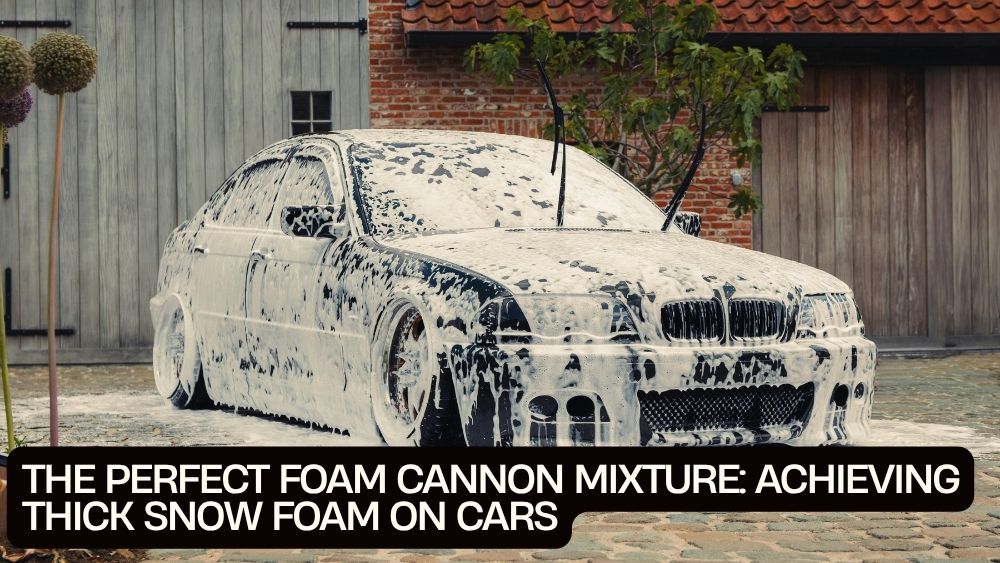
There's something deeply satisfying about covering a car in a blanket of thick, white snow foam. It clings to the hood, creeps down the doors, and turns an ordinary wash into a detailing-session highlight. But if your foam cannon produces watery suds that disappear in seconds, the problem might not be your pressure washer. It could be your soap mixture.
Getting the right foam cannon soap dilution ratio for pressure washer snow foam involves more than pouring extra shampoo into a bottle. The soap's concentration, the cannon's adjustment knob, your water supply, and your pressure washer's actual flow all influence the result.
The good news? You don't need a professional detailing setup to achieve satisfying foam at home. Start with the right mixture, make small adjustments, and follow a repeatable process.
This guide covers practical dilution ratios, measurements for common foam cannon bottles, troubleshooting tips, and how to use a pressure washer foam cannon without wasting soap or damaging your car's finish.
1. What Is the Best Foam Cannon Soap Dilution Ratio?
For many dedicated snow foam shampoos, a useful starting point is 2–4 fluid ounces of concentrate in a 32-ounce foam cannon bottle, followed by water to the appropriate fill level. That's a starting range, not a universal formula. Some concentrated products require much less, while others have specific manufacturer-recommended ratios.
Always check the label on your exact car wash soap before mixing.
Here's a simple reference for a 32-ounce bottle:
| Soap concentrate | Water to add, approximately | Starting point |
|---|---|---|
| 2 fl oz | 30 fl oz | Lighter mixture |
| 3 fl oz | 29 fl oz | Middle starting point |
| 4 fl oz | 28 fl oz | Richer mixture |
These amounts assume the bottle holds 32 fluid ounces in total. Follow your bottle's fill markings and leave room for the cannon head if the design requires it.
Important: The ratio inside the bottle is not the same as the final dilution reaching your car. The foam cannon draws the premixed solution and combines it with additional water and air as it sprays. That means two setups using the same bottle mixture can produce different foam.
What if your soap label specifies a different ratio?
Follow the product's directions first. A dedicated snow foam concentrate may be formulated differently from ordinary car shampoo, so using the same amount of each product will not necessarily give the same results.
For instance, a product that calls for 100 mL of concentrate per 900 mL of water uses a 1:9 soap-to-water ratio. Another shampoo may recommend a substantially weaker mixture.
Don't assume that more soap always means better cleaning. Excess concentrate can waste money, make rinsing harder, and leave residue if the product isn't rinsed away properly.
2. How to Mix Snow Foam for a Pressure Washer
Once you've checked the soap label, mixing the solution is straightforward.
Step 1: Choose a foam-cannon-compatible car shampoo
Look for a product specifically intended for foam cannons or pressure-washer pre-washes. If you want to preserve existing wax, sealant, or ceramic protection, check that the shampoo is suitable for your paint-protection system.
Avoid substituting household dishwashing liquid or an unapproved all-purpose cleaner. A thick-looking foam is not worth risking damage to paint, trim, coatings, or other vehicle surfaces.
Step 2: Add water before the concentrate
Pour the appropriate amount of water into the reservoir first, then add the measured shampoo. This helps reduce excessive suds forming inside the bottle before you start spraying.
Use clean, preferably lukewarm water if the soap and equipment instructions permit it. Avoid hot water unless the product specifically allows it.
Step 3: Measure the concentrate
Use a measuring cup or the bottle's marked scale instead of guessing. Small differences can affect the results, especially when using a concentrated product.
If the label recommends 3 ounces, start there rather than immediately doubling the amount.
Step 4: Mix gently
Secure the lid and gently swirl the solution if needed. Avoid vigorous shaking that fills the reservoir with foam before it reaches the cannon.
Step 5: Attach the foam cannon securely
Follow the pressure washer and foam cannon instructions for connecting the accessory. Check that the connector is compatible, the seal is seated correctly, and the attachment is locked in place.
Never point the nozzle at people, animals, electrical equipment, or delicate surfaces.
Step 6: Test one panel
Apply foam to a small section and check the consistency, coverage, and cling time. If the result is too watery, adjust one variable at a time rather than changing the soap ratio, nozzle, and pressure settings simultaneously.
That makes it much easier to identify what actually improved the foam.
3. Why Does Snow Foam Need to Be Thick?
Thick snow foam is popular because it coats the vehicle visibly and can remain on vertical panels longer than a very runny mixture. During a pre-wash, the detergent helps loosen and lift some surface contamination before you make contact with the paint.
However, foam thickness alone doesn't determine cleaning performance.
A fluffy blanket that looks impressive on camera may not clean better than a less dramatic foam with an effective detergent formula. What matters is the product's cleaning ability, its suitability for your vehicle, how well it clings, and whether you rinse and wash correctly.
Snow foam is generally a pre-wash step, not a complete substitute for contact washing. Stubborn road film, oily contamination, and bonded dirt may remain after rinsing. A suitable wash mitt and car shampoo may still be needed to clean the vehicle thoroughly.
The goal is to loosen dirt before contact, reducing the chance of dragging grit across the paint.
4. Five Factors That Affect Foam Cannon Performance
If you have measured the mixture correctly but still aren't getting the desired result, look beyond the soap bottle.
1. The shampoo formula
Not all car shampoos are designed to produce thick foam through a pressure washer. Dedicated snow foam products are formulated for that use, while some ordinary bucket-wash shampoos may produce less impressive results.
Before increasing the concentration, make sure the product is appropriate for the equipment.
2. Water hardness
Hard water contains minerals such as calcium and magnesium that can interfere with the performance of some cleaning products. Depending on your local water supply and the shampoo formula, foam may appear less dense or rinse differently.
If you suspect hard water is affecting your results, try a suitable filtered or softened water source if practical. Change only the water source during the test so you can compare results fairly.
3. The foam cannon's adjustment knob
Many foam cannons include a control that adjusts the amount of soap solution drawn into the spray. Depending on the model, turning the control in one direction increases detergent flow, while turning it the other way reduces it.
Check the markings and manual for your particular cannon. Make a small adjustment, spray a test area, and compare.
Opening the control fully is not always the best setting. Too much solution can waste concentrate without delivering a useful improvement.
4. The nozzle and orifice
The foam cannon's internal orifice influences how the pressure washer and cannon work together. A poorly matched or obstructed orifice can affect foam quality and spray consistency.
Use the manufacturer's recommended nozzle and orifice for your pressure washer's actual operating specifications. Don't assume that every cannon is compatible with every pressure washer simply because the connectors fit.
If the cannon pulses or the washer behaves unusually, stop and check the compatibility instructions instead of forcing it to run.
5. Pressure washer flow rate
Pressure and flow are related but different measurements. PSI describes water pressure, while gallons per minute (GPM) describes the volume of water delivered.
A pressure washer advertised with a high maximum PSI rating may not operate at that pressure during every task. Actual output depends on the machine, nozzle, water supply, and operating conditions.
A foam cannon needs a suitable combination of pressure and flow to create the intended spray. If your setup is underperforming, check the washer's operating specifications and the cannon manufacturer's compatibility guidance before buying a stronger machine.
5. How to Get Thick Snow Foam Without Wasting Soap
You don't need to fill the reservoir with concentrate to achieve a satisfying result. Use a controlled process and let the equipment do its job.
Start with the recommended mixture. Follow the shampoo label and test the solution on one panel.
Adjust in small increments. If the foam is too thin, increase the concentrate slightly or adjust the cannon's soap control. Avoid making several changes at once.
Use the correct accessory. Confirm that your foam cannon is compatible with your pressure washer and that the internal parts are clean.
Work in suitable conditions. Wash in shade when possible and avoid letting detergent dry on the paint. Hot panels and direct sunlight can shorten working time and make rinsing more difficult.
Use enough product to cover the vehicle evenly. You want useful coverage, not an unnecessarily heavy layer that drains straight onto the driveway.
Rinse thoroughly. Follow the shampoo instructions and rinse all treated areas before the product dries.
The sweet spot is the lowest practical concentration that delivers adequate coverage and cleaning for your setup. That saves product and makes your routine easier to repeat.
6. Step-by-Step: Using a Foam Cannon to Wash Your Car
Once the mixture is ready, follow this process for a typical home wash.
Step 1: Park in the shade
Work on a cool surface whenever possible. Avoid applying detergent to hot paint or allowing it to dry before rinsing.
Step 2: Rinse away loose dirt
Use the pressure washer to remove loose grit, mud, and debris before applying snow foam. Maintain a safe distance and use a suitable nozzle for automotive surfaces.
High-pressure water can damage paint, seals, tires, and trim if used too aggressively or from too close.
Step 3: Apply foam evenly
Cover the vehicle in a consistent layer, following the foam cannon's operating instructions. Work methodically so you don't leave one section sitting with detergent while you continue spraying the rest.
Step 4: Allow the recommended dwell time
Let the foam work for the period specified by the product manufacturer. The exact time depends on the shampoo, conditions, and surface.
Do not allow the product to dry on the vehicle.
Step 5: Rinse thoroughly
Remove the foam and loosened dirt with the pressure washer. Pay attention to panel gaps, mirrors, trim, and other areas where residue can collect.
Step 6: Contact-wash if needed
For a thorough maintenance wash, use a clean wash mitt and suitable car shampoo after the pre-wash, unless the product instructions specify a different process.
Use clean washing equipment and avoid dragging dirt back across the paint.
Step 7: Dry with clean materials
Dry the vehicle using a clean, paint-safe microfiber drying towel or another suitable method. This helps reduce water spots and avoids reintroducing contamination.
Step 8: Flush the foam cannon
When finished, follow the cannon's instructions to flush detergent from the internal components, commonly by running clean water through the system where the design allows it. This helps prevent residue buildup and keeps the accessory ready for the next wash.
7. Troubleshooting: Why Is My Foam Cannon Producing Watery Foam?
Use this quick guide when the results don't match your expectations.
| Problem | What to check | Practical fix |
|---|---|---|
| Foam is very watery | Soap type and dilution | Use a compatible snow foam product and verify the label ratio |
| Foam disappears quickly | Surface temperature and product dwell characteristics | Work in shade and follow the recommended dwell time |
| Foam output is weak | Cannon adjustment and pressure washer compatibility | Check the settings and specified operating range |
| Spray pulses or surges | Orifice compatibility, water supply, or washer behavior | Stop and inspect the manual and connections |
| Soap remains after rinsing | Concentration and rinsing technique | Use the recommended ratio and rinse thoroughly |
| Cannon draws little or no soap | Reservoir pickup tube, filter, or blockage | Inspect and clean components according to the manual |
A key troubleshooting rule: don't blame the dilution ratio automatically. If the product is correct and the measured mixture matches the label, an equipment issue may be responsible.
8. Choosing a Pressure Washer for Snow Foam
If you wash your car regularly, a pressure washer with a compatible foam cannon can make pre-washing more convenient.
TotalFindz offers the VEVOR Electric Pressure Washer, Max 4500 PSI and 3.2 GPM, with Nozzles and Foam Cannon.

The product listing identifies it as an electric pressure washer supplied with nozzles and a foam cannon. Before using it for automotive washing, review the manufacturer's operating instructions and confirm that the supplied accessories and settings are suitable for your vehicle.
Keep these considerations in mind when comparing pressure washers:
-
Operating pressure: Maximum advertised PSI is not necessarily the pressure you'll use for every cleaning task.
-
Water flow: GPM influences how much water the machine delivers and affects accessory performance.
-
Foam cannon compatibility: Confirm the connector, orifice, and recommended operating range.
-
Pressure control: Adjustable output can help you choose an appropriate setting for different cleaning jobs.
-
Maintenance: Follow the instructions for water supply, detergent use, storage, and flushing the equipment after use.
For car washing, higher pressure isn't automatically better. Correct technique, a suitable nozzle, safe working distance, and compatible detergent matter just as much as the headline specifications.
Frequently Asked Questions
What is the best foam cannon soap dilution ratio for a pressure washer?
For many dedicated snow foam products, 2–4 fluid ounces in a 32-ounce reservoir is a reasonable starting range. However, the manufacturer's instructions take priority because formulations vary.
Can I use regular car shampoo in a foam cannon?
Some regular car shampoos work in foam cannons, but the results vary. A product specifically designed for foam cannon use is generally the better starting point for thick, clinging snow foam.
Does more soap make thicker foam?
Not always. Increasing the concentration can help when the mixture is too weak, but excessive soap may waste product or make rinsing harder. Adjust the mixture gradually.
Why does my foam cannon produce watery foam even with a strong pressure washer?
Possible causes include the wrong shampoo, an unsuitable dilution, the cannon's adjustment setting, water hardness, a blocked component, or a mismatch between the cannon and the washer's operating flow.
Should I rinse the car before applying snow foam?
For most pre-wash routines, rinsing first removes loose dirt and grit. Follow the directions for your specific product, particularly if it specifies a particular application method.
How long should snow foam stay on the car?
Follow the shampoo manufacturer's recommended dwell time. Never allow the foam to dry on the paint, especially in warm weather or direct sunlight.
Final Verdict: The Best Snow Foam Starts With the Right Mix
The secret to thick snow foam isn't an overflowing bottle of soap. It's a compatible shampoo, a measured dilution, correctly adjusted equipment, and a consistent washing process.
Start with the product label, test a small area, and change one variable at a time. If the foam remains watery, investigate the cannon settings, water supply, and pressure washer compatibility before pouring in more concentrate.
With the right setup and careful technique, you can build a repeatable car-washing routine that produces satisfying foam, helps loosen surface dirt, and avoids unnecessary product waste.