
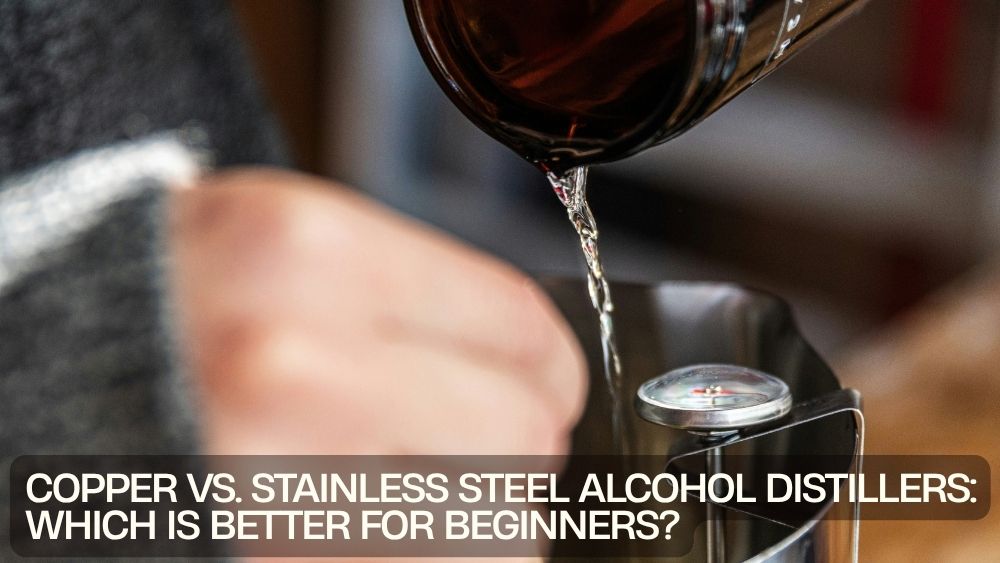
Choosing equipment is one of the first big decisions for anyone exploring distillation. And when the conversation turns to copper vs. stainless steel alcohol distillers for beginners, two materials dominate the discussion.
Copper has an old-school reputation for a reason. It has been used in traditional distilling equipment for generations and is valued for its heat-transfer properties and chemical interactions with certain compounds.
Stainless steel takes a different approach. It is durable, relatively easy to maintain, resistant to corrosion, and well suited to modern equipment designs.
So which material makes more sense for a beginner?
The answer depends on what you value most. Copper brings traditional appeal and useful chemistry, while stainless steel generally emphasizes durability, straightforward maintenance, and long-term practicality.
Before choosing any equipment, however, check the laws that apply where you live. In the U.S. and Canada, regulations around producing distilled spirits can differ depending on the jurisdiction and intended use. Distillation equipment can also involve significant heat, pressure, flammable vapors, and other hazards.
With that groundwork in place, let's compare the two materials.
Copper vs. Stainless Steel: The Quick Comparison
| Feature | Copper | Stainless Steel |
|---|---|---|
| Traditional distilling use | Excellent | Good |
| Durability | Good | Excellent |
| Corrosion resistance | Moderate | Excellent |
| Maintenance | Higher | Lower |
| Heat transfer | Excellent | Good |
| Ease of cleaning | Good | Excellent |
| Appearance | Traditional | Modern |
| Flavor chemistry | Can interact with sulfur compounds | Generally more chemically neutral |
| Long-term practicality | High | Very high |
| Beginner appeal | Traditional experience | Straightforward maintenance |
Neither material is automatically "better" in every situation.
Instead, think about the kind of equipment experience you want.
Why Copper Has Such a Strong Reputation
Copper and distillation have a long relationship.
Traditional stills are frequently associated with copper because the material transfers heat efficiently and can interact with certain unwanted sulfur-containing compounds.
That chemistry is particularly relevant to the character of distilled spirits.
Copper surfaces can help reduce certain sulfur compounds that may contribute undesirable aromas or flavors. This is one reason copper remains important in traditional distilling equipment.
But there is a catch.
Copper is not completely maintenance-free.
Over time, it can tarnish, develop deposits, and require more attention than stainless steel. Its surface can also react with certain materials and compounds.
For a beginner who enjoys traditional craftsmanship and does not mind additional maintenance, that may be perfectly acceptable.
For someone looking for a low-maintenance piece of equipment, stainless steel may be more attractive.
Why Stainless Steel Is Popular
Stainless steel is the modern workhorse.
Food-grade stainless steel is widely used in kitchens, commercial food processing, brewing equipment, and other applications where durability and sanitation matter.
Its biggest advantages are straightforward:
- Strong construction
- High corrosion resistance
- Easy cleaning
- Long service life
- Modern appearance
- Generally low maintenance
A stainless-steel vessel can also be easier to integrate into equipment designed for repeated cleaning and storage.
For beginners, this simplicity matters.
There is something appealing about equipment that does not demand constant polishing or special care simply to keep its surface looking good.
Copper vs. Stainless Steel for Beginners: What About Flavor?
This is where the comparison becomes more interesting.
Copper can interact with sulfur compounds during distillation. In the right context, that chemistry can contribute to a cleaner sensory profile.
Stainless steel is much more chemically neutral.
That does not mean stainless steel automatically produces inferior results. Spirit character depends on many variables, including the original fermented material, equipment design, separation characteristics, aging, and other factors.
The material is only one piece of the puzzle.
Think of copper as an active participant in the chemistry, while stainless steel is more of a neutral stage.
Neither description tells you everything about the finished spirit.
Heat Transfer: Copper Has the Edge
Copper conducts heat more efficiently than stainless steel.
That is one reason copper has remained popular in traditional thermal equipment.
Efficient heat transfer can help equipment respond more quickly to changes in heating conditions and can contribute to more uniform thermal behavior.
Stainless steel conducts heat less efficiently, but that does not make it unsuitable.
Modern stainless-steel equipment can incorporate thoughtful vessel designs, heating systems, insulation, and other engineering features that compensate for the material's lower thermal conductivity.
So while copper has a clear material advantage in heat transfer, the performance of an actual piece of equipment depends on its entire design.
Durability: Stainless Steel Takes the Lead
If durability is near the top of your checklist, stainless steel has an obvious appeal.
Quality stainless steel can withstand repeated use and cleaning while resisting corrosion better than many other metals.
That makes it particularly attractive for equipment that will spend years in a workshop, kitchen, garage, or dedicated hobby area.
Copper is durable too, but it generally requires more attention.
Scratches, oxidation, discoloration, and surface deposits are part of the ownership experience.
Some people appreciate that traditional character. Others would rather spend their time maintaining the equipment as little as possible.
Maintenance and Cleaning
This is an important consideration that beginners sometimes overlook.
Distillation equipment should be kept clean and maintained according to the manufacturer's instructions. Residue can accumulate in equipment, and improper cleaning can create contamination or equipment problems.
Copper
Copper equipment typically requires more attention to its surface.
Depending on the design and manufacturer's instructions, owners may need to monitor discoloration, deposits, and corrosion.
Copper can also react with certain cleaning chemicals, so using an inappropriate cleaner can damage the material.
Stainless Steel
Stainless steel is generally easier to maintain.
Its corrosion resistance and smooth surfaces make cleaning relatively straightforward when the equipment is designed appropriately.
However, stainless steel is not indestructible.
Harsh chemicals, abrasive cleaning tools, chloride exposure, and poor maintenance can still damage stainless surfaces.
The lesson is simple: easy-care does not mean no-care.
What About a Stainless-Steel Distiller Kit?
For beginners who prioritize durability and straightforward maintenance, stainless-steel equipment can be an appealing starting point.
For example, TotalFindz offers a 70L stainless-steel water and alcohol distiller kit constructed around 304 stainless steel and featuring a thermometer.

The broader takeaway is more important than the individual product: when evaluating equipment, look beyond the word "stainless."
Pay attention to the stated material grade, construction quality, seals, fittings, thermometer placement, manufacturer documentation, and cleaning requirements.
A well-designed piece of equipment matters more than simply choosing one material over another.
304 Stainless Steel vs. Copper
If you're shopping for stainless equipment, you may encounter grades such as 304 stainless steel.
304 is a common stainless-steel grade used in food and beverage applications because of its corrosion resistance and general durability.
Copper, meanwhile, is valued for its thermal conductivity and traditional use in distilling.
The comparison therefore looks something like this:
304 stainless steel: durability, corrosion resistance, easier maintenance.
Copper: thermal conductivity, traditional construction, interaction with certain sulfur compounds.
Neither material eliminates the need for appropriate equipment design and safe handling.
Does More Copper Mean Better Equipment?
Not necessarily.
A common mistake is assuming that an equipment label containing "copper" automatically makes the entire system superior.
The actual design matters.
Ask:
- Where is the copper located?
- What parts contact the vapor or liquid?
- What is the construction material elsewhere?
- How easy is the equipment to clean?
- Are replacement parts available?
- Are seals and fittings appropriate for the application?
- Does the manufacturer provide clear specifications?
- Is the equipment designed for the intended use?
A small copper component and an extensively copper-built system are not equivalent.
The same logic applies to stainless steel.
A product described as stainless steel should still be evaluated for its actual construction and component quality.
Beginner Buying Checklist
Before purchasing any distillation equipment, consider these questions.
1. What is the equipment legally intended for?
Rules concerning distilled spirits vary by location and intended use.
Do not assume that owning equipment means you are legally permitted to produce beverage alcohol.
Check applicable federal, state, provincial, and local requirements before proceeding.
2. What material is actually used?
Look for specific material information rather than vague claims such as "premium metal."
For stainless steel, the stated grade can provide useful information.
3. How easy is it to clean?
Look for accessible surfaces, removable components where appropriate, and clear manufacturer cleaning guidance.
4. How durable are the fittings?
Connections, seals, valves, and other components deserve attention.
A strong vessel with poorly designed fittings is still a poorly designed system.
5. Is there clear documentation?
Good documentation matters.
Look for specifications, warnings, compatible components, maintenance information, and manufacturer instructions.
6. Are replacement components available?
Long-term ownership becomes easier when seals, fittings, and other wear components can be replaced rather than requiring complete equipment replacement.
Safety Matters More Than Material Choice
Copper versus stainless steel is an interesting comparison, but safety should sit above the material debate.
Distillation can involve:
- High temperatures
- Hot liquids and surfaces
- Flammable alcohol vapors
- Fire hazards
- Pressurized or restricted systems
- Potentially hazardous chemical exposure
Equipment should never be operated outside its intended design or with blocked outlets.
Improvised modifications can also introduce risks that the original equipment was never designed to handle.
Always follow the manufacturer's safety instructions and applicable laws.
For beginners, the most useful equipment feature may therefore be neither copper nor stainless steel. It may be clear documentation and a design that is easy to inspect and maintain.
Copper or Stainless Steel: Which Fits Your Priorities?
Rather than searching for a universal winner, start with your priorities.
Choose copper when you prioritize:
- Traditional equipment design
- Excellent thermal conductivity
- Copper's interaction with certain sulfur compounds
- Traditional craftsmanship
- A willingness to perform more maintenance
Consider stainless steel when you prioritize:
- Durability
- Corrosion resistance
- Easier maintenance
- Straightforward cleaning
- Modern equipment construction
- Long-term practicality
There is also a middle ground.
Some equipment combines stainless-steel construction with copper components. This approach can offer some of the practical benefits of stainless steel while incorporating copper where its properties are useful.
The Hidden Factor: Equipment Design
Material gets most of the attention, but engineering can matter just as much.
Two pieces of equipment made from the same grade of stainless steel can behave very differently if their designs differ.
Look at vessel geometry, connections, seals, heat management, instrumentation, accessibility, and overall construction.
The same applies to copper equipment.
A beautifully polished copper vessel is not automatically well designed.
For beginners, a sensible evaluation process is:
Material → construction → documentation → maintenance → safety → legal suitability
That order prevents shiny marketing from becoming the main decision-maker.
Common Beginner Mistakes
Buying based on appearance
Copper looks fantastic.
Stainless steel looks professional.
Neither appearance tells you whether equipment suits your needs.
Ignoring maintenance
Every metal has maintenance requirements.
Plan for cleaning and inspection before buying.
Assuming one material guarantees better flavor
Spirit character depends on far more than vessel material.
Forgetting replacement parts
A product that is inexpensive initially can become frustrating if essential seals or fittings cannot be replaced.
Ignoring local regulations
This is the biggest non-equipment issue.
Distilled spirits are regulated differently from many fermented beverages, so verify the rules applicable to your location and intended activity.
Final Verdict: Copper vs. Stainless Steel for Beginners
The alcohol distiller copper vs. stainless steel beginner debate does not have one universal answer.
Copper offers excellent thermal conductivity and a long traditional history in distilling. Its interaction with certain sulfur compounds is another important reason it remains relevant.
Stainless steel offers durability, corrosion resistance, easier maintenance, and a practical modern approach.
For many beginners, the deciding factor should therefore be less about which metal has the better reputation and more about which equipment design matches their priorities, maintenance habits, budget, and legally permitted use.
If low maintenance and durability are high on your list, stainless steel deserves serious consideration. If traditional construction and copper's chemical properties are important to you, copper may be more appealing.
Either way, look beyond the metal.
A good piece of equipment should be clearly specified, appropriately constructed, maintainable, and accompanied by reliable safety documentation. The best beginner purchase is the one that makes responsible ownership easier, not simply the one with the shiniest surface.

