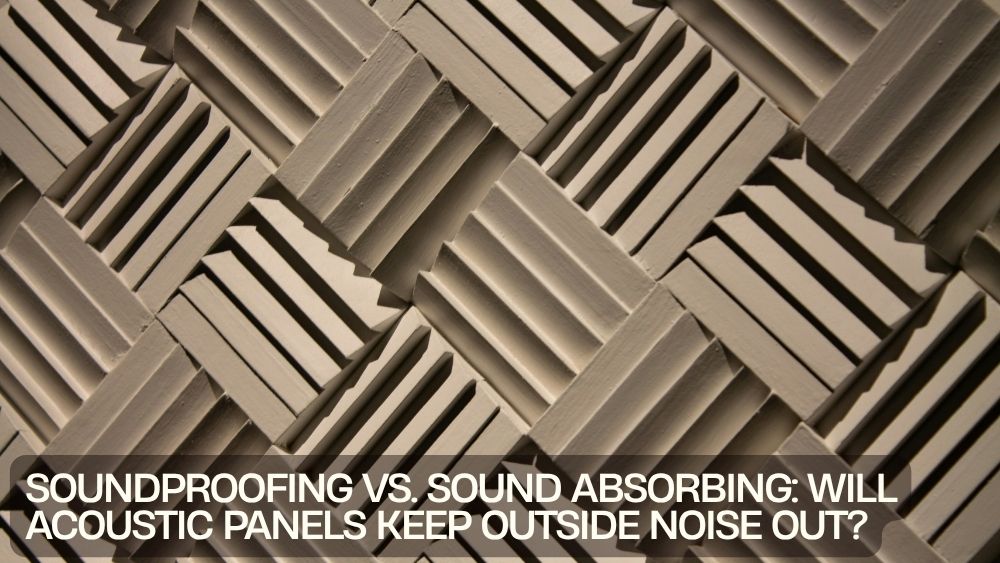
You install acoustic panels on a wall expecting peace and quiet.
Then the neighbor's dog barks.
A truck rolls past.
Someone starts mowing the lawn.
And suddenly you're wondering: do acoustic panels keep noise out or just reduce echo?
Usually, acoustic panels are much better at controlling sound inside a room than stopping sound from entering or leaving it.
That distinction is the key to understanding acoustic treatment.
Acoustic panels can dramatically change how a room sounds. They can reduce reflections, tame echo, improve speech clarity, and make music or video calls easier to hear. But conventional acoustic panels are not automatically soundproofing barriers.
Soundproofing is a different engineering problem.
The good news is that once you understand the difference, it becomes much easier to choose the right solution for your room.
Acoustic Panels vs. Soundproofing: The Short Answer
Here is the simplest way to think about it:
Sound absorption controls reflections inside a room.
Soundproofing reduces the amount of sound passing through walls, ceilings, floors, doors, windows, and other building elements.
An acoustic panel is typically designed to absorb some of the sound energy that reaches its surface.
A soundproofing assembly is designed to resist sound transmission.
Those are two very different jobs.
So if your main problem is:
"My room sounds echoey."
Acoustic panels may help considerably.
If your problem is:
"I can hear traffic through my window."
Acoustic panels attached to the interior wall are unlikely to solve the main problem.
You may need to address the actual transmission path.
What Does Sound Absorption Mean?
Sound absorption happens when a material takes in some of the acoustic energy rather than reflecting all of it back into the room.
Hard surfaces such as glass, concrete, tile, and bare drywall can reflect sound strongly.
When many reflections bounce around a room, you may hear:
- Echo
- Reverberation
- Harshness
- Boomy sound
- Poor speech clarity
- Excessive room ambience
Absorptive materials can reduce those reflections.
This can make the room feel acoustically calmer without necessarily making it quieter from the outside.
Think of absorption as managing the sound already inside the room.
What Does Soundproofing Mean?
Soundproofing is about reducing sound transmission between spaces.
Imagine a bedroom next to a busy street.
Traffic noise enters through a combination of possible paths:
- Windows
- Doors
- Wall assemblies
- Ceiling
- Floor
- Air gaps
- Electrical penetrations
- Plumbing openings
- Structural connections
Adding an acoustic panel to the bedroom wall may absorb some of the sound that reaches the room.
But the panel does not necessarily stop the traffic noise from passing through the building envelope.
That is why soundproofing often requires construction changes rather than simply adding soft materials to the wall.
Do Acoustic Panels Keep Noise Out or Just Reduce Echo?
For most conventional acoustic panels, the answer is:
They primarily reduce echo and reflected sound.
They can make outside noise seem less prominent in some situations because they reduce the room's reverberation.
But that is not the same thing as blocking the source.
Imagine a truck passing your house.
The sound enters the room.
Without acoustic treatment, the direct sound combines with reflections from the walls, ceiling, floor, and furniture.
With absorptive panels, some of those reflections are reduced.
The truck has not necessarily become quieter at the wall.
Your room has simply become less acoustically reflective.
That distinction is crucial.
Sound Absorption vs. Soundproofing
| Feature | Sound Absorption | Soundproofing |
|---|---|---|
| Main goal | Reduce reflections | Reduce sound transmission |
| Helps control echo | Yes | Sometimes |
| Blocks outside noise | Limited | Yes, when properly designed |
| Typical materials | Acoustic panels, fabric panels, absorbers | Mass, airtight assemblies, decoupling, specialized barriers |
| Installation | Often simple | Often more involved |
| Changes room acoustics | Significant | Can |
| Requires structural work | Usually no | Often |
| Best for | Echo, reverberation, clarity | Traffic, neighbors, machinery, room-to-room noise |
The two approaches can also work together.
A properly soundproofed room can still sound terrible inside if reflections are uncontrolled.
Likewise, a beautifully treated room can remain noisy if sound transmission paths are not addressed.
Why Acoustic Slat Panels Are Popular
Wood slat acoustic panels have become popular because they combine acoustic treatment with interior design.
A typical slat panel uses decorative wood elements combined with an absorptive backing or acoustic layer.
The visible wood creates a finished architectural appearance while the acoustic backing helps manage reflected sound.
For example, these walnut acoustic slat wall panels can be used as part of a room's acoustic treatment while also adding a warmer visual finish.

That makes this style particularly appealing for:
- Home offices
- Recording rooms
- Media rooms
- Music spaces
- Podcast studios
- Meeting rooms
- Gaming rooms
- Living spaces
But the same rule still applies:
A decorative acoustic panel is not automatically a soundproof wall.
When Acoustic Panels Actually Make a Big Difference
Acoustic panels are particularly useful when the problem is reverberation.
Consider a home office with:
- Hardwood flooring
- Bare walls
- Large windows
- Minimal furniture
- A high ceiling
The room may produce noticeable reflections.
During a video call, speech can sound distant or muddy.
Adding absorptive treatment can reduce those reflections and improve clarity.
The room may immediately sound better.
That's where acoustic panels earn their keep.
What About Outside Traffic Noise?
Traffic noise is a sound transmission problem.
The first step is identifying how the sound enters.
Windows are often significant weak points.
If a room has thin single-pane windows with gaps around the frame, adding several acoustic panels to the opposite wall may not address the primary transmission path.
Similarly, a hollow interior door with a large gap underneath can allow substantial sound transmission.
In such cases, improving the door, seals, window assembly, or wall construction may have a much greater effect.
Mass Matters in Soundproofing
One fundamental principle of sound isolation is mass.
Heavy building assemblies generally resist airborne sound transmission better than lightweight ones, all else being equal.
This is why soundproofing systems may incorporate materials and assemblies designed to add mass or improve isolation.
A thin decorative acoustic panel does not suddenly turn a lightweight wall into a massive barrier.
That's why absorption and isolation should never be confused.
Airtightness Matters Too
Sound can travel through surprisingly small gaps.
If air can easily pass through an opening, airborne sound may also find a path through it.
Potential weak points include:
- Door gaps
- Window seals
- Electrical outlets
- Cable penetrations
- Ventilation openings
- Wall joints
- Pipe penetrations
For sound isolation, an airtight assembly is important.
This is one reason acoustic treatment attached to the visible wall surface cannot compensate for a major gap around a door or window.
The sound will simply take the easier route.
Why Decoupling Can Help
Another important soundproofing concept is decoupling.
If two building surfaces are mechanically connected, vibration can travel through the structure.
Decoupled assemblies attempt to reduce that direct mechanical path.
In residential construction, this can involve specially designed wall or ceiling assemblies.
The details matter enormously.
Simply placing an acoustic panel over an existing wall does not create meaningful structural decoupling.
For serious sound isolation, construction design becomes much more important than decorative treatment.
What About Bass and Low-Frequency Noise?
Low-frequency sound is particularly difficult to control.
Think:
- Subwoofers
- Heavy traffic
- HVAC equipment
- Machinery
- Bass-heavy music
- Footsteps and structural impact
Many lightweight absorbers are much more effective at certain mid and high frequencies than at deep bass.
This is another reason people sometimes feel disappointed after installing acoustic panels.
The room may sound less echoey, but the low-frequency rumble from outside remains.
For low-frequency problems, the solution may involve a combination of mass, isolation, construction changes, and specialized low-frequency acoustic treatment.
Acoustic Treatment Can Still Make a Noisy Room Feel Better
There is an important nuance here.
Suppose outside traffic measures essentially the same level at the wall before and after treatment.
The room may still feel quieter after acoustic treatment.
Why?
Because the treatment reduces reflected energy.
Instead of the sound bouncing around the room repeatedly, more of that energy is absorbed.
The result can be:
- Less reverberation
- Better speech clarity
- Less harshness
- Reduced perceived room "liveliness"
- Cleaner audio recordings
- Better intelligibility
That is a real improvement.
It simply isn't the same thing as sound transmission loss.
Where Should You Put Acoustic Panels?
If your goal is reducing echo, panel placement matters.
Start by identifying the major reflective surfaces.
Common locations include:
First-reflection areas
These are points where sound from a speaker or sound source reflects toward the listening position.
Treating these areas can improve clarity.
Behind speakers
Depending on the room and system, treatment behind or around speakers can help manage reflections.
Side walls
Side-wall reflections can affect stereo imaging and speech clarity.
Rear wall
The rear wall can create strong reflections, especially in smaller rooms.
Ceiling
A ceiling reflection can contribute significantly to reverberation.
The ideal layout depends on the room geometry and purpose.
Randomly covering every square inch of wall is not necessarily the goal.
Acoustic Panels in a Home Office
For a home office, acoustic treatment can be particularly useful.
A room with hard floors and bare walls may create enough reverberation to make video calls sound less professional.
Strategically placed panels can help speech sound cleaner.
However, if your main complaint is the neighbor's leaf blower, you should investigate the wall, windows, door, and other transmission paths too.
Acoustic treatment and sound isolation solve different problems.
Acoustic Panels for a Home Theater
Home theaters benefit from both concepts.
You want to control reflections inside the room while also preventing excessive sound from escaping into bedrooms or neighboring spaces.
Acoustic panels can help with the first goal.
Soundproof construction is needed for the second.
A home theater with excellent acoustic treatment but weak sound isolation may sound fantastic inside while still sending bass into the room next door.
Acoustic Panels for Recording and Podcasting
This is another area where the distinction matters.
Recording spaces need controlled reflections.
A microphone can capture room reflections along with the speaker's voice.
Acoustic treatment can help reduce those unwanted reflections.
But if an airplane flies overhead or a truck rattles past the building, acoustic panels do not transform the room into a soundproof booth.
For professional recording environments, sound isolation is typically addressed during construction.
Common Acoustic Panel Mistakes
Expecting panels to block traffic noise
Absorption is not the same as isolation.
Covering every wall
More treatment is not automatically better.
An excessively dead room can sound unnatural.
Ignoring windows and doors
These can be major sound transmission paths.
Treating only high frequencies
Low-frequency problems often require different strategies.
Buying based solely on appearance
A beautiful panel still needs appropriate acoustic performance.
Assuming thicker automatically means soundproof
Thickness can affect absorption, but it does not automatically create a soundproof barrier.
How to Decide What You Actually Need
Start with one question:
Where is the problem?
If the problem is echo:
Consider acoustic absorption.
If voices sound unclear:
Consider acoustic absorption and room treatment.
If music sounds harsh:
Consider acoustic treatment and reflection control.
If traffic enters through a window:
Investigate window sound isolation.
If neighbors' voices come through a wall:
Investigate wall construction, gaps, and transmission paths.
If bass travels through the building:
Look at structural transmission, mass, decoupling, and specialized treatment.
This simple diagnostic step can prevent spending money on the wrong solution.
The Best Approach Can Be Both
You do not have to choose between sound absorption and soundproofing.
In a well-designed room, they often work together.
A recording studio, for example, may use:
Sound isolation to keep external noise out and internal sound in.
Then it uses:
Acoustic absorption and diffusion to control the sound inside.
One deals with transmission.
The other deals with reflections.
It's a two-layer strategy rather than a competition.
Final Thoughts: Will Acoustic Panels Keep Outside Noise Out?
So, do acoustic panels keep noise out or just reduce echo?
For conventional acoustic panels, their primary job is to reduce reflected sound and control room acoustics, not to provide substantial soundproofing against outside noise.
They can make a room sound clearer, calmer, and less reverberant. That can sometimes make external noise feel less intrusive, but the panels themselves are not a substitute for sound isolation.
If outside noise is your main problem, identify the transmission path first.
Look at windows, doors, walls, ceilings, floors, vents, and gaps.
If echo is the problem, acoustic panels may be exactly the treatment you need.
And if you have both problems, use both strategies.
The simplest rule to remember is:
Absorption changes how sound behaves inside a room. Soundproofing changes how much sound crosses between rooms.
Once you know which problem you're actually trying to solve, choosing the right acoustic treatment becomes considerably easier.