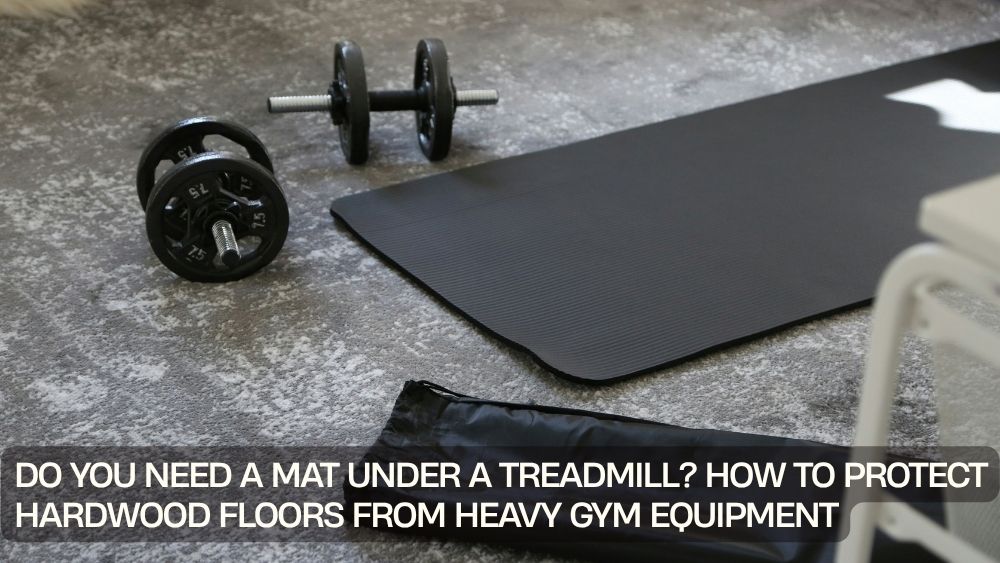
A treadmill can turn a spare room into a convenient home gym, but it can also introduce a problem that isn't visible until the equipment moves, vibrates, or sits in the same place for months.
Your hardwood floor.
Heavy gym equipment places concentrated weight on relatively small contact points. Add vibration from a moving belt, repeated foot strikes, dust, sweat, and occasional equipment movement, and your beautiful flooring may need more protection than it gets from a quick sweep.
So, do you need a mat under a treadmill?
For most home setups, a properly sized exercise equipment mat is a smart layer of protection. It can help separate the treadmill from the floor, reduce direct contact, catch moisture and debris, and provide a more stable surface.
The important part is choosing the right mat and installing it correctly.
If you're considering High-Density Interlocking EVA Foam Gym Mats, understanding how mats work and what to look for can help you create a safer, cleaner, and more floor-friendly workout area.
Why Put a Mat Under a Treadmill?
A treadmill isn't just a heavy piece of furniture.
It is a machine that moves.
The belt continuously travels while the user repeatedly steps onto a moving surface. Depending on the treadmill and workout intensity, that creates vibration and repeated loading.
A mat creates a protective layer between the equipment and your flooring.
It can help:
- Reduce direct contact between equipment and flooring
- Protect against scratches and scuffs
- Catch sweat and moisture
- Reduce dust accumulation underneath equipment
- Provide additional surface stability
- Make cleaning around the treadmill easier
- Help protect finished flooring from equipment movement
A mat isn't a magic shield, though.
It won't compensate for a badly positioned treadmill, uneven flooring, damaged equipment, or excessive moisture.
Think of it as one part of a complete home-gym setup.
Can a Treadmill Damage Hardwood Floors?
It can.
The risk depends on several factors, including the treadmill's weight, floor finish, equipment feet, movement, vibration, and how frequently the machine is used.
A stationary treadmill may leave little visible impact for months, then develop marks if the equipment shifts slightly during repeated workouts.
Small particles underneath the feet can also behave like abrasive material when the machine moves.
Moisture is another concern.
Sweat can drip onto the floor during workouts, and repeated exposure to moisture isn't something hardwood flooring appreciates.
The exact level of risk varies by flooring type and finish, so follow the flooring manufacturer's care recommendations as well as the treadmill manufacturer's instructions.
What Does a Treadmill Mat Actually Do?
A treadmill mat creates a buffer.
Instead of placing the equipment directly against the hardwood surface, you place the mat between them.
That barrier can help distribute contact and reduce direct friction between the treadmill and floor.
The mat can also capture small amounts of dust, debris, and moisture before they reach the flooring underneath.
Some mats are designed specifically for exercise equipment, while others are multipurpose fitness mats.
The key is matching the mat to the equipment.
A lightweight yoga mat isn't necessarily designed to sit under a heavy treadmill.
High-Density EVA Foam vs. Other Exercise Mat Materials
EVA foam is commonly used in exercise mats because it can provide cushioning and a relatively lightweight surface.
High-Density Interlocking EVA Foam Gym Mats can be particularly useful for creating a modular workout area.
Interlocking sections allow you to build a larger floor surface without handling one enormous mat.
However, not every EVA foam mat is suitable for every treadmill.
Check the manufacturer's specifications for weight capacity, thickness, dimensions, and intended use.
For heavier equipment, the mat needs enough structural strength and stability for the application.
What Size Mat Do You Need Under a Treadmill?
The mat should generally extend beyond the treadmill's footprint.
Don't think only about the machine's dimensions.
Consider where your feet land, where the machine may move, and where sweat or debris might fall.
A mat that's barely larger than the equipment can leave exposed strips of flooring around the edges.
Before purchasing, measure:
Treadmill length + desired front/rear clearance
and
Treadmill width + desired side clearance
The exact amount of extra coverage depends on the treadmill design and your available space.
If the treadmill manufacturer specifies a particular mat size or clearance requirement, follow those instructions.
What About a 12 x 6-Foot Exercise Mat?
The featured VEVOR 12 x 6 ft Exercise Mat provides a substantially larger surface than a small equipment pad.

Its size can make it useful for creating a broader exercise zone around gym equipment rather than protecting only the exact footprint of a single machine.
That can be useful if your treadmill sits alongside other workout activities.
A larger mat can create a defined training area for:
- Treadmill workouts
- Stretching
- Bodyweight exercises
- Pilates
- Yoga
- Mobility work
- Light fitness routines
The important distinction is that a large mat is not automatically a perfect treadmill mat.
Check the product's intended use and specifications before placing heavy equipment on it.
Why High-Density Construction Matters
Density affects how foam behaves under pressure.
A low-density foam surface may compress significantly under heavy equipment.
A higher-density material can provide a firmer platform.
For gym flooring, you generally want a surface that provides protection without becoming excessively soft or unstable under the equipment.
This matters particularly for treadmills because excessive movement or instability can be undesirable.
Always check the manufacturer's specifications rather than assuming that every product described as "high density" has the same performance characteristics.
Can a Mat Reduce Treadmill Vibration?
A suitable mat can help dampen some vibration and isolate the equipment from the floor.
However, the amount of vibration reduction varies.
It depends on:
- Treadmill construction
- Mat material
- Mat thickness
- Mat density
- Flooring type
- User weight
- Workout intensity
- Equipment condition
Don't expect a mat to eliminate vibration completely.
If the treadmill is producing unusual shaking, rattling, or movement, inspect the equipment itself. It may need leveling, adjustment, maintenance, or servicing.
Protecting Hardwood From Scratches
Hardwood can be particularly vulnerable to scratches from grit and equipment movement.
Imagine placing a heavy object on the floor and then repeatedly shifting it by tiny amounts.
Any dirt trapped underneath can create friction between the equipment and finish.
A mat creates separation.
Before placing the treadmill on the mat, clean the floor thoroughly.
Then inspect the treadmill's contact points.
Remove debris from the equipment feet and ensure the mat lies flat.
A clean floor plus a properly positioned mat creates a much better protective setup than simply dropping a mat over existing dirt.
Sweat and Moisture Protection
Your treadmill may be mechanical, but your workout is biological.
Sweat happens.
A mat can help catch moisture before it reaches the flooring, but it should not be treated as waterproof armor unless the manufacturer specifically says it is.
After workouts, wipe up visible moisture.
If moisture gets underneath the mat, allow the area to dry according to the flooring and mat manufacturer's recommendations.
This is especially important for hardwood.
Prolonged moisture exposure can cause problems depending on the type of flooring and finish.
How to Install a Mat Under a Treadmill
Installation doesn't need to be complicated.
Step 1: Measure the Area
Measure the treadmill and the available floor space.
Step 2: Clean the Floor
Remove dust, grit, hair, and debris.
This prevents particles from becoming trapped underneath the mat.
Step 3: Prepare the Mat
Lay the mat flat according to the manufacturer's instructions.
If you're using interlocking EVA foam sections, connect them securely.
Step 4: Check for Gaps
Make sure the pieces fit together properly and the mat sits flat.
Step 5: Position the Treadmill
Place the treadmill carefully onto the mat.
Avoid dragging heavy equipment across the floor or mat.
Step 6: Check Stability
Stand on the treadmill and verify that it feels stable.
Check the equipment's leveling system if necessary.
Step 7: Leave Adequate Clearance
Make sure the treadmill remains accessible and has the clearance recommended by the manufacturer.
What Are Interlocking Gym Mats?
Interlocking mats use puzzle-like edges that connect individual foam pieces.
Instead of buying one large sheet, you assemble a larger floor surface from smaller sections.
This design offers several practical benefits.
If part of the floor becomes damaged, you may be able to replace individual sections rather than the entire surface, depending on the product.
Interlocking construction can also make storage and transportation easier because the pieces can be separated.
For multipurpose home gyms, modularity can be especially convenient.
You can expand the workout area later if additional compatible pieces are available.
Are Interlocking Mats Good for Hardwood Floors?
They can be, but compatibility matters.
Some foam products may be suitable for finished floors, while others may interact differently with certain flooring finishes.
Check the mat manufacturer's recommendations before installation.
Also consider whether the flooring manufacturer has specific requirements regarding rubber, foam, moisture barriers, or prolonged contact with exercise equipment.
When in doubt, test a small inconspicuous area first if the flooring manufacturer permits it.
Don't Forget the Treadmill's Own Feet
A mat won't fix damaged or unstable contact points.
Inspect the treadmill feet periodically.
Look for:
- Cracks
- Dirt buildup
- Uneven contact
- Worn components
- Loose hardware
If the treadmill rocks, don't simply add extra layers underneath it.
Follow the manufacturer's leveling and adjustment instructions.
A stable treadmill should sit properly on the floor surface and mat.
Should You Put Multiple Mats Under One Treadmill?
Usually, adding random layers isn't the best solution.
Multiple loose mats can shift independently and create an uneven surface.
Instead, use a mat designed for the equipment and sized appropriately for the application.
If you need more floor coverage, a larger compatible mat or properly connected modular flooring system may be more practical.
The objective is a stable, continuous surface.
What If Your Treadmill Is on Carpet?
Carpet creates a different situation.
A treadmill can compress carpet fibers and potentially become less stable depending on the carpet and underlay.
A suitable equipment mat can help create a firmer surface and protect the carpet.
But the same principle applies: check the treadmill manufacturer's recommendations and make sure the equipment remains stable.
Don't assume a mat automatically solves every carpet-related problem.
Treadmill Mat vs. Yoga Mat
These products can look similar, but they have different purposes.
A yoga mat is primarily designed for exercises performed directly on the floor.
A treadmill mat is intended to support exercise equipment and protect the underlying surface.
The featured 12 x 6 ft VEVOR Exercise Mat is positioned as a large fitness mat for activities such as yoga, Pilates, and floor workouts.
If you're using it under heavy equipment, verify that its specifications support that application.
For a heavy treadmill, an equipment-specific mat may be preferable if the manufacturer recommends one.
How to Protect Hardwood Beyond Using a Mat
A mat is only one part of floor protection.
Keep the Equipment Clean
Dust and debris can accumulate underneath and around the treadmill.
Clean Spills Quickly
Don't allow sweat or other moisture to remain on the floor.
Inspect the Mat
Check for tears, curling edges, gaps, or compression.
Move Equipment Carefully
If you need to relocate the treadmill, avoid dragging it across hardwood.
Use appropriate moving procedures and follow the manufacturer's instructions.
Check Leveling
An unstable treadmill can move more than intended.
Maintain the Treadmill
Loose components and mechanical problems can increase vibration or movement.
Regular maintenance helps protect both the machine and the floor.
Common Mistakes When Using a Treadmill Mat
Choosing a Mat That's Too Small
A tiny mat may leave vulnerable flooring exposed.
Ignoring the Floor Underneath
Dirt trapped beneath the mat can still create problems.
Using a Soft Yoga Mat Without Checking Specifications
Not every exercise mat is designed to support heavy equipment.
Allowing Moisture to Accumulate
A mat can trap moisture if it isn't periodically inspected and cleaned.
Dragging the Treadmill
Heavy equipment can damage both flooring and mat when dragged.
Blocking Required Clearance
Don't position the treadmill so tightly against walls or furniture that it violates the manufacturer's recommended clearance.
How to Choose a Gym Mat for Home Equipment
Before buying, check these factors:
Dimensions: Make sure the mat covers the equipment and provides appropriate surrounding protection.
Material: Look for a material suitable for your specific equipment and flooring.
Density: Consider how the material behaves under sustained pressure.
Thickness: More thickness isn't automatically better. The mat needs to provide protection while maintaining suitable stability.
Surface: A suitable surface can help keep the equipment stable.
Cleaning: Choose a mat that fits your cleaning routine.
Modularity: Interlocking sections can be useful for larger workout areas.
Floor compatibility: Confirm that the material is appropriate for your flooring.
Is a Treadmill Mat Worth It?
For many home-gym setups, yes.
The cost and effort of adding a protective layer are relatively small compared with the inconvenience of repairing or refinishing damaged flooring.
A mat can also make the workout area easier to clean and organize.
For hardwood floors in particular, protecting the finish from equipment contact, dirt, and moisture can be a sensible precaution.
But the mat should be selected based on the treadmill's weight, dimensions, movement, and the flooring beneath it.
Final Thoughts
A treadmill brings a lot of useful energy into a home gym.
Unfortunately, some of that energy can end up traveling straight into your floor.
A properly selected mat creates a protective barrier between heavy equipment and the surface underneath. It can help reduce direct contact, catch moisture and debris, improve the organization of the workout area, and provide some vibration isolation.
For larger home-gym spaces, a 12 x 6 ft high-density exercise mat can provide broad coverage for multiple types of workouts, while High-Density Interlocking EVA Foam Gym Mats can offer a modular approach when you want to build or expand a dedicated exercise area.
Just remember that the mat is part of the solution, not the entire solution.
Measure the treadmill, check the flooring, follow the equipment manufacturer's instructions, keep the area clean and dry, and inspect the setup regularly.
Your treadmill should make your heart work harder.
Your hardwood floor doesn't need to.