Road trips have a funny way of making a car feel smaller.
The trunk looks generous until you add suitcases, camping equipment, jackets, sports gear, coolers, and everyone's "just one more thing." Suddenly, you're playing automotive Tetris.
That is where rooftop cargo storage comes in.
Two popular options are soft shell roof cargo bags and hard cargo boxes. Both move luggage above the passenger compartment, but they differ significantly in installation, protection, storage, and compatibility.
The biggest question for many drivers is even simpler:
Can you use a roof bag without a roof rack?
Sometimes, yes. But the answer depends on the specific roof bag, your vehicle's roof design, the manufacturer's installation requirements, and the vehicle's roof load limits.
Let's unpack the details before you pack the car.
What Is a Soft Shell Roof Cargo Bag?
A soft roof cargo bag is a flexible storage container designed to sit on the roof of a vehicle.
Unlike a rigid cargo box, it can fold down when you're not using it.
That makes it attractive for drivers who need extra storage occasionally but don't want to keep a bulky rooftop container in the garage year-round.
A Waterproof Soft Shell Car Roof Cargo Carrier Bag can be particularly useful for:
- Road trips
- Family vacations
- Camping
- Ski and outdoor equipment
- Moving bulky lightweight items
- Holiday travel
- Long-distance driving
The flexible construction can also make it easier to accommodate oddly shaped luggage.
However, "soft" doesn't mean you can ignore installation.
The bag still needs to be securely attached to the vehicle and used within the manufacturer's requirements.
Can You Use a Roof Bag Without a Roof Rack?
This is where things get interesting.
Some soft roof cargo bags are designed to be used without a traditional roof rack, while others require crossbars or another approved mounting system.
You should never assume that every roof bag works directly on every bare roof.
The exact installation system matters.
Some bags use straps that pass through the vehicle's doors or attach according to a specified mounting arrangement. Others are intended to sit on roof-rack crossbars.
Before buying, check the product's vehicle compatibility and installation instructions.
Your vehicle owner's manual also matters because the roof has a maximum permissible load, and that limit can vary by vehicle and configuration.
What if Your Car Has a Bare Roof?
A bare roof does not automatically mean "no rooftop cargo."
It means you need to verify that the particular cargo bag is approved for that type of installation.
If the bag's instructions specifically allow door-frame or direct-roof installation, follow that method exactly.
If the manufacturer requires crossbars, you need the appropriate rack system.
Do not improvise attachment points simply because the straps appear long enough.
A rooftop cargo system is only useful when the load stays securely attached throughout the journey.
Soft Roof Bag vs. Hard Cargo Box
Both systems increase storage capacity, but they solve slightly different problems.
| Feature | Soft Roof Cargo Bag | Hard Cargo Box |
|---|---|---|
| Construction | Flexible fabric | Rigid shell |
| Storage when not in use | Folds down | Requires dedicated storage |
| Installation | Often flexible, depending on model | Usually requires roof rack/crossbars |
| Weather protection | Depends on waterproof design and closure | Generally strong weather resistance |
| Shape flexibility | High | Limited by box shape |
| Empty weight | Often lighter | Usually heavier |
| Garage storage | Easy | Takes more space |
| Security | Generally lower | Often better with locking systems |
| Best for | Flexible, occasional cargo | Frequent, organized rooftop storage |
Neither option is automatically right for every driver.
The better match depends on how often you travel, what you carry, how your vehicle is equipped, and what type of protection you need.
Why Choose a Soft Roof Cargo Bag?
The biggest advantage is flexibility.
A soft bag can often be folded and stored in a closet, garage shelf, or vehicle storage compartment when empty.
That is convenient for occasional travelers.
You also get flexibility in packing.
A rigid cargo box has a defined interior shape. A soft bag can conform somewhat to the luggage inside it, although you should still follow its loading limits and avoid forcing oversized objects into the container.
For families, that extra flexibility can be valuable.
One trip might involve suitcases.
The next might involve sleeping bags and camping gear.
The following weekend, the bag might stay folded in the garage.
The 21-Cubic-Foot Rooftop Cargo Bag
For drivers looking for substantial additional storage, the VEVOR 21-cubic-foot rooftop cargo carrier bag listed for car roofs is designed around high-volume rooftop storage.

A 21-cubic-foot capacity gives you room to think beyond a couple of small bags.
That can be useful when the vehicle's interior is already occupied by passengers and everyday essentials.
Before loading, however, capacity should never be confused with allowable weight.
A bag may have a large volume while the vehicle roof has a much lower weight limit.
Always calculate the total load.
Think in Weight, Not Just Cubic Feet
Imagine your cargo weighs:
- Suitcases: 55 lb
- Camping equipment: 35 lb
- Sleeping bags: 15 lb
- Jackets and soft gear: 20 lb
That is 125 lb of cargo.
The fact that the bag has enough physical space does not mean your vehicle can safely carry that weight on its roof.
Check the vehicle's roof-load specification and the cargo carrier's own limit before loading.
This is one of the most important distinctions between capacity and safe payload.
Waterproof Does Not Mean Invincible
A waterproof roof bag can help protect luggage from rain and road spray.
But good installation still matters.
Water can find its way through:
- Improperly closed zippers
- Open seams
- Poorly positioned flaps
- Damaged fabric
- Overloaded closures
- Incorrect installation
Before a long trip, inspect the bag carefully.
Make sure the closure is fully secured and the attachment system is correctly tightened.
If you're driving through heavy rain, stopping periodically to inspect the cargo setup can also be sensible.
What About a Hard Cargo Box?
Hard cargo boxes use a rigid shell that maintains its shape regardless of what's inside.
They are often preferred by drivers who want a more permanent rooftop storage solution.
A hard box can provide:
- Rigid protection
- Organized storage
- Better resistance to crushing
- A more structured interior
- Potentially improved security when equipped with a lock
But there is a trade-off.
Hard boxes typically need a compatible roof rack or crossbar system.
They also take up substantially more storage space when removed.
That can matter if your garage already resembles a game of Jenga.
Which Is Easier to Store?
The soft bag wins on storage flexibility simply because it can be folded.
After a trip, you can remove it, clean and dry it according to the manufacturer's instructions, fold it, and store it.
A hard cargo box needs a dedicated location.
Some owners install storage brackets or ceiling hoists in garages, but that adds another layer of equipment and planning.
For occasional use, the ability to collapse the cargo carrier can be a major practical advantage.
What About a Rooftop Tent?
A rooftop tent is another category entirely.
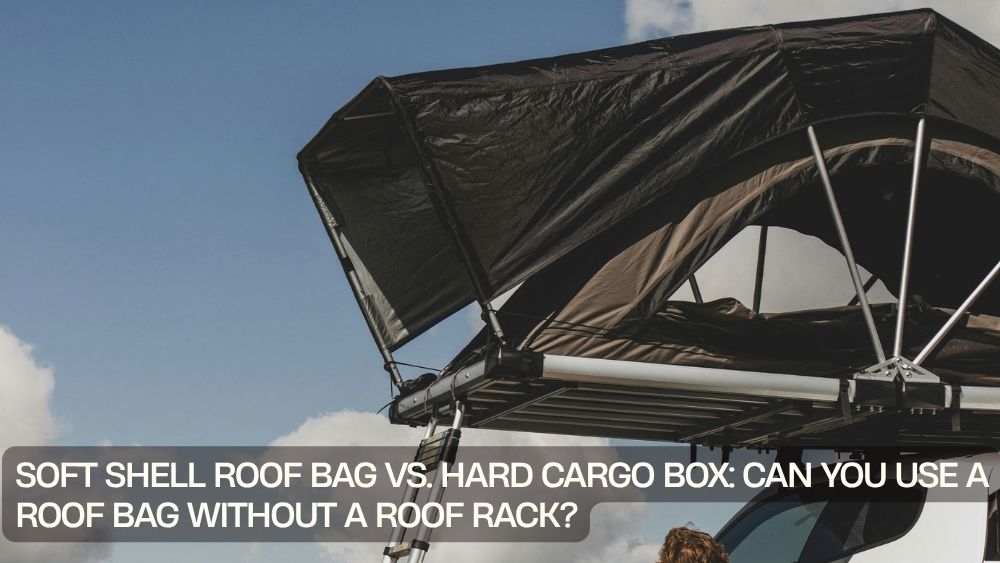
For example, the listed VEVOR hard-shell rooftop tent is designed as a waterproof rooftop sleeping solution for two to three people and includes a ladder.

That is fundamentally different from a cargo carrier.
A cargo bag is designed to transport belongings.
A rooftop tent is designed to provide sleeping accommodation above the vehicle.
Don't treat them as interchangeable rooftop accessories.
Their weight, mounting requirements, roof compatibility, and intended use can be very different.
How to Install a Soft Roof Bag Safely
If your particular cargo bag is approved for installation without a roof rack, follow its instructions precisely.
A general installation process may look like this:
1. Inspect the Roof
Remove dirt, grit, and debris from the contact area.
Particles trapped underneath the bag can potentially cause surface abrasion while driving.
2. Position the Bag
Center the cargo bag according to the manufacturer's instructions.
Avoid placing it where it interferes with the windshield, sunroof, antenna, hatch, or other vehicle components.
3. Load Evenly
Put heavier items toward the center of the allowed loading area and distribute weight rather than creating a lopsided load.
Keep sharp objects away from the fabric.
4. Secure the Closure
Close the bag completely.
Check the zipper, flap, buckle, or other closure system.
5. Attach the Straps
Use only the approved attachment points and routing method.
If the system is designed for door-frame attachment, make sure the straps do not interfere with doors, windows, seals, or airbags.
6. Tighten Everything
The bag should remain stable.
Avoid loose straps that can flap against the vehicle or become caught in moving components.
7. Perform a Final Inspection
Walk around the vehicle.
Check the front, sides, rear, straps, closures, and overall position.
If anything looks questionable, stop and fix it before driving.
Protecting Your Vehicle's Roof
One concern with soft cargo bags is contact between the bag and the roof.
The best defense is prevention.
Start with a clean roof.
Keep the underside of the cargo bag clean.
Don't allow sand, gravel, or other abrasive debris to remain trapped underneath it.
Also avoid overloading the bag until it becomes rigid or distorted.
If the manufacturer recommends a protective mat, use the specified accessory or an approved alternative.
The goal is to prevent unnecessary movement between the cargo carrier and the vehicle roof.
Don't Forget Vehicle Height
A rooftop cargo bag adds height to your vehicle.
That can become surprisingly important.
Think about:
- Parking garages
- Drive-through structures
- Toll facilities
- Low bridges
- Garage doors
- Tree branches
- Ferry loading areas
Before entering a low-clearance area, remember that your vehicle is now taller.
A soft bag may compress somewhat when empty, but loaded cargo can still add meaningful height.
How Rooftop Cargo Affects Driving
Adding cargo to the roof changes the vehicle's overall aerodynamic profile.
A loaded roof can also increase wind exposure and may affect fuel consumption.
Keep the load secure and drive according to road and weather conditions.
Avoid placing loose items inside the bag.
Even soft luggage should be packed so that it cannot shift excessively.
The objective is not merely to get everything onto the roof.
It is to keep everything controlled from departure to arrival.
When a Roof Bag Makes Sense
A soft cargo bag can be useful if you:
- Need extra storage only occasionally
- Take road trips
- Carry bulky soft items
- Have limited garage space
- Want a flexible cargo solution
- Prefer something that can be folded away
It can be especially practical for families carrying clothing, bedding, camping equipment, and other relatively compressible items.
When a Hard Cargo Box Makes More Sense
A hard cargo box may better fit drivers who:
- Use rooftop storage frequently
- Want rigid protection
- Prefer a structured container
- Want easier organization
- Need additional security features
- Already have compatible roof crossbars
The choice becomes less about "soft versus hard" and more about how you use your vehicle.
Questions to Ask Before Buying a Roof Bag
Before clicking the purchase button, check these details.
Does it work without crossbars?
Do not rely on generic descriptions.
Confirm the manufacturer's approved installation method.
What is the maximum cargo weight?
Check both the bag's capacity and your vehicle's roof-load limit.
The lower applicable limit matters.
Is it genuinely weather-resistant?
Look for the manufacturer's stated water-resistance or waterproofing specifications.
How large is it?
Measure the roof area.
A huge bag is not useful if it interferes with the hatch, sunroof, windshield, or other components.
How will you store it?
If you travel twice a year, foldability may matter more than rigid construction.
What happens if the weather changes?
Consider rain, snow, wind, and temperature conditions expected during your trip.
Common Mistakes to Avoid
Buying based only on capacity
A 21-cubic-foot bag sounds impressive, but you still have to respect the weight limit.
Assuming every roof bag works on a bare roof
Compatibility varies.
Check the exact installation requirements.
Overpacking
A bulging cargo bag can put unnecessary stress on closures and attachment points.
Ignoring straps
Loose straps can create noise, movement, and potential safety issues.
Packing sharp objects directly against the bag
Use suitable protection for anything with edges or points.
Forgetting the added vehicle height
The parking garage may not care that you forgot your rooftop cargo was there.
Skipping a pre-trip inspection
Take a few minutes before departure to inspect the entire setup.
That small pause can prevent a much larger roadside problem.
Final Thoughts
A soft roof cargo bag can be a practical way to create extra vehicle storage without committing to a large rigid box.
And yes, some roof bags can be used without a traditional roof rack, but that is not a universal rule.
The decisive factor is the manufacturer's approved installation method and your vehicle's roof specifications.
If you're considering a Waterproof Soft Shell Car Roof Cargo Carrier Bag, focus on more than cubic-foot capacity. Check compatibility, attachment method, weight limits, waterproofing, closure design, vehicle height, and storage requirements.
For occasional road trips, a foldable soft bag can offer a flexible approach to rooftop storage.
For frequent use and rigid protection, a hard cargo box may fit a different set of needs.
Either way, the safest rooftop cargo setup is the one that matches the vehicle, follows the equipment instructions, respects the load limits, and stays securely attached for the entire journey.
Pack smart. Check twice. Then hit the highway.