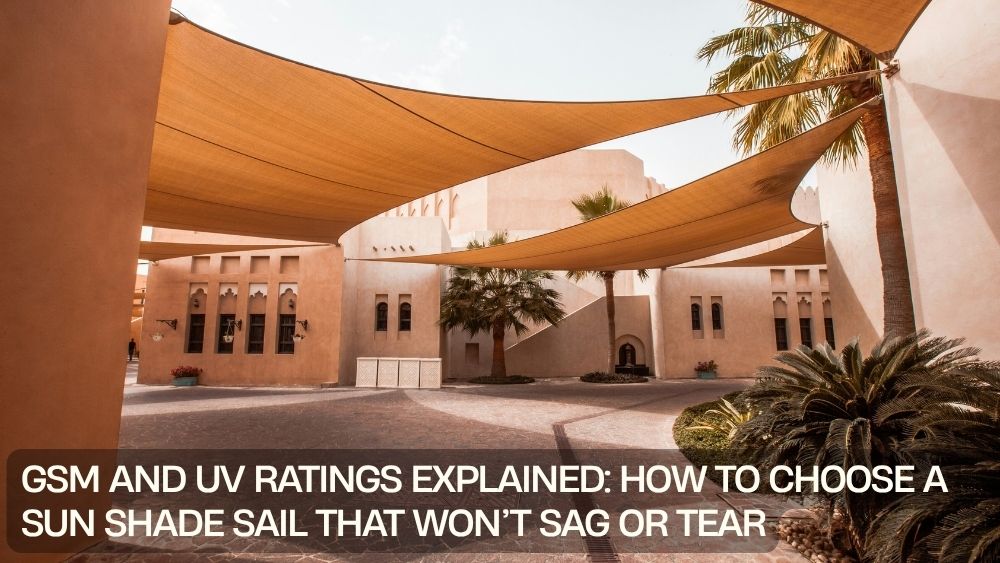
A sun shade sail can transform a blazing patio into a much more usable outdoor space.
But not every shade sail handles sunlight, wind, tension, and repeated seasonal use in the same way.
One sail stays tight and attractive.
Another starts looking like a hammock after a few weeks.
Then there is the classic problem: one corner begins pulling away from its attachment point, the fabric stretches, and suddenly your carefully planned shade structure looks more like a giant outdoor bedsheet.
The difference often comes down to details shoppers overlook.
GSM. UV protection. Fabric construction. Size. Shape. Attachment hardware. Installation tension.
If you are shopping for a Heavy Duty 185GSM Rectangle Sun Shade Sail, understanding these specifications can help you choose a product that is better suited to your outdoor space.
But GSM alone does not guarantee durability.
A heavier fabric can still sag if it is poorly tensioned. A strong fabric can still tear if the attachment points are weak. And a high UV rating does not automatically tell you how well the entire sail will perform in wind.
So let's unpack the numbers and turn the technical jargon into a practical buying guide.
What Does GSM Mean on a Sun Shade Sail?
GSM stands for grams per square meter.
It describes the mass of the fabric per square meter of material.
In simple terms, a higher GSM generally means more material is used in the fabric.
For example:
- 160 GSM = 160 grams per square meter
- 185 GSM = 185 grams per square meter
- 200 GSM = 200 grams per square meter
That makes GSM useful when comparing fabrics of similar construction.
But there is an important catch.
GSM is not the same thing as strength.
A 185 GSM fabric is not automatically stronger than every 160 GSM fabric, because fiber type, weave, coatings, stitching, and manufacturing quality also influence performance.
Think of GSM as one piece of the durability puzzle, not the entire puzzle.
Is 185 GSM Heavy Duty for a Shade Sail?
A 185 GSM sun shade sail sits in a useful range for shoppers looking for a substantial outdoor fabric without necessarily moving into extremely heavy material.
The phrase “heavy duty,” however, should be interpreted alongside the construction.
When comparing products, look beyond the GSM number and investigate:
- Fabric material
- Weave or knitted construction
- UV treatment
- Reinforced corners
- Edge webbing
- Stitching
- Attachment rings
- Shape
- Manufacturer's recommended installation method
A well-constructed 185 GSM sail can be a practical option.
A poorly constructed heavier sail can still develop problems.
GSM vs. Fabric Strength: Why the Difference Matters
Imagine two fabrics.
Fabric A weighs 185 GSM.
Fabric B weighs 185 GSM.
That does not mean they are identical.
One might have better UV stabilization.
One might use stronger fibers.
One might have better edge reinforcement.
One might have more robust stitching around the corners.
This is why comparing only GSM can lead to disappointing purchases.
When shopping for a Heavy Duty 185GSM Rectangle Sun Shade Sail, treat the GSM specification as a starting point.

Then examine the rest of the construction.
What Does UV Protection Mean?
UV protection is another specification that frequently appears in shade-sail listings.
Ultraviolet radiation from sunlight includes UVA and UVB wavelengths. Prolonged exposure can contribute to skin damage, while sunlight can also degrade outdoor materials over time.
A shade sail is designed to reduce direct solar exposure beneath the canopy, but the exact amount of protection depends on the fabric, construction, color, and design.
This is why sellers may advertise UV-resistant or UV-protection fabric.
But there is an important distinction:
UV protection and UV resistance are not necessarily the same claim.
UV protection generally refers to the shade provided to people or objects underneath.
UV resistance can refer to the fabric's ability to withstand degradation from sunlight.
Ideally, you want to understand both.
Why UV Resistance Matters for the Fabric Itself
Outdoor shade fabric spends its life under the sun.
That means the fabric is exposed to ultraviolet radiation repeatedly.
Over time, UV exposure can affect synthetic materials and may contribute to fading, weakening, or degradation depending on the material and its formulation.
A shade sail therefore has two jobs:
- Reduce sunlight reaching the shaded area.
- Survive the sunlight hitting the fabric.
That second job is easy to forget.
A sail that provides excellent shade for a short period but deteriorates rapidly is not a particularly useful long-term solution.
What Causes a Sun Shade Sail to Sag?
Sagging is one of the most common complaints with shade sails.
And it is not always caused by low GSM.
Several factors can contribute.
1. Incorrect Tension
A shade sail needs appropriate tension between its attachment points.
If the fabric is installed too loosely, gravity naturally pulls the middle downward.
2. Incorrect Mounting Height
If all attachment points are installed at roughly the same height, water can collect on some types of shade fabric during rain.
A better installation often uses different attachment heights to create a deliberate pitch.
3. Oversized Sail
A sail that is too large for the available structure can be difficult to tension correctly.
Bigger is not automatically better.
4. Fabric Stretch
Outdoor fabrics can change shape under repeated exposure to tension, weather, moisture, and temperature fluctuations.
5. Weak Attachment Points
If the mounting hardware moves, bends, or pulls out, the sail loses tension even if the fabric itself is strong.
This is why installation is part of the durability equation.
The Shape of the Sail Matters
Shade sails are commonly available in triangular, square, rectangular, and other configurations.
The geometry changes how the fabric distributes tension.
A triangle has three primary corners.
A rectangle has four.
That means the installation requirements are different.
For a rectangular sail, you have four attachment points to position and tension correctly.
For a triangular sail, the three corners create a different tension pattern.
Neither shape is automatically better.
The right shape depends on the space you are trying to shade and where you can safely install attachment points.
Heavy Duty 185GSM Rectangle vs. Triangular Shade Sail
This distinction matters for the product supplied with this article.
The primary keyword targets a Heavy Duty 185GSM Rectangle Sun Shade Sail.
The supplied TotalFindz product is an Outsunny triangular 10 ft sun shade sail, listed with UV protection and a carrying bag.
Those are different configurations.
Do not describe the Outsunny product as a rectangular 185 GSM sail unless its current product specifications explicitly confirm both details.
The Outsunny triangular format can still be relevant to the article because it illustrates an important shopping principle:
Shape and size should be chosen according to your installation area, not simply according to the keyword you searched.
How to Choose the Right Size
Start by measuring the area you actually want to shade.
Do not measure only the patio furniture.
Think about the entire area where people will sit, eat, play, or relax.
Then identify potential mounting points.
This is critical.
A shade sail cannot float wherever you want it. It needs structurally appropriate attachment locations.
Measure the distance between those points.
Then account for the hardware required to tension the sail.
You may need additional distance between the sail corners and the attachment structure depending on the hardware and manufacturer's instructions.
Buying the largest possible sail without considering mounting geometry is a common mistake.
Why a Slightly Smaller Sail Can Be Easier to Install
A sail needs enough room to be tensioned.
If it barely fits between your attachment points, you may struggle to create proper tension.
If it is substantially larger than the available mounting area, you may also have trouble installing it correctly.
The goal is not to fill every available inch.
The goal is to create a stable, tensioned shade surface.
That is especially important when shopping for a rectangular sail because four corners give you four separate attachment relationships to manage.
Look Closely at the Corners
The corners are among the most important parts of a shade sail.
Why?
Because that is where installation forces are transferred into the structure.
A strong fabric with weak corner reinforcement can still fail.
Look for features such as:
- Reinforced corner sections
- Strong webbing
- Secure attachment rings
- Multiple rows of stitching
- Reinforced perimeter edges
Manufacturers use different construction methods, so compare the actual product specifications and photos rather than assuming every shade sail uses the same design.
Don't Forget the Mounting Hardware
A shade sail is only as secure as the structure supporting it.
Depending on the installation, hardware may include:
- Eye bolts
- Turnbuckles
- Carabiners
- Mounting brackets
- Posts
- Extension hardware
The correct hardware depends on the structure.
A masonry wall, wooden post, steel structure, and tree are not interchangeable mounting surfaces.
If you are installing into a building, make sure the attachment point is connected to an appropriate structural component rather than merely a decorative surface or weak cladding.
For permanent installations, professional advice can be worthwhile when structural loads are uncertain.
Why Wind Changes Everything
A shade sail is essentially a large piece of fabric exposed to the elements.
Wind can exert substantial force on outdoor structures.
That means a sail's size, shape, tension, attachment method, and supporting structure all matter.
Do not assume that a heavier GSM rating makes a sail suitable for every wind condition.
Instead, follow the manufacturer's installation and weather recommendations.
If severe weather is expected, inspect the structure and consider removing or lowering the sail if the manufacturer recommends doing so.
The weakest component can determine the outcome.
A powerful gust does not care whether your fabric is 185 GSM.
Waterproof vs. Breathable Shade Fabric
Another important distinction is whether the shade sail is designed primarily for shade or also for rain protection.
Some shade sails are made from breathable materials that allow air and some water movement.
Others are designed to provide greater water resistance or waterproofing.
These designs involve different trade-offs.
A breathable shade sail may be better suited to reducing heat and providing airflow.
A waterproof canopy can offer rain protection but may require different installation considerations, particularly regarding drainage and wind loads.
Never assume “shade sail” means “waterproof.”
Check the product specification.
Dark vs. Light Shade Sail Colors
Color affects more than appearance.
A dark fabric can create a strong visual contrast and may provide a different perceived shading environment than a pale fabric.
A light-colored sail can produce a brighter appearance underneath.
However, the actual performance depends on the fabric's construction and UV properties, not simply the color.
Choose the color based on both aesthetics and the manufacturer's performance specifications.
A patio shade sail should look like part of the outdoor space rather than a parachute someone accidentally left behind.
How to Prevent a Shade Sail From Sagging
Use this checklist before installation:
Measure Carefully
Confirm the distances between all attachment points.
Create Proper Tension
Follow the manufacturer's guidance for tensioning rather than simply pulling the fabric as tight as possible.
Use Appropriate Hardware
Select mounting hardware that matches the structure and installation.
Create a Pitch
Where appropriate, use different attachment heights to create drainage and improve the shape of the sail.
Inspect the Corners
Make sure every corner is securely attached and reinforced.
Avoid Overloading the Fabric
Do not hang objects from the sail or modify it without understanding how that changes the structure.
Check It Regularly
Inspect stitching, edges, attachment hardware, and mounting points periodically.
How to Prevent Tearing
Tearing can happen because of more than weak fabric.
Potential contributors include:
- Excessive wind
- Poorly reinforced corners
- Incorrect installation
- Sharp contact points
- Excessive tension
- Structural movement
- Long-term UV degradation
- Improper storage
This is why a durability assessment should consider the complete system.
Fabric + stitching + reinforcement + hardware + installation + weather exposure.
That is a much more accurate way to think about shade-sail performance.
What Should You Look for in a Heavy Duty 185GSM Rectangle Sun Shade Sail?
If your search specifically targets a Heavy Duty 185GSM Rectangle Sun Shade Sail, use this buying checklist:
Fabric: Confirm the actual GSM and material.
UV protection: Look for specific manufacturer claims rather than vague marketing language.
UV resistance: Check whether the fabric is designed for long-term outdoor exposure.
Shape: Confirm that it is actually rectangular.
Dimensions: Match the sail to your mounting area.
Corners: Look for reinforced attachment areas.
Edges: Check for reinforced perimeter construction.
Hardware: Determine what is included and what must be purchased separately.
Installation: Review recommended mounting methods and tensioning instructions.
Weather: Check the manufacturer's recommendations for wind, rain, snow, and seasonal removal.
This checklist can help you compare products based on construction rather than a single headline specification.
Where Does the Outsunny 10 ft Triangle Sail Fit?
The supplied Outsunny product is a triangular 10 ft sun shade sail designed for outdoor spaces such as patios, gardens, and lawns. Its listing highlights UV protection and includes a carrying bag.
That makes it a useful example of a more compact triangular shade solution.
Its geometry differs from a rectangular 185 GSM sail, so shoppers should compare it according to the actual space they need to cover.
If you have three suitable mounting points and want a relatively compact shade configuration, a triangular design can be worth considering.
If your patio requires a broad four-corner coverage area, a rectangular sail may make more sense.
The important thing is matching the geometry to the space.
Common Sun Shade Sail Buying Mistakes
Buying by GSM Alone
Higher GSM can be useful, but it does not tell you everything about durability.
Ignoring the Mounting Structure
A premium sail cannot compensate for an inadequate attachment point.
Choosing the Largest Size
Oversizing can make proper tension difficult.
Assuming UV Protection Means Unlimited Outdoor Life
All outdoor fabrics experience environmental exposure.
Ignoring Wind
Large fabric surfaces can experience significant wind forces.
Installing Without Planning Drainage
A poorly pitched rain-exposed sail can collect water.
Confusing Product Types
A triangular sail, rectangular sail, waterproof canopy, and breathable shade sail can have very different characteristics.
The Bottom Line: Build the Whole System, Not Just the Fabric
Choosing a durable sun shade sail requires more than finding the biggest GSM number on a product page.
For a Heavy Duty 185GSM Rectangle Sun Shade Sail, start with the fabric specification, but then look at UV resistance, construction, reinforced corners, stitching, dimensions, shape, mounting hardware, and installation requirements.
Most importantly, remember that sagging and tearing are not caused by one specification alone.
A properly sized sail with appropriate tension and strong mounting points has a much better chance of maintaining its intended shape.
The supplied Outsunny triangular 10 ft sail demonstrates another important point: the best shade sail is the one that fits your actual outdoor space and installation geometry.
Measure first.
Choose the shape second.
Compare the fabric and construction third.
Then install it correctly.
That approach will get you much closer to a shade sail that stays taut, attractive, and useful through the outdoor season.