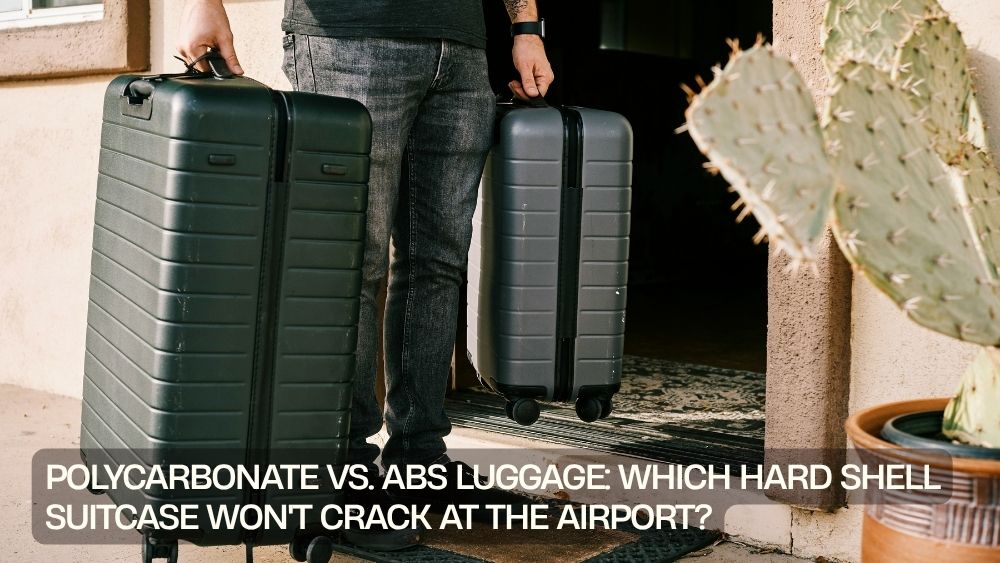
Airports can be rough on luggage.
Your suitcase may roll smoothly through the terminal, glide into the check-in line, and then disappear behind a conveyor-belt curtain. From there, it can encounter loading equipment, tight storage spaces, repeated handling, and the occasional less-than-gentle landing.
That raises a practical question for anyone shopping for hard-shell luggage:
Is polycarbonate or ABS better if you want a suitcase that is less likely to crack?
Both materials are widely used in hard-shell luggage, but they behave differently.
Polycarbonate is generally valued for its impact resistance and ability to flex under force. ABS is lightweight and can offer good value, but its behavior under repeated impacts can differ depending on the formulation, shell thickness, construction, and overall suitcase design.
The material matters, but it is not the entire story.
Shell construction, corners, zippers, wheel housings, handles, expansion systems, and how the suitcase is packed can all influence durability.
If you're searching for 100% Polycarbonate Expandable Spinner Luggage, here's what you should know before making the jump.
Polycarbonate vs. ABS: The Basic Difference
Let's start with the material itself.
Polycarbonate Luggage
Polycarbonate is a thermoplastic known for its toughness and impact resistance.
In luggage, that can translate into a shell that flexes rather than immediately cracking when exposed to an impact.
This makes polycarbonate particularly appealing for travelers who check luggage regularly.
It can also be relatively lightweight compared with some other rigid materials.
But "polycarbonate" does not automatically mean indestructible.
A thin or poorly designed polycarbonate suitcase can still suffer damage.
ABS Luggage
ABS stands for acrylonitrile butadiene styrene.
It is another thermoplastic commonly used in luggage manufacturing.
ABS can be lightweight and cost-effective, which helps explain its popularity in entry-level and budget-friendly hard-shell suitcases.
However, the performance of ABS luggage depends heavily on the specific construction.
Two suitcases made from ABS can behave differently because shell thickness, molding, reinforcement, hardware, and overall design are not identical.
Which Is Less Likely to Crack?
If your primary concern is impact resistance, polycarbonate generally has the advantage over conventional ABS.
Why?
Because polycarbonate is designed to withstand significant impact and can flex under stress.
ABS is rigid and can perform well under normal travel conditions, but repeated or severe impacts can make cracking a greater concern.
That does not mean every polycarbonate suitcase will survive every airport mishap.
It means the material has characteristics that make it attractive for travelers who prioritize impact resistance.
If you check luggage frequently, material selection deserves serious attention.
What Does "100% Polycarbonate" Actually Mean?
This phrase deserves a closer look.
When luggage is advertised as 100% polycarbonate, it generally indicates that the primary shell material is polycarbonate rather than an ABS/polycarbonate blend.
That distinction matters.
Some luggage products are marketed as "polycarbonate luggage" even though only certain components or layers use the material.
If you specifically want a 100% polycarbonate shell, check the manufacturer's material specification instead of relying solely on the product title.
Also remember that the shell is only one part of a suitcase.
A polycarbonate shell can still have:
- Plastic wheel components
- Fabric lining
- Metal or plastic handles
- Zippers
- Plastic corner components
- Expandable gussets
Durability is therefore a complete-system question.
Why Airport Handling Can Be Hard on Suitcases
A checked suitcase doesn't receive the same treatment as the carry-on bag you roll beside you.
It may be:
- Loaded onto carts
- Moved through conveyor systems
- Stacked with other luggage
- Handled repeatedly
- Placed into aircraft cargo areas
- Retrieved and transported again
The exact handling process varies by airport and airline.
The important point is that checked luggage needs to tolerate impacts and compression that a suitcase carried into an aircraft cabin may rarely experience.
That is one reason frequent checked-luggage travelers often pay closer attention to shell construction.
Polycarbonate's Biggest Advantage: Flexibility
Imagine dropping two rigid objects.
One shatters when it reaches its limit.
The other bends slightly, absorbs some of the force, and returns toward its original shape.
Polycarbonate's ability to flex is one reason it is popular in impact-resistant applications.
In luggage, that flexibility can be useful when the shell experiences pressure or impact.
Instead of immediately cracking, the shell may deform temporarily.
Of course, this is not a guarantee against damage.
Extreme impact, sharp objects, manufacturing defects, and repeated stress can still damage polycarbonate luggage.
ABS's Biggest Advantage: Weight and Value
ABS remains popular because it can provide a lightweight hard-shell suitcase at a relatively accessible price.
For occasional travelers who primarily use carry-on luggage and don't routinely expose their suitcase to aggressive handling, ABS can be a reasonable choice.
It can also be attractive when you're purchasing a multi-piece luggage set and want several coordinated sizes without a premium price.
The key is to understand the trade-off.
If your priority is maximum impact resistance, material characteristics become more important.
If your priority is affordability and light weight for occasional trips, ABS may still make sense.
What About ABS + Polycarbonate Luggage?
You will also encounter hybrid luggage.
These suitcases combine ABS and polycarbonate in the shell.
Hybrid construction can provide a balance between cost, weight, and performance.
But don't automatically assume a hybrid suitcase performs identically to a suitcase made entirely from polycarbonate.
If your search specifically targets 100% Polycarbonate Expandable Spinner Luggage, verify the material specification before buying.
A product labeled simply "polycarbonate" may not necessarily meet that exact requirement.
Expandable Luggage: Useful or Risky?
Expandable luggage gives you extra packing space when you need it.
That can be incredibly useful on the return journey.
Maybe you bought souvenirs.
Maybe you packed lighter than expected.
Maybe your shopping bag mysteriously became heavier. It happens.
An expansion zipper or gusset allows the suitcase to increase its usable depth.
But there is a trade-off.
When expanded, the suitcase becomes deeper and may be more difficult to maneuver in crowded spaces.
It also gives you more room to overpack.
That can increase the total weight of the suitcase and place additional stress on wheels, handles, zippers, and the shell.
Expansion is therefore best treated as flexible capacity, not permission to turn your suitcase into a portable black hole.
Spinner Wheels Matter More Than You Think
A suitcase can have an excellent shell and still become frustrating if its wheels fail.
Spinner luggage typically uses four wheels that rotate independently, allowing the suitcase to move in multiple directions.
This can make airport navigation easier.
You can push the suitcase beside you rather than dragging it behind you.
But wheels are also exposed components.
When evaluating luggage, check:
- Wheel size
- Wheel housing
- Wheel attachment
- Rotation
- Overall construction
- Handle stability
If you're buying a luggage set, test the wheels on every piece rather than assuming all three pieces will behave identically.
The Handle Is Another Potential Weak Point
The telescoping handle receives repeated use.
You pull it up.
You push it down.
You extend it.
You retract it.
You pull the suitcase across uneven flooring.
That repetitive motion can place stress on the handle assembly.
A suitcase with a tough shell but a flimsy telescoping handle isn't a particularly useful travel companion.
Look for a handle that extends smoothly and locks securely into position.
Avoid dragging the suitcase sideways using excessive force on the extended handle.
Zippers vs. Hard-Shell Closures
Most hard-shell luggage uses zippers, although some premium cases use frame-style closures and integrated locking mechanisms.
Zippers can be convenient and lightweight.
They can also become a failure point if the suitcase is severely overpacked.
A useful rule is simple:
Don't force the zipper around an overstuffed suitcase.
If the shell is bulging because you've packed too much, the zipper is working against unnecessary tension.
Expansion features can help, but they don't eliminate the importance of sensible packing.
How to Pack a Hard-Shell Suitcase for Less Stress
Your packing technique can influence how much stress the suitcase experiences.
Start by distributing weight.
Avoid putting all heavy items into one corner.
Use clothing to create padding around delicate items.
Keep sharp objects away from the shell.
Don't force bulky items into spaces where they press aggressively against the case.
If your suitcase has two compartments, distribute the load between them.
Most importantly, pay attention to total weight.
A heavy suitcase puts additional load on the wheels, handles, shell, and zipper system.
Is a Three-Piece Luggage Set Worth It?
A three-piece luggage set can be useful if you regularly travel with different packing requirements.
You might use:
- A smaller case for short trips
- A medium case for longer journeys
- A larger case for extended vacations
A coordinated set can also simplify storage and give you matching luggage sizes for different members of a household.
The key is to evaluate the construction of each piece.
Don't assume that because the largest suitcase looks substantial, the smaller cases have identical hardware or reinforcement.
Exploring the Vintage Air 3-Piece Luggage Set
If you're shopping for coordinated luggage, the Vintage Air 3-piece luggage set is one option to consider.

A three-piece configuration gives travelers multiple suitcase sizes for different trip lengths and packing needs.
However, if your specific buying requirement is 100% polycarbonate construction, verify the product's listed shell material before making that assumption.
That distinction is important because this article compares material categories, while the supplied product should be evaluated according to its own specifications.
You can also browse the wider TotalFindz luggage collection when comparing different suitcase styles and configurations.
Polycarbonate vs. ABS: Quick Comparison
| Feature | Polycarbonate | ABS |
|---|---|---|
| Impact resistance | Generally excellent | Generally good |
| Flexibility | Higher | Lower |
| Crack resistance | Generally stronger under impact | More dependent on construction |
| Weight | Usually lightweight | Often lightweight |
| Price | Often higher | Often more budget-friendly |
| Frequent checked travel | Strong candidate | Depends on construction |
| Occasional travel | Excellent | Practical |
| Expandable options | Widely available | Widely available |
| Spinner options | Widely available | Widely available |
The table is a general material comparison. Actual suitcase performance depends on the specific product design.
What About Scratches?
Cracking isn't the only form of luggage damage.
Hard-shell cases can develop scratches, scuffs, and surface marks during travel.
This is especially noticeable on darker glossy finishes.
A textured or matte shell may make everyday scratches less visually obvious.
Some travelers don't mind a few marks because they view them as part of the suitcase's travel history.
Others want their luggage to look pristine.
Either way, don't confuse scratch resistance with impact resistance.
A suitcase can resist cracking while still collecting plenty of airport battle scars.
Can Polycarbonate Luggage Crack?
Yes.
This is important.
Polycarbonate is impact-resistant, not damage-proof.
Extreme force can exceed the material's ability to absorb impact.
Repeated stress can also weaken components.
Corners may receive concentrated impacts.
Wheel housings can be damaged separately from the shell.
And no luggage material can compensate for poor manufacturing or defective hardware.
Think of polycarbonate as a material that improves the odds of surviving rough treatment, not a force field.
Can ABS Luggage Crack?
Yes, ABS can crack under sufficient stress.
Its performance depends on formulation, thickness, construction, temperature, and the nature of the impact.
That doesn't make ABS unsuitable for luggage.
It simply means buyers should understand what they're prioritizing.
For occasional travelers who want affordable hard-shell luggage, ABS can still be useful.
For frequent travelers who place a premium on impact resistance, polycarbonate is often worth considering.
How to Choose Your Hard-Shell Suitcase
Use this checklist before buying.
1. Check the Shell Material
Is it ABS, polycarbonate, or a combination?
2. Verify the Material Claim
If you specifically want 100% polycarbonate, confirm the manufacturer's specification.
3. Examine the Corners
Corners often receive concentrated impacts.
4. Check the Wheels
Make sure they rotate smoothly and appear securely attached.
5. Test the Telescoping Handle
It should extend and retract smoothly without excessive play.
6. Consider Expansion
Expandable luggage provides flexibility, but don't use the extra space as an excuse to overload the suitcase.
7. Check Dimensions
Make sure the suitcase fits your airline's current baggage requirements for the type of travel you plan to do.
8. Consider Weight
A heavy empty suitcase leaves less of your baggage allowance for your belongings.
9. Think About Your Travel Style
Frequent checked luggage creates different demands from occasional carry-on travel.
So, Polycarbonate or ABS?
If your biggest concern is resistance to cracking from impact, polycarbonate generally has the edge.
Its combination of toughness and flexibility makes it particularly attractive for frequent travelers and checked luggage.
ABS can still be a sensible choice when affordability, light weight, and occasional use are higher priorities.
But don't make the decision based on shell material alone.
A well-designed suitcase needs a strong combination of shell, corners, wheels, handle, zipper, and internal structure.
And if you're specifically looking for 100% Polycarbonate Expandable Spinner Luggage, verify all three claims separately:
100% polycarbonate shell.
Expandable construction.
Spinner wheels.
That little checklist can prevent a lot of shopping confusion.
Final Thoughts
Airport luggage damage isn't entirely predictable.
No suitcase can promise that it will never crack, break, scratch, or lose a wheel after enough abuse.
But material selection can influence how a hard-shell suitcase responds to impact.
Polycarbonate generally offers stronger impact resistance and greater flexibility than conventional ABS, making it an attractive option for travelers who frequently check bags or simply want a tougher shell.
ABS remains useful for travelers who prioritize value and lightweight construction.
Then there is everything around the shell: wheels, handles, zippers, corners, expansion systems, and how you pack the case.
Choose the material according to your travel habits, check the complete construction, and don't confuse "hard shell" with "indestructible."
Because the airport conveyor belt has never signed a peace treaty with your suitcase.