A patio can look inviting in summer and feel like an entirely different planet once temperatures drop.
That does not mean outdoor entertaining has to disappear with the warm weather.
A properly sized patio heater can extend the useful season of a deck, terrace, balcony, restaurant patio, or backyard seating area. But choosing one involves more than grabbing the heater with the biggest number on the box.
That number is usually BTU, or British thermal unit.
You will see patio heaters advertised at 30,000 BTU, 40,000 BTU, 42,000 BTU, 48,000 BTU, and sometimes much higher.
So how many BTUs do you actually need?
The answer depends on the size of the area, outdoor temperature, wind exposure, heater design, fuel type, and how close people are sitting to the heat source.
For cold climates in the US and Canada, those factors become especially important.
A 48,000 BTU Pyramid Propane Patio Heater can sound like an obvious choice for a chilly evening, but BTU output should be considered alongside the actual design and environment.
The TotalFindz product featured in this guide is a 42,000 BTU stainless steel pyramid patio heater with wheels, so it provides a useful real-world example of how to evaluate heater output without getting trapped by the biggest number on the specification sheet.
What Does BTU Mean on a Patio Heater?
BTU stands for British thermal unit.
In simple terms, it is a unit used to describe the amount of heat energy.
For patio heaters, the BTU rating provides an indication of the heater's heat output.
A higher BTU rating generally means more heat energy is being produced, but that does not mean the same heater will automatically keep a larger outdoor area warm.
Outdoor heating is fundamentally different from heating a sealed indoor room.
There are no four walls holding the heat in.
Wind can carry warmth away.
Cold air continuously replaces warmer air.
Open patios can lose heat in multiple directions.
That means BTU is an important starting point, not a complete prediction of comfort.
Is 48,000 BTU Enough for a Cold-Climate Patio?
For many residential outdoor spaces, a heater in the 40,000 to 50,000 BTU range can provide substantial heat output.
But "enough" depends on the conditions.
Consider two patios.
The first is a sheltered 10 × 10-foot seating area surrounded by walls and partially covered overhead.
The second is a completely exposed 20 × 20-foot deck on a windy evening.
Putting the same heater in both locations does not produce the same experience.
The sheltered patio can retain more of the useful warmth around the seating area.
The exposed patio allows wind to disperse heat much more quickly.
So instead of asking:
"How many square feet does 48,000 BTU heat?"
ask:
"How much heat do I need for my actual outdoor environment?"
That question produces a much more useful answer.
A Simple Patio Heater BTU Guide
While manufacturer coverage specifications should always take priority, you can use BTU ranges as an initial comparison tool.
| Heater Output | Typical Use Consideration |
|---|---|
| 10,000–20,000 BTU | Small, close-range outdoor heating |
| 20,000–30,000 BTU | Smaller patios and seating areas |
| 30,000–40,000 BTU | Medium outdoor spaces |
| 40,000–50,000 BTU | Larger seating areas or colder conditions |
| 50,000+ BTU | Larger or more demanding applications |
These are not guaranteed heating-area measurements.
Actual performance depends on heater design and environmental conditions.
A 42,000 BTU heater with a well-designed reflector or radiant-heating system can feel very different from another heater with a similar nominal rating.
For that reason, BTU should be one of the first specifications you compare, not the last.
Why Cold Climates Need More Planning
Cold weather creates a double challenge.
First, the surrounding air is colder.
Second, people sitting outside are constantly losing body heat to the environment.
A heater must therefore provide enough radiant warmth to make the immediate seating area comfortable.
This is why patio heater placement matters so much.
You do not necessarily want to heat an enormous outdoor space uniformly.
Instead, you want to create a comfortable warm zone around the people using the patio.
Think of the heater as creating an island of comfort in an ocean of cold air.
That approach is much more realistic than expecting an outdoor heater to behave like a central heating system.
Wind Can Matter More Than BTUs
Wind is one of the biggest enemies of outdoor heating.
A calm 40°F evening can feel very different from a windy 40°F evening.
Air movement can carry warm air away and make exposed areas feel colder.
That means a patio heater installed near a windbreak may provide noticeably better comfort than the same heater positioned in an exposed location.
Useful windbreaks can include:
- Exterior walls
- Privacy screens
- Covered structures
- Fences
- Outdoor curtains
- Strategically positioned furniture
Do not block the heater's required ventilation or violate clearance requirements just to create a windbreak.
The heater's manufacturer instructions always take priority.
Pyramid Patio Heaters: Why the Design Matters
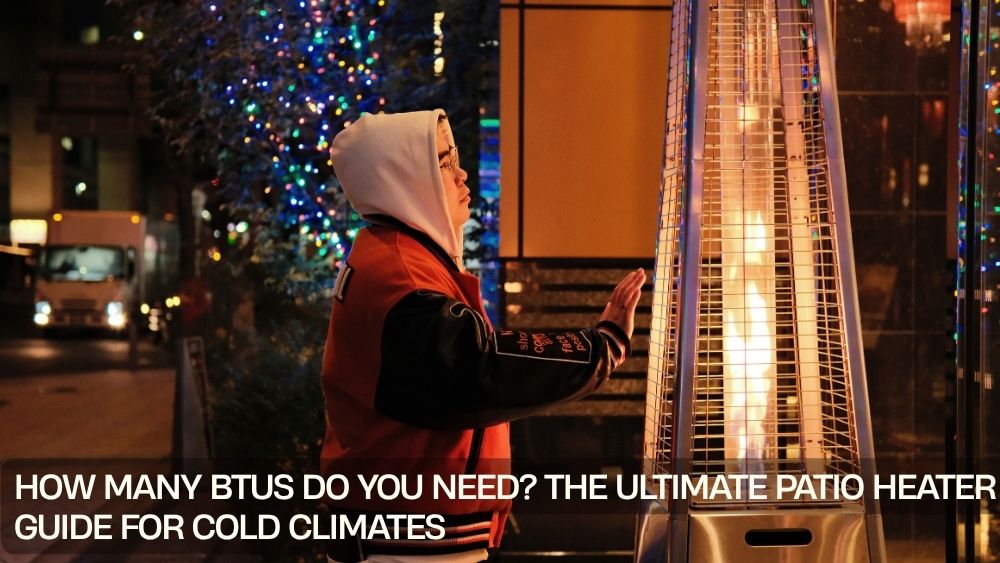
A pyramid patio heater has a distinctive appearance.
The tall vertical design often includes a visible flame column inside a glass tube, creating both heat and a decorative visual effect.
The pyramid shape can also make the heater a focal point rather than simply another piece of outdoor equipment.
The TotalFindz model featured here is a 42,000 BTU stainless steel pyramid patio heater with wheels.

That combination brings together several features worth considering:
- 42,000 BTU output
- Pyramid design
- Stainless steel construction
- Propane-powered heating
- Wheels for mobility
The wheels are particularly useful because outdoor heating needs can change depending on where people are sitting.
A heater positioned beside a dining table on Friday night may need to move toward a lounge area on Saturday.
Mobility gives you more flexibility, provided the unit is moved and operated according to the manufacturer's instructions.
42,000 BTU vs. 48,000 BTU
This is where shoppers can get caught in specification-sheet tunnel vision.
A 48,000 BTU heater produces a higher nominal heat output than a 42,000 BTU heater.
That is a factual difference.
But it does not automatically mean the 48,000 BTU heater will make every patio feel significantly warmer.
Why?
Because other factors influence perceived warmth.
These include:
- Heater height
- Radiant heat direction
- Reflector design
- Wind
- Patio layout
- Seating distance
- Ambient temperature
- Heater placement
- Whether the area is sheltered
A well-positioned 42,000 BTU heater can be more useful than a higher-output heater placed poorly.
So don't let a 6,000-BTU difference become the entire buying decision.
How Big Is Your Patio?
Before choosing a heater, measure the area you actually want to heat.
You don't necessarily need to heat the entire deck.
Focus on the seating and dining zones.
For example:
Small patio:
A compact seating area with four chairs may need only localized heating.
Medium patio:
A dining table and lounge area may benefit from a higher-output heater or multiple heating zones.
Large patio:
One heater may not provide uniform comfort across the entire space.
Instead of buying the largest possible heater, consider whether multiple strategically positioned heaters would create better coverage.
This is especially relevant for restaurants, hospitality spaces, and large outdoor entertaining areas.
Radiant Heat vs. Heating the Air
Patio heaters generally work differently from indoor forced-air heating systems.
Radiant heating warms people and objects in the heater's effective heating zone rather than attempting to warm the entire outdoor atmosphere.
This is why sitting closer to a patio heater can feel dramatically warmer.
You are receiving more direct radiant energy.
Move farther away and the experience changes.
That is also why heater placement should be based on where people actually sit.
A heater positioned 20 feet away from the dining table may look attractive but provide less useful warmth than one correctly positioned within the manufacturer's specified clearance and coverage requirements.
Propane Patio Heaters and Fuel Planning
A propane patio heater needs a fuel supply, so BTU output also has implications for fuel consumption.
A higher-output heater generally consumes fuel more quickly than a lower-output heater when operating at comparable conditions and settings.
That means a 48,000 BTU heater may require more propane over a given operating period than a 30,000 BTU model.
Your actual consumption depends on operating settings and the specific appliance.
For frequent winter use, consider:
- Tank size
- Tank availability
- Operating hours
- Local propane prices
- Storage requirements
- Replacement convenience
The goal is not simply to maximize BTUs.
It is to balance warmth with practical operating costs.
What Size Propane Tank Do You Need?
Always follow the heater manufacturer's specified fuel requirements.
Different patio heaters can have different connection systems, regulators, and fuel requirements.
Do not assume that because two heaters both use propane, their tank setup is automatically identical.
Check the product manual for:
- Compatible fuel
- Tank type
- Tank capacity
- Connection requirements
- Regulator requirements
- Hose specifications
- Storage instructions
The product listing should be treated as a starting point, while the manufacturer's instructions determine the correct operating configuration.
Heater Height Changes the Experience
Tall patio heaters distribute heat from an elevated position.
This can be useful around dining tables and outdoor seating areas because the heat source is positioned above the people rather than occupying valuable table space.
But height also affects how heat reaches the seating zone.
The goal is to position the heater so the intended occupants are within its effective heating area while maintaining every required clearance.
Never reduce clearance distances simply because the heater feels more comfortable when placed closer.
Comfort should never come at the expense of safe installation.
Covered Patio vs. Open Patio
A covered patio can retain heat differently from a completely open deck.
However, a roof or overhead structure introduces another important consideration: clearance and ventilation.
Propane patio heaters require appropriate outdoor use and ventilation.
Do not assume that placing a propane heater underneath a roof automatically makes it suitable for that location.
Check the manufacturer's instructions for required clearances and permitted installation environments.
For enclosed or poorly ventilated spaces, propane combustion can create serious hazards.
A patio heater should be used only in locations appropriate for that specific appliance.
Cold Climate Patio Heater Placement
If you live somewhere with cold winters, placement deserves almost as much attention as BTU output.
Try to identify:
The seating zone
Where will people actually sit?
The wind direction
Which direction does cold air typically move through the space?
Nearby walls
Can an existing structure provide shelter without violating heater clearances?
Foot traffic
Will people constantly walk around the heater?
Fuel access
Can the propane tank be installed and replaced conveniently?
Storage
Where will the heater and fuel components be stored when not in use?
Good placement can turn a heater from an expensive decoration into a genuinely useful part of the outdoor living area.
One Heater or Multiple Heaters?
For a compact patio, one heater may be enough.
For a large outdoor entertaining area, multiple heaters can create separate warm zones.
Imagine a large deck with:
- Dining table
- Outdoor sofa
- Grill area
- Bar
- Fire pit
One heater positioned near the dining table may do little for people sitting on the sofa.
Multiple heating points can distribute warmth more effectively.
However, adding heaters also increases:
- Fuel consumption
- Equipment cost
- Setup requirements
- Required clearances
- Maintenance
- Operational complexity
The correct number depends on the layout.
Safety Is Part of Heater Sizing
BTUs should never be considered separately from safety.
Before operating a propane patio heater, check the manufacturer's instructions for:
- Required clearances
- Approved locations
- Fuel connections
- Ventilation
- Stability
- Ignition procedure
- Shutdown procedure
- Storage
- Weather conditions
Keep combustible materials away from the appliance according to the manufacturer's specified clearances.
Do not place furniture, decorations, umbrellas, curtains, or other materials closer than permitted.
And never modify the heater to increase its output.
The goal is controlled outdoor heating, not building a backyard miniature sun.
Common Patio Heater Buying Mistakes
Buying only by BTU
Higher output is not automatically better for every space.
Ignoring wind
A powerful heater can still struggle in a highly exposed location.
Forgetting patio layout
Heat people where they sit, not merely where the heater looks attractive.
Ignoring clearance requirements
Outdoor heating equipment needs adequate space around it.
Choosing the wrong fuel setup
Always verify the manufacturer's fuel requirements.
Forgetting fuel costs
A higher-output heater can consume more propane during operation.
Assuming one heater covers everything
Large patios may require multiple heating zones.
Ignoring storage
Seasonal equipment needs an appropriate place when not being used.
How to Choose the Right BTU Level
Use this simple decision process.
Step 1: Measure your seating area
Determine the approximate space you want to keep comfortable.
Step 2: Check your climate
A mild autumn evening is very different from a freezing winter night.
Step 3: Evaluate wind
An exposed deck may need a different strategy from a sheltered courtyard.
Step 4: Consider seating distance
People sitting close to the heater experience more direct radiant warmth.
Step 5: Choose the heater type
Pyramid, mushroom-style, wall-mounted, tabletop, and other designs distribute heat differently.
Step 6: Check fuel requirements
Make sure the propane setup matches the heater.
Step 7: Follow manufacturer coverage guidance
Use the manufacturer's specifications as the final reference for that specific model.
Is a 42,000 BTU Patio Heater Enough?
A 42,000 BTU patio heater can be a substantial option for outdoor entertaining, particularly when the seating area is reasonably sized and the heater is positioned effectively.
The TotalFindz model offers 42,000 BTU output, stainless steel construction, a pyramid-style design, and wheels for mobility.
That makes it an interesting option for homeowners who want a combination of outdoor warmth and a decorative patio centerpiece.
But whether it is enough for your particular space depends on the conditions.
A sheltered patio may feel comfortable with one heater.
A large, exposed deck in strong wind may require a different approach.
And if you are comparing it against a 48,000 BTU model, don't judge the difference by BTU alone.
Consider the complete heating system.
Final Thoughts
So, how many BTUs do you need for a patio heater?
There is no universal number.
A 48,000 BTU Pyramid Propane Patio Heater provides a higher nominal output than a 42,000 BTU model, but that difference should be considered alongside patio size, wind exposure, heater design, placement, seating distance, ambient temperature, and fuel requirements.
For many cold-climate patios, a heater in the 40,000-BTU range can provide a substantial source of outdoor heat when correctly positioned and operated according to the manufacturer's instructions.
The TotalFindz 42,000 BTU stainless steel pyramid patio heater with wheels offers a practical example. Its 42,000 BTU output is paired with a tall pyramid design and mobile construction, making it suitable for shoppers who want to move their heating zone around an outdoor entertaining area.
The key is to stop thinking of BTU as a magic square-footage calculator.
Outdoor heating is about creating a comfortable zone.
Measure your patio.
Consider the wind.
Think about where people actually sit.
Check the fuel requirements.
Respect clearance and ventilation requirements.
Then choose the heater output that matches the environment rather than simply chasing the biggest number.
Because the best patio heater is not necessarily the one with the loudest BTU number.
It is the one that keeps your guests comfortably outside when the evening air starts telling everyone to go indoors.