When you're shopping for a camping tent, waterproof ratings can look like secret codes.
You might see 1,200mm, 2,000mm, 3,000mm, or even 10,000mm printed in a product specification and wonder what those numbers actually mean.
Does 3,000mm mean a tent can survive a storm?
Does a higher number always mean a better tent?
And how does a 4-Person Instant Pop-Up Camping Tent with a 3,000mm waterproof rating perform in real camping conditions?
The short answer is that a 3,000mm rating indicates a meaningful level of resistance to water pressure, but the number does not tell the entire weather story.
Tent construction, seams, rainfly coverage, floor design, ventilation, site selection, and setup all influence how dry you stay.
Let's unpack the number without turning this into a physics exam.
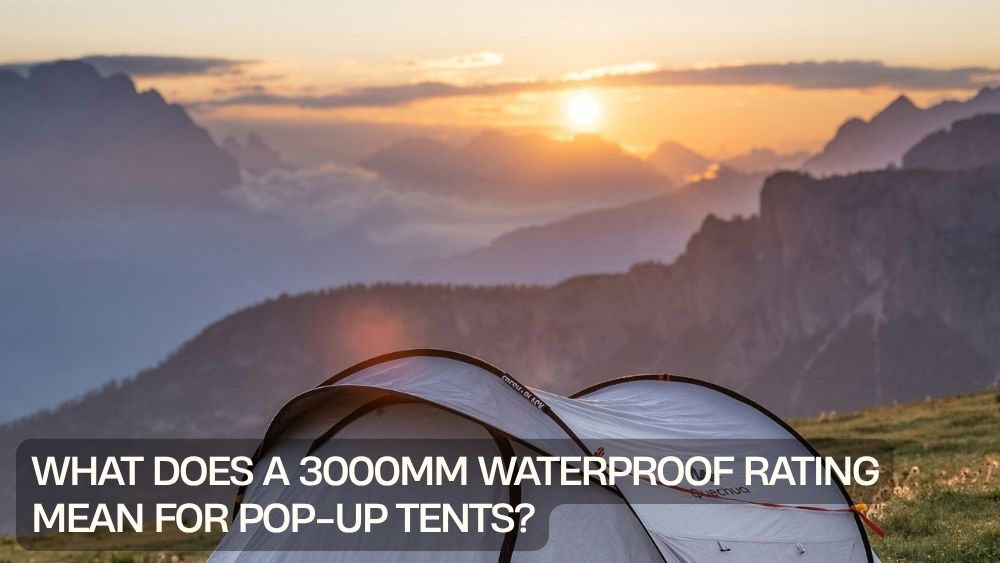
What Does 3000mm Waterproof Rating Mean?
A 3,000mm waterproof rating generally refers to hydrostatic head, a laboratory measurement of how much water pressure a fabric can withstand before water penetrates through it.
The measurement is expressed in millimeters of water column.
In simple terms, imagine a vertical tube filled with water sitting against the fabric.
The higher the water column can become before water passes through the material, the higher the hydrostatic-head rating.
REI explains that waterproof testing uses water-column or hydrostatic-pressure methods, with results commonly expressed in millimeters. REI considers 2,109mm or higher equivalent to 3 PSI as rainproof for its rainwear guidance.
So, when you see 3,000mm, you're looking at a fabric-level water-pressure measurement rather than a prediction of how many inches of rain a tent can handle.
That's an important distinction.
Is 3000mm Waterproof Good for Camping?
A 3,000mm rating can provide substantial water resistance for many camping situations.
But it should not be interpreted as a guarantee that the entire tent will remain dry under every possible weather condition.
Why?
Because water doesn't only attack fabric from directly above.
Rain can:
- Blow sideways
- Pool on the ground
- Splash upward
- Run down seams
- Enter through doors
- Push beneath a poorly positioned rainfly
- Find gaps around zippers
- Collect beneath the tent floor
A fabric can have a strong hydrostatic-head rating while the complete shelter still has vulnerable points.
Think of the waterproof rating as one piece of the tent's weather-defense system.
Fabric Rating vs. Whole-Tent Waterproofing
This is where many camping shoppers get tripped up.
A waterproof rating usually describes a particular material or component.
The complete tent is a system.
That system may include:
- Tent canopy
- Rainfly
- Floor
- Seams
- Zippers
- Doors
- Windows
- Pole connections
- Guy lines
- Ground contact points
A tent with a 3,000mm-rated fabric can still experience leakage if water enters through an untreated seam or an exposed opening.
Conversely, thoughtful construction can make a tent perform better than a single specification might suggest.
REI notes that full-coverage rainflies provide greater protection from wind and rain than roof-only rainflies.
That is why the waterproof rating should never be your only buying criterion.
What Is Hydrostatic Head?
Hydrostatic head sounds complicated, but the basic concept is straightforward.
It measures resistance to water pressure.
Imagine placing a fabric sample at the bottom of a transparent vertical tube.
Water is added.
As the water column gets taller, pressure against the fabric increases.
At some point, water begins penetrating the material.
The height of the water column at that point is the hydrostatic-head measurement.
A 3,000mm rating therefore represents a fabric that withstands a water column of approximately 3,000mm under the relevant test conditions.
It does not mean the tent can sit beneath 3 meters of standing water.
It does not mean 3,000mm of rainfall can fall on the tent.
And it does not automatically describe the waterproof performance of every part of the shelter.
Why a 3000mm Rating Isn't the Same as "3000mm of Rain"
This distinction deserves emphasis.
Rainfall is normally measured as the amount of precipitation accumulated over a period of time.
Hydrostatic head measures water pressure applied during a test.
Those are different measurements.
A storm delivering heavy rain does not simply create a vertical 3,000mm column of water on your tent.
Wind, surface runoff, splash, pooling, fabric tension, and construction details can all affect performance.
So if a product specification says 3,000mm waterproof, don't translate that into "this tent can handle 3,000mm of rain."
Instead, interpret it as information about the water-pressure resistance of the tested material.
Why Tent Seams Matter
Even excellent waterproof fabric has seams.
Every seam creates a potential pathway for water.
That is why seam construction matters when evaluating a tent.
Manufacturers may use:
- Seam tape
- Seam sealing
- Welded construction
- Overlapping fabric
- Protective rainfly designs
For example, REI product specifications show tents using taped seams and waterproof fabrics as part of a broader weatherproofing system.
If you're shopping for a rainy-weather tent, don't stop after reading the hydrostatic-head number.
Look for information about seam treatment too.
The Floor Deserves Extra Attention
Your tent floor has a particularly difficult job.
It doesn't just deal with rain from above.
It sits against the ground.
That means water can come from below or from runoff moving across the campsite.
A good tent floor should be designed to resist ground moisture, particularly when the surrounding soil becomes saturated.
Some tents use a bathtub-style floor that extends upward around the lower walls.
This design helps reduce the likelihood of water entering where the floor meets the tent walls.
The floor may also have a different waterproof rating from the rainfly.
That's normal.
For example, current tent specifications can show different hydrostatic-head ratings for fly and floor materials, reflecting their different jobs.
Why Setup Can Affect Waterproofing
Even a well-designed tent can perform poorly if it is pitched incorrectly.
The rainfly should be positioned correctly.
Guy lines should be used when appropriate.
The tent should be tensioned according to the manufacturer's instructions.
Doors and windows should be fully closed during heavy rain.
The tent should also be positioned so water can drain away from the sleeping area.
Avoid low points where rainwater naturally collects.
Camping in a shallow depression may look comfortable when the weather is dry.
After several hours of rain, it can become an unwanted swimming-pool prototype.
Does a Pop-Up Tent Have Good Rain Protection?
The major advantage of a pop-up tent is convenience.
Instead of assembling a collection of separate poles and sleeves, an instant design can significantly simplify setup.
That convenience is particularly useful for:
- Weekend camping
- Family trips
- Festivals
- Road trips
- Beginner campers
- Quick overnight stays
- Campsites where setup time matters
However, easy setup does not automatically equal maximum storm performance.
You still need to follow the manufacturer's setup instructions and secure the tent appropriately for the conditions.
4-Person Instant Pop-Up Camping Tent: What to Look For
A 4-Person Instant Pop-Up Camping Tent is designed around convenience and shared camping space.
The TotalFindz tents collection includes camping options for different outdoor setups.
The supplied product is a 4-person easy pop-up camping tent featuring doors, windows, a carry bag, and an automatic setup design.
That combination makes it particularly relevant for campers who want to reduce setup complexity.
The product is also listed as a yellow tent, which can provide easy visual identification around a busy campground.
When considering an instant tent for wet-weather camping, look beyond its setup mechanism.
Check:
- Waterproof rating
- Rainfly design
- Floor construction
- Seam treatment
- Door coverage
- Window design
- Ventilation
- Guy-line points
- Included stakes
- Packed size
- Carrying system
You can explore the 4-person instant pop-up camping tent when comparing easy-setup options.
Does a Higher Waterproof Rating Always Mean a Better Tent?
Not necessarily.
A 10,000mm fabric may have a higher hydrostatic-head rating than a 3,000mm fabric.
That doesn't automatically make the entire tent better for your particular trip.
Why?
Because you also need to consider:
Ventilation
A completely sealed shelter can become humid and uncomfortable.
Weight
More robust materials can increase packed weight.
Packability
Backpackers often prioritize low weight and compact packed dimensions.
Durability
Coating quality and fabric construction affect longevity.
Pole and frame design
A waterproof fabric doesn't make a tent structurally suitable for severe weather.
Rainfly coverage
A full-coverage fly can provide important additional protection.
REI specifically notes that tent shape, pole structure, rainfly coverage, and fabric construction all contribute to weather performance.
The best tent is therefore the one whose overall design matches your intended conditions.
3000mm vs. 1000mm vs. 5000mm
It's useful to think about waterproof ratings as part of a spectrum rather than a simple pass/fail scale.
| Waterproof Rating | General Interpretation |
|---|---|
| Around 1,000mm | Lower water-pressure resistance |
| Around 2,000mm | Greater resistance for wet-weather use |
| Around 3,000mm | Strong water-pressure resistance for many camping applications |
| Around 5,000mm | Higher resistance, often useful for floors or demanding conditions |
| 10,000mm+ | Very high hydrostatic-head rating, depending on material and construction |
These numbers should not be treated as universal performance grades.
Testing methods, materials, coatings, construction, and manufacturer specifications can vary.
REI also points out that waterproof testing standards and interpretations can differ between brands and product categories.
What About Wind-Driven Rain?
Wind changes the equation.
Rain falling vertically is one thing.
Rain blowing sideways into the tent is another.
Wind-driven precipitation can reach:
- Door edges
- Windows
- Fly gaps
- Lower wall sections
- Zippers
- Seams
This is one reason full-coverage rainflies can be useful.
Tent shape matters too.
REI notes that taller tents can experience more wind movement because larger fabric panels catch gusts, while lower-profile shapes can offer advantages in exposed conditions.
For a family pop-up tent, choose a sheltered campsite when conditions allow and secure the tent properly.
Ventilation Still Matters
Waterproofing isn't about creating a sealed plastic bubble.
People generate moisture simply by breathing.
Wet clothing, damp equipment, and temperature differences can add even more.
Without sufficient ventilation, condensation can develop inside the tent.
And condensation can look suspiciously like a leak.
That is why doors, windows, mesh panels, and vents are important.
A good camping shelter needs to manage both outside water and inside moisture.
Your goal is dry camping, not a portable sauna.
How to Keep a 3000mm-Rated Tent Dry
Even a well-rated tent benefits from smart campsite habits.
Choose Higher Ground
Avoid depressions where rainwater can collect.
Use Proper Stakes
Secure the tent according to the manufacturer's instructions.
Tension the Rainfly
Avoid unnecessary contact between the rainfly and inner tent where the design calls for separation.
Keep Doors Closed
Don't leave entrances open during heavy rain.
Manage Wet Gear
Keep wet clothing and footwear organized rather than spreading moisture throughout the sleeping area.
Ventilate
Use available vents or mesh panels to reduce condensation.
Protect the Floor
If a footprint is recommended or included, use it according to the manufacturer's instructions.
Dry the Tent Before Storage
Moisture left inside a packed tent can contribute to mold and deterioration.
The North Face's tent care guidance similarly recommends drying tents thoroughly before storage because moisture and mold can damage waterproof coatings.
Common Waterproofing Mistakes
Assuming 3000mm Means Storm-Proof
It doesn't.
The rating describes water-pressure resistance, not every possible weather condition.
Ignoring the Seams
Fabric can resist water while a poorly protected seam becomes a weak point.
Setting Up in a Low Spot
Even an excellent tent can't stop water from pooling around it indefinitely.
Blocking Ventilation
Trying to keep every opening closed can increase condensation.
Packing the Tent Wet
This can damage materials over time.
Treating the Rating as a Product Score
A waterproof number doesn't tell you everything about durability, ventilation, wind performance, or setup.
Is a 3000mm Pop-Up Tent Good for Family Camping?
For many recreational campers, a 3,000mm-rated fabric can be a useful specification to see, particularly when combined with appropriate tent construction.
A 4-person instant tent can make sense when convenience is a priority.
You get a straightforward setup process, room for a small group, and a design that is easier to manage than a complicated pole system.
But always consider the conditions.
A casual summer campsite is different from an exposed mountain location.
A sheltered forest campground is different from an open beach.
A weekend forecast with light showers is different from a severe storm.
Match the shelter to the environment.
Final Thoughts
So, what does a 3000mm waterproof rating actually mean for a pop-up tent?
It means the tested material has a hydrostatic-head resistance of approximately 3,000mm under the applicable test conditions.
That's useful information.
But it's not the whole story.
A tent's real-world rain performance also depends on its seams, rainfly coverage, floor construction, doors, windows, ventilation, setup, campsite location, and overall design.
For campers considering a 4-Person Instant Pop-Up Camping Tent, the 3,000mm figure should be viewed as one part of the buying checklist.
Look at the complete shelter.
Check how quickly it sets up.
Consider the number of occupants.
Inspect the rainfly and floor design.
Think about ventilation.
And most importantly, match the tent to the weather you're actually likely to encounter.
A waterproof rating is a number.
A dry campsite is a system.
Build the system wisely, and rainy camping becomes a manageable inconvenience rather than the headline of your weekend.