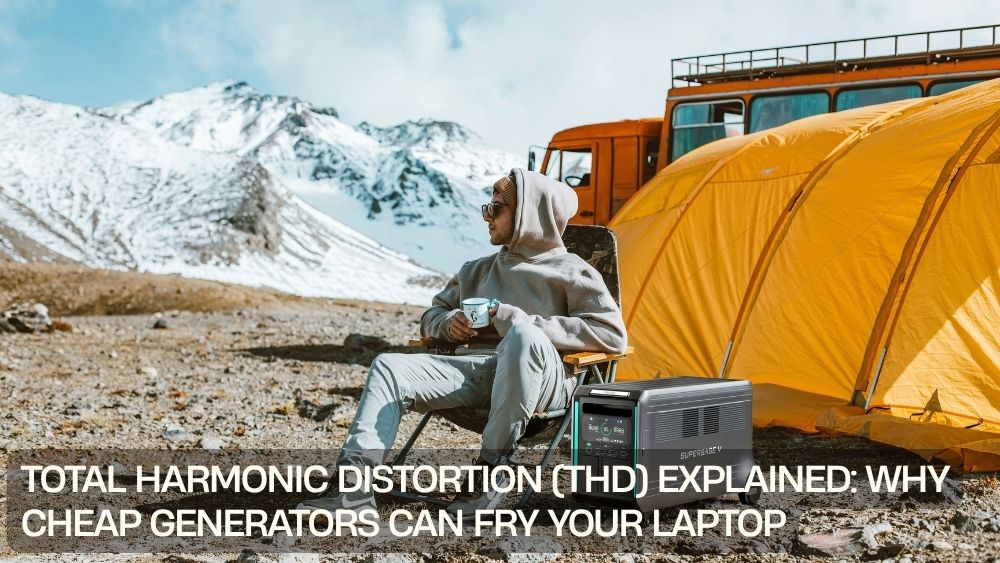
A generator can keep your refrigerator running, power the lights during an outage, and make a camping trip considerably less primitive.
But if you're planning to connect a laptop, television, gaming console, router, or other sensitive electronics, there's another specification worth understanding before you pull the starter.
Total Harmonic Distortion, or THD.
It sounds like something from an electrical engineering textbook. In reality, it is one of the most useful concepts to understand when you're comparing portable generators for modern electronics.
The reason is simple: not all generator electricity has the same waveform quality.
A conventional generator can produce power that is perfectly adequate for some loads while being less ideal for sensitive electronic equipment. Inverter generators use a different electrical architecture designed to produce a cleaner, more controlled output waveform.
That doesn't mean every inexpensive conventional generator will instantly destroy your laptop. The real story is more nuanced.
But if you're shopping for a 2000W Portable Super Quiet Inverter Generator, understanding THD can help you evaluate what you're actually buying instead of choosing based only on peak watts, engine size, or price.
What Is Total Harmonic Distortion?
Electricity supplied by the grid is designed around a sinusoidal AC waveform.
In an idealized world, the voltage rises and falls smoothly in a predictable sine-wave pattern.
Real electrical systems aren't perfectly ideal, however.
Nonlinear loads and generation equipment can introduce additional frequency components called harmonics.
Total Harmonic Distortion measures the amount of harmonic content relative to the fundamental frequency.
In simplified terms:
Lower THD = voltage waveform that is closer to a clean sine wave.
Higher THD = greater distortion from the ideal waveform.
The U.S. Department of Energy describes harmonic distortion as a form of power-quality issue that can affect electrical equipment and power systems.
For generator shoppers, the important takeaway is that wattage tells you how much power a generator can supply, while THD tells you something about the quality of the AC waveform being supplied.
Those are two very different questions.
Why Does THD Matter for Electronics?
Modern electronics are packed with power supplies, switching circuits, microprocessors, chargers, and other components designed to convert incoming AC power into the DC voltages they need.
A laptop charger, for example, doesn't simply pass generator electricity directly into your computer.
It converts and regulates incoming power.
That doesn't mean the quality of the incoming waveform is irrelevant.
Poor power quality can contribute to additional stress, heating, interference, or malfunction in some electrical equipment.
The sensitivity varies significantly by device and power-supply design.
This is why manufacturers of electronics and generators often provide guidance about compatible power sources rather than assuming every AC source behaves identically.
Does High THD Really "Fry" a Laptop?
This is where generator marketing can get dramatic.
You will often see claims suggesting that high-THD generators will immediately destroy laptops, phones, televisions, and other electronics.
That's too simplistic.
High THD does not automatically mean a laptop will be destroyed.
Many modern electronic power supplies are designed to tolerate a range of input conditions.
The risk depends on the equipment, the generator, the actual waveform, voltage regulation, frequency stability, load conditions, and other characteristics of the power source.
However, if you're deliberately choosing a generator for sensitive electronics, there's little reason to ignore power quality.
The safer purchasing approach is to look for a generator with a clearly specified low-THD inverter output and follow the electronics manufacturer's guidance.
What Is an Inverter Generator?
A conventional portable generator generally uses an engine to turn an alternator that produces AC electricity.
An inverter generator takes a different approach.
The generator produces electrical energy, which is processed electronically before being converted into the final AC output.
This architecture allows the generator to electronically control the output waveform and frequency.
The result can be a cleaner, more stable AC supply than that produced by many conventional portable generator designs.
The U.S. Department of Energy notes that inverter generators can provide cleaner power for sensitive electronics while also allowing the engine to operate at variable speeds depending on electrical demand.
That variable-speed operation is also one reason inverter generators are often associated with quieter operation and improved fuel efficiency.
THD and the Sine Wave
A clean AC waveform is commonly represented as a sine wave.
A simplified illustration looks like this:
Clean waveform
Smooth rise → peak → smooth fall → negative peak → repeat
Harmonic distortion changes that shape by adding additional frequency components.
The waveform may become more irregular.
You don't need an oscilloscope to understand the practical point.
If a generator manufacturer specifically publishes a low THD figure for its inverter output, that gives you useful information about the quality of the electricity you're buying.
If the manufacturer doesn't publish THD at all, you have less information.
Why Inverter Generators Are Popular for Laptops
A laptop is a classic example of a modern electronic load.
It contains sensitive components and normally receives power through an external AC adapter.
During an outage, you might want to run:
- Laptop
- Wi-Fi router
- Monitor
- Phone charger
- Television
- Gaming console
- Small networking equipment
These are very different from purely resistive loads such as some basic heating elements.
A laptop charger has electronic circuitry that converts AC into DC.
That's why shoppers specifically interested in electronics often look for inverter generators rather than selecting a conventional generator solely because it offers more watts.
The 2000W Number Is Not a THD Rating
2000W Portable Super Quiet Inverter Generator
Notice that "2000W" and "THD" describe completely different things.
A generator can have:
- High wattage and high THD
- High wattage and low THD
- Lower wattage and low THD
- Lower wattage and unknown THD
The wattage tells you how much electrical load the generator can support.
THD tells you about waveform distortion.
Noise level tells you how loud the generator operates.
Fuel capacity tells you how long it may run under particular conditions.
None of these specifications replaces the others.
That's why generator shopping is much easier when you treat each number as answering a different question.
The TotalFindz Product: 2900W Peak, 1800W Running
The supplied TotalFindz product is a portable inverter generator rated at 2,900W peak power and 1,800W running power, with a quiet-gas-powered design and a CO sensor.
The product's listed figures are:
- 2,900W peak output
- 1,800W running output
- Portable inverter-generator design
- Gas-powered engine
- Quiet-operation positioning
- CO sensor
Shop the Portable Inverter Generator on TotalFindz

For buyers, the distinction between peak and running power is particularly important.
Peak Watts vs. Running Watts
Generators often publish two wattage figures.
Running watts represent the power the generator can continuously provide under the manufacturer's specified conditions.
Peak or starting watts represent additional short-term power available for starting certain loads.
Motors and compressors can require significantly more power during startup than they consume once running.
That's why a generator might advertise something like:
2,900W peak / 1,800W running
The larger number is not the amount of power you should assume is continuously available.
For planning a generator setup, start with the continuous loads you actually need to run.
Then consider startup requirements for equipment with motors or compressors.
Why You Shouldn't Add Every Appliance's Wattage Blindly
Imagine an outage scenario:
- Laptop: low power
- Wi-Fi router: low power
- LED lights: low power
- Television: moderate power
- Refrigerator: moderate running power with startup demand
Adding the nameplate wattages gives you a starting point.
But refrigerators, pumps, air conditioners, power tools, and other motor-driven devices can have startup requirements that differ substantially from their running consumption.
The U.S. Department of Energy recommends considering both running and starting power when sizing a generator for appliances with motors.
This is why a generator's peak number should never be treated as its everyday operating capacity.
How Quiet Is "Super Quiet"?
The phrase super quiet sounds wonderfully peaceful.
It is also not a standardized performance category.
Noise should be evaluated using a published decibel rating, ideally with the measurement conditions provided.
Generator noise can vary according to:
- Distance from the generator
- Load level
- Engine speed
- Generator enclosure
- Surface beneath the generator
- Surrounding environment
Inverter generators can be quieter because their engines can reduce speed when electrical demand falls.
The U.S. Department of Energy notes that inverter generators can vary engine speed according to electrical load, which can reduce fuel consumption and noise compared with generators that operate at a constant speed.
So when you see "quiet," look for actual dB information rather than relying on the adjective.
What About the CO Sensor?
Carbon monoxide is a serious hazard associated with fuel-burning generators.
A CO sensor or automatic CO shutoff system can provide an additional safety feature, but it does not make indoor generator operation safe.
Portable fuel-burning generators should be operated outdoors and away from doors, windows, and vents, according to manufacturer instructions and applicable safety guidance.
The U.S. Consumer Product Safety Commission warns that carbon monoxide from portable generators can kill within minutes and recommends operating generators outside and far away from structures.
A CO sensor is therefore not permission to run a generator in a garage, basement, shed, enclosed porch, or other enclosed space.
Think of the sensor as a backup safety layer, not a substitute for proper placement.
THD Isn't the Only Power-Quality Specification
THD deserves attention, but it isn't the entire power-quality picture.
When evaluating an inverter generator for electronics, also consider:
Voltage Regulation
The generator should maintain voltage within the manufacturer's stated operating range under changing loads.
Frequency Stability
North American household AC power is typically based around 60 Hz.
Frequency stability matters for equipment that relies on AC timing.
Waveform Quality
THD gives you information about harmonic distortion.
Load Management
Large changes in electrical demand can affect generator behavior.
Protection Features
Look for overload protection, low-oil shutdown, grounding information, and other manufacturer-specified safety features.
How Much THD Is Acceptable?
This is one of the trickiest questions because there isn't one universal number that guarantees compatibility with every electronic device.
Many inverter generators marketed for sensitive electronics advertise THD below 3%, and some manufacturers specify even tighter figures.
However, don't treat a particular percentage as a universal guarantee that every electronic device will operate safely.
Instead, check:
- The generator manufacturer's THD specification.
- The electronics manufacturer's power requirements.
- Voltage and frequency specifications.
- Generator operating instructions.
- Any required surge protection or conditioning equipment.
The lower the published THD, the closer the waveform generally is to the ideal fundamental waveform, but compatibility remains equipment-specific.
What About a Surge Protector?
A surge protector and a low-THD generator solve different problems.
A surge protector is designed to help protect equipment against transient voltage spikes.
It does not magically transform a distorted generator waveform into a perfect sine wave.
Similarly, a low-THD inverter generator does not eliminate every possible electrical hazard.
Think of them as different layers of electrical protection.
If your equipment manufacturer recommends a particular power-conditioning solution, follow that guidance.
UPS Systems Add Another Layer
If you're particularly concerned about a laptop, workstation, network system, or other sensitive electronics, a UPS can provide another layer of protection.
A UPS can keep equipment powered during short interruptions and, depending on its design, may provide power conditioning or regulation.
However, UPS units vary.
Some UPS systems may be sensitive to generator waveform characteristics, while others are designed to work with generator power.
If you plan to connect a UPS to a generator, check compatibility with both manufacturers.
How to Choose a Generator for Electronics
If your priority is powering electronics during outages, use this checklist.
1. Look for an Inverter Design
An inverter generator is generally the type shoppers consider when cleaner power for electronics is a priority.
2. Check the THD Specification
Don't settle for vague phrases such as "safe for electronics" if the manufacturer can provide an actual THD figure.
3. Check Running Watts
This tells you more about sustained capacity than peak wattage.
4. Check Starting Watts
Consider appliances with motors and compressors.
5. Check Voltage and Frequency
Make sure they match the requirements of your equipment and region.
6. Check Noise Ratings
Look for actual dB measurements and the conditions under which they were recorded.
7. Check CO Safety Features
A CO sensor can be valuable, but proper outdoor operation remains essential.
8. Consider Runtime
Look for published runtime at a stated load percentage rather than assuming the maximum runtime applies under full load.
A Practical Emergency Power Setup
Suppose you want a generator primarily for a home office during a power outage.
Your equipment might include:
- Laptop
- External monitor
- Wi-Fi router
- Phone charger
- LED desk lamp
The total electrical demand could be relatively modest.
Instead of buying the largest generator you can afford, calculate the actual continuous load and consider startup requirements for anything with a motor.
An inverter generator can then provide a combination of portable power, controlled output, and relatively low operating noise.
If you also need to operate a refrigerator, sump pump, furnace blower, or other motor-driven equipment, the sizing calculation becomes more complicated.
That's when peak demand becomes important.
Common Generator Shopping Mistakes
Mistake 1: Buying by Peak Watts Alone
2,900W peak does not mean 2,900W continuous.
Mistake 2: Ignoring THD
If you're powering electronics, waveform quality deserves attention.
Mistake 3: Assuming "Inverter" Means Perfect Power
Inverter technology can provide cleaner output, but check the manufacturer's actual specifications.
Mistake 4: Treating "Quiet" as a Measured Specification
Look for decibels.
Mistake 5: Running a Generator Indoors
Never use a fuel-burning portable generator inside a home, garage, basement, shed, or other enclosed space.
Mistake 6: Assuming a CO Sensor Makes Indoor Use Safe
It doesn't.
Mistake 7: Confusing Running and Peak Watts
Use continuous output for sustained loads and account for startup requirements separately.
The Bottom Line
THD is one of the most useful specifications to understand when choosing a generator for modern electronics, but it isn't the only specification that matters.
A generator's wattage tells you about capacity.
THD tells you about harmonic distortion.
Voltage regulation tells you about voltage stability.
Frequency tells you about AC timing.
Noise ratings tell you how loud the machine is under specified conditions.
Runtime tells you how long you can operate before refueling.
And safety systems help address hazards associated with generator operation.
For someone researching a 2000W Portable Super Quiet Inverter Generator, the smartest approach is therefore to look beyond the headline wattage.
Check the actual running output, peak output, published THD, voltage and frequency, noise rating, runtime, safety features, and manufacturer instructions.
The TotalFindz product featured here illustrates why those distinctions matter. Its listed 2,900W peak and 1,800W running output describe generator capacity, while its inverter architecture addresses the way electrical power is produced and controlled.
Most importantly, don't let a generator's price or wattage become the entire buying decision.
Your laptop doesn't care how impressive the generator looks in the garage.
It cares about the electricity coming out of it.