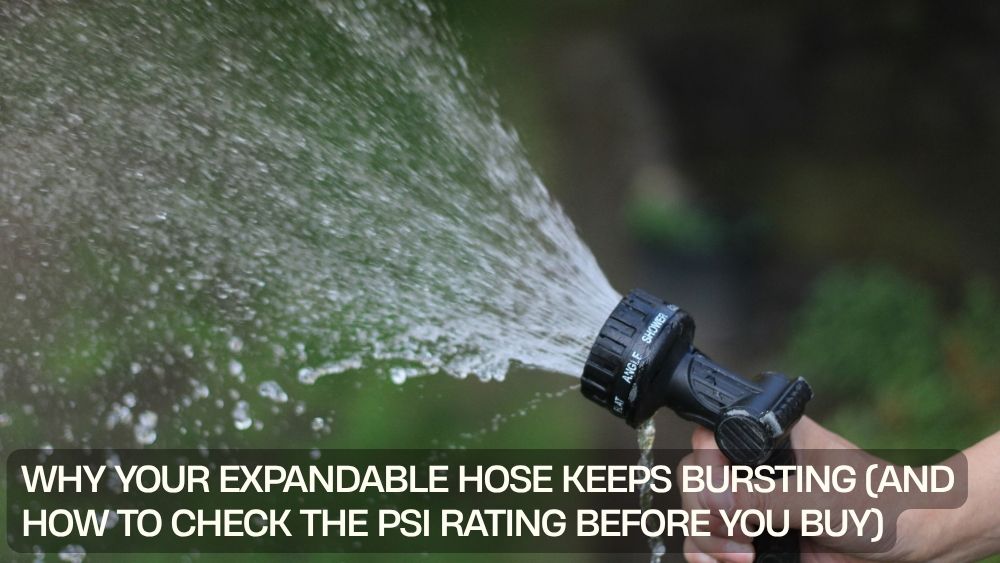
Nothing ruins a peaceful Saturday morning quite like the sound of a garden hose turning into a water-powered snake.
One minute you're watering tomatoes.
The next, there's a geyser erupting beside your feet.
Expandable hoses are especially convenient because they're lightweight, compact, and designed to expand when pressurized. But convenience doesn't make a hose indestructible. Pressure, heat, sunlight, abrasion, poor fittings, aging materials, and improper storage can all contribute to leaks or failures.
And there's one number that deserves much more attention before you buy:
PSI.
Understanding a hose's pressure rating can help you choose equipment that matches your home's water supply and intended use. It can also prevent a common mistake: confusing a hose's working pressure with its maximum or burst pressure.
If you're shopping for a Heavy-Duty 100ft Expandable Garden Hose with Solid Brass Fittings, there's another detail worth checking. The supplied TotalFindz product is actually a 100-foot stainless-steel metal garden hose, not an expandable hose. Its listed specifications include an 80 PSI working water pressure and 500 PSI maximum pressure, along with solid brass connectors.
So let's unpack the PSI mystery before your next hose decides to become modern art.
What Does PSI Mean on a Garden Hose?
PSI means pounds per square inch.
It measures pressure.
Your home's outdoor faucet delivers water at a certain pressure, and the hose needs to be capable of operating safely within its rated limits.
But garden-hose specifications can include multiple pressure numbers, and they don't all mean the same thing.
You might see:
- Working pressure
- Maximum working pressure
- Burst pressure
- Maximum pressure
- Test pressure
The most important number for everyday use is generally the working pressure rating.
That's the pressure the hose is designed to handle during normal operation.
A much higher burst or maximum-pressure figure should not be interpreted as the pressure you should routinely operate the hose at.
For example, VEVOR lists one of its heavy-duty 100-foot hoses at 150 PSI working pressure and 600 PSI burst pressure. Those are two different ratings serving two different purposes.
Working Pressure vs. Burst Pressure
This distinction is crucial.
Imagine a hose has:
Working pressure: 150 PSI
Burst pressure: 600 PSI
That doesn't mean you should run your garden faucet at 600 PSI.
The 600 PSI figure describes a much higher pressure threshold associated with failure testing or burst capacity. It is not the everyday operating target.
Think of working pressure as the hose's normal-duty lane.
Burst pressure is closer to the edge of the cliff.
You want to spend your gardening life comfortably inside the first lane.
How Much Water Pressure Does a Typical Home Have?
Consumer Reports reported that ordinary residential water pressure is commonly around 40 to 80 PSI, while its testing of several expandable hoses found that they did not burst until pressure exceeded 200 PSI.
That doesn't mean every house has the same pressure.
Your home's pressure depends on factors such as:
- Municipal supply
- Pressure regulator settings
- Plumbing design
- Elevation
- Well system settings
- Water demand
- Building configuration
That's why checking your actual outdoor-faucet pressure can be useful when selecting a hose.
If your water supply is unusually high, you should pay particular attention to the hose's rated working pressure.
Why Does an Expandable Hose Burst?
An expandable hose typically contains a flexible inner tube surrounded by an outer protective material.
When water pressure enters the hose, the inner portion expands and the hose becomes longer and wider.
When the water is shut off, the hose contracts.
That flexibility is the entire appeal.
But it also means the hose's construction has to repeatedly tolerate pressure cycles.
Several things can contribute to failure.
1. Excessive Water Pressure
The most obvious culprit is pressure beyond the hose's rated operating range.
If your supply pressure is too high, you're asking the hose to work outside its intended conditions.
Don't look only at the maximum pressure number.
Check the working pressure rating first.
2. Damage to the Outer Cover
A small cut or abrasion can become a weak point.
Consumer Reports found that small nicks in expandable hoses could create weak spots during testing, and its reporting also noted that damaged expandable hoses generally weren't repairable in the same way as conventional hoses.
Dragging a hose repeatedly across concrete, rocks, sharp landscaping edges, or metal corners can accelerate wear.
3. UV Exposure
Sunlight can be hard on outdoor materials.
Expandable-hose manufacturers have warned users to keep these hoses out of direct sunlight when not in use, according to Consumer Reports.
If your hose spends every afternoon baking on a driveway, you're adding unnecessary environmental stress.
4. Poor Storage
Leaving a hose tangled, crushed, or exposed to extreme weather can shorten its useful life.
Proper storage isn't glamorous.
Neither is replacing a burst hose for the third time.
5. Weak Connections
Sometimes the hose isn't the problem.
The connector is.
A poorly fitted adapter, damaged washer, cross-threaded connection, or low-quality fitting can produce leaks even when the hose itself remains intact.
That's why the fittings deserve nearly as much attention as the hose material.
Why Fittings Matter So Much
The hose wall might be strong, but the connection between the hose and faucet still needs to contain pressurized water.
A good garden hose should have fittings that connect securely and use appropriate washers or seals.
The supplied VEVOR 100-foot stainless-steel hose uses solid brass connectors and is designed around a leak-resistant connection system. VEVOR lists the hose at 80 PSI working water pressure and 500 PSI maximum pressure.
This is one reason the phrase Heavy-Duty 100ft Expandable Garden Hose with Solid Brass Fittings contains an important buying concept even though the supplied product itself is not expandable.

Don't evaluate the hose tube alone.
Evaluate the entire water path.
The Supplied 100-Foot Hose Is Different From an Expandable Hose
This distinction matters for shoppers.
The product supplied for this article is the VEVOR 100 ft Metal Garden Hose, featuring a stainless-steel outer layer and a PVC inner tube.
VEVOR lists:
- 100-foot length
- 201 stainless-steel outer material
- 80 PSI working water pressure
- 500 PSI maximum pressure
- Approximately 10.41 lb weight
- 10-pattern spray nozzle
- Solid brass connectors
- Kink-resistant construction
The product is therefore better described as a stainless-steel metal garden hose rather than an expandable hose.
It does not rely on the familiar stretch-and-contract design of fabric-covered expandable hoses.
That can be an important distinction if you're tired of hoses that expand, retract, or become difficult to control.
Why a Metal Hose Doesn't "Expand" Like an Expandable Hose
An expandable hose changes its dimensions as pressure changes.
A metal garden hose is constructed differently.
The stainless-steel exterior provides a protective layer around the flexible internal tube, while the hose maintains its general physical form during use.
The supplied VEVOR model is specifically marketed as kink-resistant and lightweight relative to traditional rubber hoses. VEVOR says its stainless-steel construction is designed to resist wear and corrosion and that the hose weighs 20–30% less than traditional rubber hoses.
That makes it an interesting alternative for shoppers who want flexibility without the characteristic expansion and contraction of an expandable hose.
How to Check Your Home's Water Pressure
Before choosing a hose based on PSI, you can measure your home's water pressure with a water-pressure gauge designed for this purpose.
Many gauges connect to a hose bib or outdoor faucet.
The basic process is:
- Turn off water-consuming fixtures.
- Attach the pressure gauge to the faucet.
- Open the faucet fully.
- Read the pressure.
- Compare the measurement with the hose's rated working pressure.
If your home's pressure is unusually high, don't simply choose a hose with an impressive maximum PSI number and assume the problem is solved.
Investigate the plumbing system and pressure regulation as appropriate.
A hose should not be used as a substitute for correcting excessive household water pressure.
Don't Confuse Pressure With Water Flow
PSI isn't the same thing as gallons per minute.
Pressure describes the force pushing water through the system.
Flow describes how much water is actually moving through the hose over time.
A larger-diameter hose can potentially deliver greater flow under appropriate conditions, while restrictions in the hose, fittings, nozzle, faucet, or plumbing can reduce flow.
That's why a hose can have a high pressure rating without necessarily delivering an enormous stream of water.
If you're choosing a hose for watering a garden, washing a vehicle, filling containers, or cleaning a patio, consider both:
Pressure + flow.
Why a Nozzle Changes the Experience
The nozzle at the end of the hose can dramatically change how the water feels.
A narrow spray pattern can create a concentrated stream.
A mist setting distributes water over a broader area.
A flat spray may be useful for certain cleaning tasks.
The supplied VEVOR 100-foot metal hose includes a 10-pattern spray nozzle, allowing different spray configurations for watering and cleaning.
That versatility can make a long hose more useful around a property.
But remember:
A nozzle controls the water leaving the hose.
It doesn't increase the hose's safe working-pressure rating.
Can You Connect a Garden Hose to a Pressure Washer?
This is another place where people get into trouble.
A garden hose and a pressure-washer hose are not automatically interchangeable.
The supplied VEVOR 100-foot metal garden hose specifically states that use with a pressure washer is not recommended.
That's an important example of why matching a product to its intended application matters.
If you're using a pressure washer, use a hose specifically designed and rated for that equipment.
Don't assume that a high maximum PSI number on a garden hose means it's suitable for pressure-washer discharge pressure.
How to Make Your Hose Last Longer
A good hose still benefits from good habits.
Avoid sharp edges
Don't repeatedly drag the hose across abrasive concrete, rocks, or sharp landscaping.
Don't run over it
Vehicles, lawn equipment, and heavy objects can damage hose structures and fittings.
Avoid unnecessary kinks
Even a hose marketed as kink-resistant should not be treated like an indestructible cable.
Shut off the water when finished
Don't leave a hose continuously pressurized when you don't need it.
Drain before storage
Removing trapped water can reduce unnecessary weight and help with seasonal storage.
Store away from harsh exposure
Direct sunlight and extreme environmental conditions can accelerate aging for many hose materials.
Inspect regularly
Look for:
- Bulges
- Cracks
- Abrasions
- Cuts
- Leaks
- Damaged fittings
- Loose connectors
- Deformed washers
If a hose develops significant damage, replace it rather than attempting to push it beyond its intended service life.
What PSI Rating Should You Look For?
There isn't one universal PSI number that's perfect for every garden hose.
Instead, compare the hose's working pressure rating with the pressure available from your water supply.
For example, if a hose is rated for 80 PSI working pressure, that rating should be treated as an important operating limit.
The supplied VEVOR metal hose is listed at exactly 80 PSI working water pressure, with a separate 500 PSI maximum-pressure specification.
Other VEVOR heavy-duty hoses have different ratings. One 100-foot 5/8-inch reinforced hose, for example, is listed at 150 PSI working pressure and 600 PSI burst pressure.
That difference illustrates why you should never assume all "heavy-duty" hoses share the same PSI rating.
Read the specification sheet for the exact model.
Expandable vs. Metal Garden Hose
| Feature | Expandable Hose | Stainless-Steel Metal Hose |
|---|---|---|
| Changes length under pressure | Yes | No |
| Compact when not pressurized | Usually | Less so |
| Outer protection | Often fabric/material sleeve | Stainless-steel outer layer |
| Kink resistance | Depends on design | Designed for kink resistance |
| Pressure rating | Model specific | Model specific |
| Fitting quality | Varies | Product specific |
| Storage | Often compact | Typically coils like a conventional hose |
| Best for | Lightweight, compact watering | Durable everyday gardening and cleaning |
| Pressure checking | Essential | Essential |
Neither design eliminates the need to check specifications.
A hose is only as reliable as its weakest component.
Is a 100-Foot Hose Right for You?
A 100-foot hose gives you considerable reach.
That's useful for:
- Large yards
- Gardens
- Driveways
- Patios
- Vehicle washing
- Outdoor cleaning
- Pet washing
- Reaching distant planting beds
But more length also means more hose to move and store.
A 100-foot hose can become surprisingly substantial once you're dragging it around a property.
The supplied VEVOR model weighs about 10.41 pounds, before accounting for additional accessories or water inside the hose.
Before buying, measure the distance from your faucet to the farthest area you actually need to reach.
You might discover that 100 feet is perfect.
Or you might discover that 50 feet would be considerably easier to manage.
The PSI Checklist Before You Buy
Before purchasing any garden hose, especially a product marketed as a Heavy-Duty 100ft Expandable Garden Hose with Solid Brass Fittings, check these specifications:
1. Working PSI
This is your primary number for normal operation.
2. Burst or maximum PSI
Useful for understanding the product's pressure limits, but don't treat it as a recommended operating pressure.
3. Hose length
Choose enough reach without buying unnecessary extra length.
4. Diameter
Diameter influences potential flow and compatibility with fittings.
5. Fittings
Look for secure, compatible connectors and quality washers.
6. Material
Rubber, PVC, hybrid, fabric-covered expandable designs, and stainless-steel exterior constructions behave differently.
7. Intended use
Garden watering isn't the same as pressure-washer discharge.
8. Storage requirements
A hose exposed to the elements year-round may age differently from one stored properly.
Final Takeaway
When an expandable hose bursts, the cause isn't always simply "bad quality."
The failure can involve excessive pressure, damaged material, UV exposure, weak connections, improper storage, or repeated mechanical stress.
That's why PSI should be one of the first specifications you check, not a number buried at the bottom of a product page.
And remember the crucial distinction:
Working PSI tells you about normal operating pressure.
Burst or maximum PSI tells you about a much higher pressure limit.
They are not interchangeable.
For shoppers who want a long, durable outdoor hose without the expansion-and-retraction behavior of a traditional expandable design, the supplied 100-foot VEVOR stainless-steel metal hose offers a different approach. It is listed with an 80 PSI working-pressure rating, 500 PSI maximum pressure, a stainless-steel outer layer, and solid brass connectors.
So before you buy, don't just ask:
"How long is the hose?"
Ask:
"What's the working PSI, what's the construction, what are the fittings made from, and is this hose designed for the job I actually want to do?"
That five-minute specification check could save you from the much less enjoyable experience of discovering your answer through a sudden backyard waterfall.